[Note from Erich Vieth: Welcome to Bill Heath, our newest author at DI]
Greetings. I am, indeed, Bill Heath. I graduated Frostburg State University in 1970. I enjoyed the atmosphere of free exchange of ideas that the University promoted at the time. I have recently read the policy on posting at Lane University Center, and am disturbed. It appears unclear and and subject to abuse through capricious and arbitrary use. Specifically, " Postings that are deemed offensive, and/or that promote alcohol use, abuse, sale or distribution, will not be approved and are not permitted to be posted on LUC bulletin boards, with the exception of events approved by the University."
I have no problem with barring the alcohol-related content, nor the exception of University-approved events. I have a significant problem with "deemed offensive." The immediate questions are by whom, to whom, and under what standards?
I give a pass to postings and conduct that use a "reasonable person" standard, although I would prefer a "reasonable and prudent person" standard as that is better-defined in case law.
Under harassment policies, "Verbal/Written Assault includes verbal or written acts, including social media sites, which place a person in personal fear or which have the effect of harassing or intimidating a person...." authorizes the individual who believes he or she was offended, harassed or intimidated to set the standard, leaving the accused in a position of needing to prove his or her innocence. That policy cannot be reconciled with the University I attended, nor with my understanding of English Common Law and the U.S. legal practices descended from it. In short, without a revived office of the advocatus diaboli, or a Red Team with official sanction, the standards are clearly unconstitutional within a government entity such as FSU.A statement of policy is unlikely to be sufficient. Rather, action to affirm that the accuser's rights are not unlimited, nor are the accused's rights to be infringed.
I describe this example of a modern attempt to control speech to illustrate a wide and growing problem. For many additional examples courtesy of an organization that is willing to bring lawsuits against colleges and universities with over broad speech codes, see the website of FIRE, FOUNDATION FOR INDIVIDUAL RIGHTS IN EDUCATION.
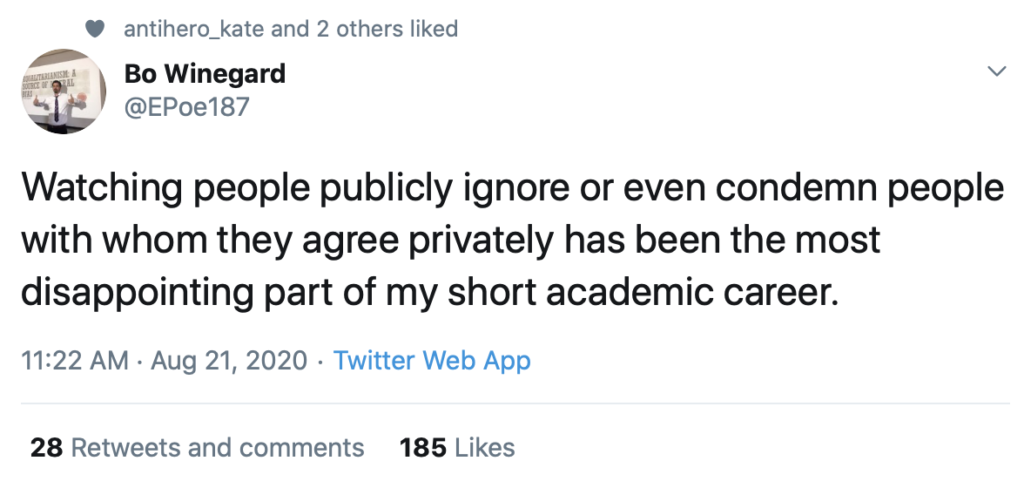
This public/private divide in honest communications is ubiquitous in the outside world too. If only we could force everyone to install devices on their heads that would, at random times throughout the day, broadcast their actual thoughts. We would take extra pains to make all people wear these devices in churches, political gatherings and wherever people feel pressure to please their in-groups. Doing this would be revolutionary in our hypocrisy-permeated world. Mind-blowingly revolutionary. If we made people wear these devices for even a month this would train us to say what we are actually thinking and to clearly admit when we don't actually know things.
OK, yes. It this would also cause serious chaos as our hidden romantic/sexual secrets are made public at inopportune random times. This thought experiment is a work in progress . . .
The concept of using "race"--physical appearance--as a proxy for character is as absurd as astrology. I'm well aware that people look different from each other, but the concept of "race" is scientifically baseless. The concept of "race" embraces the logic of astrology: shoving individual people (each of whom is complex) into a handful of simplistic superficial categories and then drawing conclusions that are evidence-free (or often, contrary to evidence) based upon these unwarranted simplistic cartoon-like categorizations. The concept of "race" should be constantly ridiculed the same way that intelligent people ridicule astrology. Any attempt to classify another human being by "race" or birthdate is a lazy ham-handed anti-scientific and pernicious claim that one knows what it is impossible to know--the complexity of that human being--without investing time and effort to get to known them. That is the point of Morgan Freeman:
This enormous flaw with the modern use of the concept of "race" is a conceptual hole so vast that one could easily drive a truck through it. Yet the concept of "race" is rarely attacked at the root. The first racist act is categorizing people by dividing them into simplistic categories such as white or Black. Without this first move, racism would be impossible. What is especially distressing is that this widespread exuberant willingness to mis-categorize people into simplistic categories is embraced by both White Supremacists and those who claim to be seeking social justice by embracing critical race theory. These two groups are now in complete agreement that we can somehow know people merely by looking at their physical appearance.
There is only one way to get to know a person, and that is to take the time to learn about them, one by one, by talking with them, getting to know what they've done with their lives, reading about them or watching them interact with others. Complicating things, people change over time, so getting to know who they are requires non-stop effort. Getting to know someone else requires careful consideration of real world facts and this takes considerable and concerted effort. Taking the time to get to really know other people before casting judgment on who they are is incompatible with making snap judgments but, as we are increasingly being tuned by social media, we are increasingly people who insist on making snap judgments.
Every day, "race" arguments wildly launch off into a thousand directions like fireworks. The basic premise of most of these arguments is the incoherent concept of "race," a concept so completely and irrevocably broken that most of these discussions are a waste of time before the discussion even begins. Imagine the time we could save--time we could redirect to working on solving the immense social problems that are very real indeed (many of them correlated to the physical appearance of groups of people)--if only we cut off most discussions of "race" at the root by calling out the invalidity of the concept of "race."
I will be writing more on this emotionally-charged topic in coming months. At this point I should make two things clear.
A) As I hope I've made clear, "race" is a irretrievably flawed pernicious concept. I believe that the concept of "race" should be thrown in the dustbin of history and we should all enter a new post-racial era. Unfortunately, other people continue to believe in the reality of "race." This idiotic willingness to divide complex people into simple colors makes racism possible. For this reason, I fully acknowledge the existence and destructiveness of racism. Many people mistreat others based upon physical appearance. To do this is unfair. It hurts people, sometimes badly, sometimes leading to deaths. Racism oppresses entire groups of people and has done so systematically over long stretches of time, through the entire history of the United States and many other places. Wherever we encounter racism, we should attack it vigorously in two ways: socially (by calling it out publicly and condemning those who mistreat other people in this way) and through the use of the legal system (e.g., through civil rights laws).
B) The concept of "race" itself is bad science, and this problem needs to be pointed out whenever discussing racism. Every single time. Even young children know that "race" makes no sense but we socialize them to think otherwise. To fail to point out the absurdity of the concept of "race" whenever discussing racism will lead to more of the same. We will never be able to solve the "race" problem as long as we assume that there is such a thing as "race." One way to do this is to consistently put the word "race" in scare quotes, which is now my habit. Every time we discuss "race," we need to call out that the the casual, unthinking idea that there is such a thing as "race" is reckless and dangerous. We need to constantly call out that it is impossible and destructive to judge other people by the use of immutable physical appearance. It is, indeed, as insane as believing in astrology, phrenology or palm reading. The unthinking use of the word "race" is utterly unscientific and destructive, even when used by well-intentioned people. The concept of "race" is a mental virus that hurts people and most of those who are infected are unable to see that they are infected. To use "race" uncritically (or "critically," as is de rigeour among the Woke) is to succumb to the banality of evil--unthinking destructive acquiescence to bad ideas.
In sum, racism exists because millions of misguided people believe in the incoherent and unsubstantiated notion of "race." It will take great effort to break this bad habit because many well-meaning people who are (oftentimes heroically) fighting racism refuse to jettison the concept of "race." Until large vocal swaths of society simultaneously and consciously embrace both A and B (above), racism will tear us apart. I'm not optimistic.
On Twitter, Andy Ngo is documenting the horrific conduct on the streets of Portland and Seattle, night after night. I forced myself to watch about 10 of these videos over the past week. The videos are graphic and highly disturbing, many involving beatings of non-violent people. Rampant morally reprehensible behavior, despite the claim that these are "protesters." Police almost entirely absent.
There has been no coverage for the past ten days from the New York Times or NPR. Based on these videos, another Twitter user recently posted: "Portland was a nice city last time I visited. Now it's ruled by violent mobs. #failedstate"
"FIRE is a free-speech organization, but we’ve always interpreted “free speech†to mean something larger, older, and bolder than just your legal rights. Given that we are also concerned with academic freedom, I’ve also focused on how to make discussions productive, and how to promote tolerance for people you disagree with. Of particular importance in higher education is determining how to keep an atmosphere of robust debate, thought experimentation, and innovation alive and healthy.
From a very early stage, FIRE advocated for what could roughly be called a “culture of free speech,†where we seriously consider the ideas most opposed to our own, debate and persuade those who disagree with us, consider people’s intentions, and give space for error and forgiveness when faced with mistakes. This is the antithesis of cancel culture, which attempts to reduce individuals to a singular offensive statement or action, remove them from mainstream society, and inflict grave social costs on anyone who might defend them."
Hello, I invite you to subscribe to Dangerous Intersection by entering your email below. You will have the option to receive emails notifying you of new posts once per week or more often.
Thank you for your interest in DI!
Erich Vieth
[jetpack_subscription_form subscribe_button=”Sign Me Up”]