“Individuals with a Cervix”?

A recent Tweet by evolutionary biologist Geoffrey Miller, reminiscent of J.K. Rowling's famous "people who menstruate" Tweet:

I posted this on FB. It drew the following response from Emily Lemonds:

There are men who have cervices and there are women who don’t. There are people who do not identify as men or women who have them. They do not deserve to have their existence erased for purposes of linguistic laziness.

My Response:

That is such a melodramatic and groundless accusation, that anyone is causing anyone else to "have their existence erased" by using a perfectly useful word so deeply rooted in biology and history! Your accusation, as I see it, is a completely unhinged metaphor suggesting physical injury where there is absolutely none (though there might be frustration). No one would be physically or emotionally injured if the CNN announcement used the word "women." I also disagree with you about who is being linguistically lazy. If you take a random survey of 1,000 people who have cervices whether they consider themselves to be "women," you'll prove my case. I believe in continuing to allow each of those people who has a cervix to feel free to use the word "women" A) to refer to themselves and B) to capture the narratives of their lives, guilt-free. The 99+% of women who have cervices did not start this linguistic territorial war.

A person named Robert Pedroli then commented:

Cervical cancer screenings are recommended to start .... This is how to say it. Eric then you don’t need to get riled up about this.

My response:

I stand up to protect people who are being bullied. That's the way I'm wired. Do you really think it's rude to use the word "woman" to refer to people with cervices? I should make clear that I have no problem with anyone (with any permutation of sexual organs) referring to themselves as a "woman." If a person with a penis wants me to call them a "woman" I will happily do so.

Continue Reading“Individuals with a Cervix”?

Tower Grove Park in St. Louis: A Way to Celebrate Each Other Despite COVID

I'm repeatedly falling in love with Tower Grove Park, which is a short walking distance from my home in the near south side of St. Louis. At the TGP website, one can read: "The mission of Tower Grove Park is to be an exemplary, well-preserved and well-presented, wooded Victorian park of international significance . . . " Absolutely true.  I took these photos tonight to offer you the opportunity to see why I tend to exude over the top when talking about TGP.  The sun was setting as I took these photos; there is no time of day when this park fails to inspire.  I avoided invading the privacy of the people in these photos, but even total darkness is not a reason to leave for many of them.

While COVID keeps wearing us down, a newfound appreciation for magic places like TGP is a silver lining: People from the surrounding neighborhoods are increasingly celebrating this park. I never seen so many families using the park. Friends gather at a distance under the gazebos or on picnic blankets. It is a sacred place of peaceful celebration. No matter what day it is, I am likely to think of that classic Chicago tune, "Saturday in the Park." It is impossible to walk through TGP without soaking in upbeat social vibes from a vibrant melting pot of people representing numerous languages and demographics. I speak for all of my neighbors when I say: This upbeat diversity is why I live in this neighborhood.

That TGP serves as such a respite from COVID is not a surprise. TGP's 289 acres are covered with more than 7,000 gorgeous trees. You can easily and safely social distance from many hundreds of people in such a vast area. BTW, Central Park in NYC is 840 acres, which is smaller than the biggest park in St. Louis, Forest Park, with 1326 acres.

I try to get at least one long brisk walk every day in Tower Grove Park. I also tend to do some of my writing on a park bench or under one of the many gazebos. Along with my own photos, I'm going to include a compilation of sketches by a lithograph company called Compton & Dry, which created a detailed drawing of the City of St. Louis in 1875, probably with the assistance of some balloon flights. In this compilation, you can see that TGP had been laid out before any of the houses in the surrounding areas were built. This is city planning at its best, thanks to a man named Henry Shaw, who donated this land to the City of St. Louis in 1866.

That's it for now, my Ode to Tower Grove Park. I hope that you too are finding relief from COVID, at least once in a while, by reconnecting with your community at your neighborhood parks.

Continue ReadingTower Grove Park in St. Louis: A Way to Celebrate Each Other Despite COVID

How Cancel Culture Works: The Lived Experience of Biologist Colin Wright

Many on the political left are increasingly proclaiming that cancel culture is not really a thing. Their most common tactic is to show that their best efforts are not successfully destroying the careers of prominent personalities such as J.K. Rowling and Steven Pinker. They ignore that many less-prominent people are successfully being chilled and cowed. These far more numerous lesser-known scientists and intellectuals are not sufficiently established in their careers to withstand repeated false broadside accusations that their (factually true) scientific observations are allegedly bigoted.  Thus, a deep intellectual chill has settled over the United States this summer.

At Quillette, biologist Colin Wright offers a detailed schematic of how cancel culture played out in his life. Like many others who have found that their jobs and reputations are under attack, Wright put the target on his own back by asserting scientifically true statements. In Wright's case, he asserted both that that there are only two sexes and that some people cannot be neatly categorized as male or female. These undeniably true statements appeared in an article titled "The Dangerous Denial of Sex," co-written by Wright and Emma N. Hilton, appearing in the Wall Street Journal on Feb 13, 2020. Here are the words of Wright and Hilton:

In humans, as in most animals or plants, an organism’s biological sex corresponds to one of two distinct types of reproductive anatomy that develop for the production of small or large sex cells—sperm and eggs, respectively—and associated biological functions in sexual reproduction. In humans, reproductive anatomy is unambiguously male or female at birth more than 99.98% of the time. The evolutionary function of these two anatomies is to aid in reproduction via the fusion of sperm and ova. No third type of sex cell exists in humans, and therefore there is no sex “spectrum” or additional sexes beyond male and female. Sex is binary.

There is a difference, however, between the statements that there are only two sexes (true) and that everyone can be neatly categorized as either male or female (false). The existence of only two sexes does not mean sex is never ambiguous. But intersex individuals are extremely rare, and they are neither a third sex nor proof that sex is a “spectrum” or a “social construct.” Not everyone needs to be discretely assignable to one or the other sex in order for biological sex to be functionally binary. To assume otherwise—to confuse secondary sexual traits with biological sex itself—is a category error. Denying the reality of biological sex and supplanting it with subjective “gender identity” is not merely an eccentric academic theory. It raises serious human-rights concerns for vulnerable groups including women, homosexuals and children.

Here, from Wright's article at Quillette, is the kind of thing that happens when people speak up, compelled by a sense of integrity and a burning desire to keep members of the public from being misled or harmed:

I was contacted by a biology-department chair at a private liberal arts college in the Midwest. He commended me for my writings, and told me that he’d even used my New Evolution Deniers essay as a basis for discussion in his own classes. But while he and his fellow biology-department faculty would likely support my hiring, he said, the school’s own human-resources department would almost certainly block me as “too risky.” These experiences remind me that when Blow extols “the masses” who are canceling people like me, the people he’s praising are actually just a small coalition of professional trolls such as Bird, working in effective concert with the risk-averse, upper-middle corporate bureaucrats who now have taken over decision-making on many college and university campuses.

I too have been seeing an increasing denial of cancel culture on social media, along with a denial of science, a hostility to the use of statistics to analyze complex social phenomena and even a disparagement of the intellectual tools we have inherited from The Enlightenment. See here, here and here. This is distressing for many of us to see this bullying of individuals and institutions and the consequent chilling of the many intellectuals who remain silent because they don't have the stomachs for unfair fights like these.

Continue ReadingHow Cancel Culture Works: The Lived Experience of Biologist Colin Wright

The Best Thing to Do About People Who Carefully Rely on Statistics When Analyzing Complex Social Issues? Fire Them.

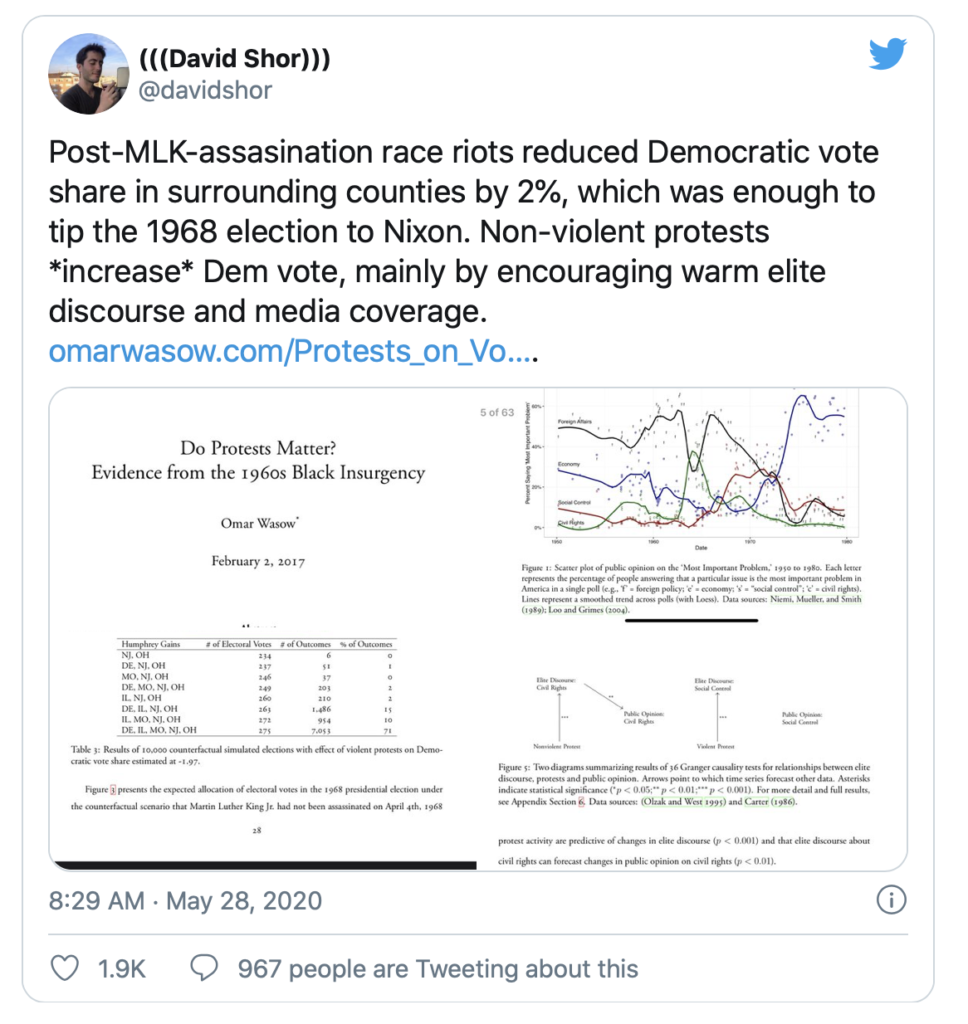
What is the effect of violent protests (versus peaceful protests) on future elections? This would seem to be a compelling topic these days. As one example of many, would it affect voters to see a video of people breaking into a car dealership in Oakland, spray painting vehicles and then setting several vehicles on fire as part of a political protest related to the detestable homicide of George Floyd?

What if a person, citing relevant statistics by Princeton political scientist Omar Wasow, offers insights based on these statistics?  Apparently, the best response is to get that person fired because such a Tweet would allegedly be "racist."  That's what happened in the case of David Shor, as reported by Vox. The video posted above post-dates the firing of Shor, but I am posting it to illustrate.

Here is Shor's May 28, 2020 Tweet:

Now, two excerpts from the detailed article in Vox:

Mass demonstrations work, in other words, but looting and disorder are counterproductive. This was Shor’s sin: repeating Wasow’s findings that marching is good but looting and vandalism are counterproductive.

...

Shor did not say that protesting is harmful; he said that rioting is harmful. And he didn’t say that data should dictate how people feel. And while one data scientist’s tweet of one political science paper should not be the last word on social movement tactics, the reasonable response to Shor would be to counter with some other form of evidence. Instead, the dialogue followed a pattern in progressive circles that often involves making evidence-free assertions about how members of various groups feel.

My concern is that we have entered an era where many people and institutions exuberantly accept feelings as a the best way to understand the world, and that feelings are more compelling than careful analysis of facts, even when the factual analysis is based on statistics.  I am seeing ubiquitous examples where intelligent-seeming people declare that anecdotes are superior to careful analysis, both on the political left and right.

We seem to be entering a new Dark Age, where important conversations can no longer be had and where thoughtful people need to choose among these two options, where there are only these two options: A) Your need to express your thoughts freely in a nation created upon the assumption that people must talk with each other freely and B) Your need to not get fired from your job.

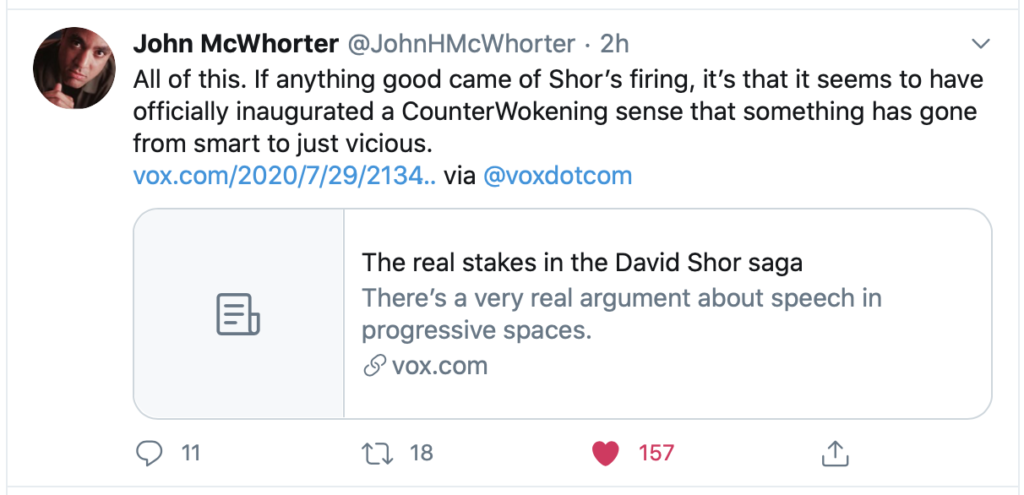
John McWhorter sees what might be a light at the end of the tunnel:

I hope McWhorter is correct.  I seem to be losing 1% of hope each day.

Continue ReadingThe Best Thing to Do About People Who Carefully Rely on Statistics When Analyzing Complex Social Issues? Fire Them.

A Clever Picture in a Legal Proceeding is Worth a Thousand Words

Our “distinct” professions often have a lot in common and that recently came to life. I’m a trial lawyer and my girlfriend, Renée Kennison, works in marketing as a creative concept developer. Among other things, both of us shape and distill ideas for maximum impact. There is a science, but also an art, to doing this well. We often look over each other’s shoulders as we work. Two days ago, it was Renée's turn to play lawyer.

I had been struggling to think of a good way to make an argument in an arbitration. I represented a married couple who had been the victim of fraud committed by a time share resort. One of the many issues of the case is that the resort was obligated by Missouri law to disclose in writing at the time of the sale that the couple had five business days from the date of the sale to rescind the deal. Missouri law allows time share purchasers to do this by merely sending a letter to the resort. Missouri law requires the resort to make this written disclosure in a precise way. The written disclosure needs to be 18-point type and it needs to have precise wording. Here’s the law:

Instead of simply printing this language as-is on a piece of paper and handing it to the couple, the resort played cute. First of all, the timeshare closing involves 50 pages of documents, many of them filled with with fluff and others with legalese. It's comparable to attending a real estate closing for a residence. Second, the resort camouflaged the disclosure by sandwiching the disclosure between two irrelevant paragraphs of fluff. It also made the entire disclosure document 18-point bold type to hide the important part of the notice, the part that gives the purchasers 5 days to cancel the deal, no questions asked. Also, instead of putting the word “Notice” at the top of the sheet as a warning to pay special attention to the notice, the resort tucked the word “Notice” into the text as though it were a verb. I can’t disclose the actual facts of this case because the resort contract forces this case to be in confidential arbitration, but the resort printed something comparable to this as its “cancellation notice”:

DEAR NEW OWNERS!

WELCOME TO OUR JOYOUS FAMILY OF RESORT OWNERS. IT IS GREAT TO HAVE YOU IN OUR FAMILY AND WE HOPE YOU ARE SO HAPPY BEING PART OF OUR COMMUNITY. PLEASE REFER YOUR FRIENDS AND FAMILY TO US, SO THAT THEY CAN BUY TIMESHARES TOO.

NOTICE YOU HAVE THE RIGHT TO CANCEL THIS AGREEMENT WITHIN FIVE DAYS AFTER THE DATE OF THIS AGREEMENT. CANCELLATION MUST BE IN WRITING AND IF SENT BY MAIL, ADDRESSED TO THE OTHER CONTRACTING PARTY AS SHOWN ON THIS AGREEMENT, CANCELLATION WILL BE ACCOMPLISHED AT THE MOMENT THE LETTER IS POSTMARKED. IF SENT BY MAIL, THE LETTER MAY BE CERTIFIED WITH A RETURN RECEIPT REQUESTED. YOUR RIGHT TO CANCEL CANNOT BE WAIVED.

AGAIN, IT’S GREAT TO HAVE YOU IN OUR COMMUNITY. ENJOY HIKING, BIKING AND ALL OF THE OTHER AMENITIES. NEVER HESITATE TO REACH OUT TO US IF WE CAN BE OF ASSISTANCE TO YOU. YOU ARE IMPORTANT TO US. NOW GO ENJOY YOUR RESORT.

The resort is claiming that it followed the law simply because all the statutorily-required words appear in their written notice.   I was looking for a way to make a high-impact argument that the resort’s method of disclosing the 5-day right to cancel violated both the terms and the spirit of Missouri Law. After hearing my concern, Renée said, “What the resort has done is like creating a highway sign that hides the important warning in between two unimportant things. Perfect! Renée offered to create an image for me, and I used her image today in my closing argument:

I argued the case today. In a few weeks, we'll see whether my clients prevail.

Continue ReadingA Clever Picture in a Legal Proceeding is Worth a Thousand Words