Joe Rogan and Glenn Greenwald Comment on Julian Assange
Update on Julian Assange. This is how the U.S. government treats people (Assange and Edward Snowden) who expose government wrongdoing:
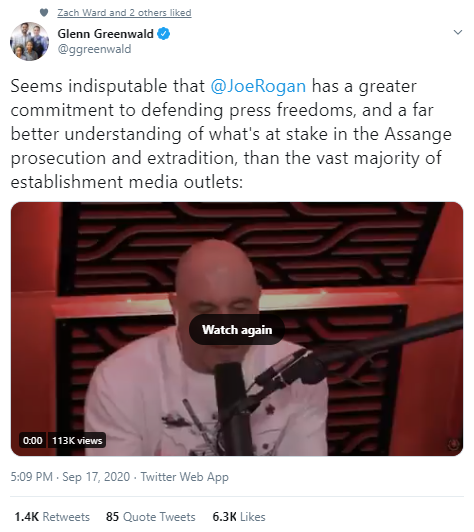
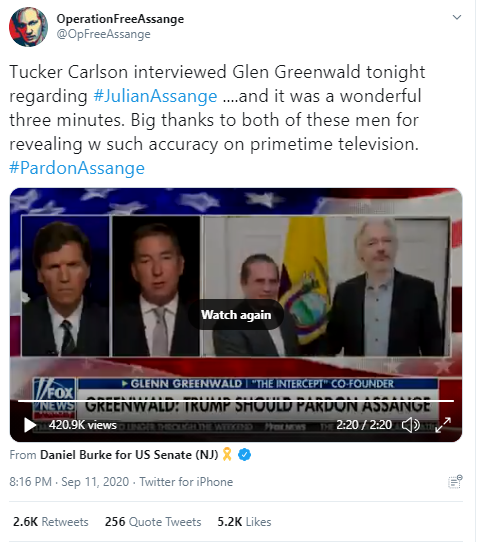

Update on Julian Assange. This is how the U.S. government treats people (Assange and Edward Snowden) who expose government wrongdoing:
[Princeton] President Christopher Eisgruber published an open letter earlier this month claiming that "racism and the damage it does to people of color persist at Princeton" and that "racist assumptions" are "embedded in structures of the University itself."
According to a letter the Department of Education sent to Princeton that was obtained by the Washington Examiner, such an admission from Eisgruber raises concerns that Princeton has been receiving tens of millions of dollars of federal funds in violation of Title VI of the Civil Rights Act of 1964, which declares that "no person in the United States shall, on the ground of race, color, or national origin, be excluded from participation in, be denied the benefits of, or be subjected to discrimination under any program or activity receiving Federal financial assistance."
Fascinating. Princeton has made a unambiguous statement that it has been thoroughly "racist" and that it continues to be "racist." The Department of Education responded by opening an investigation because this statement conflicts with many other claims Princeton made, in order to qualify for federal funding, that it was not racist. Now we'll see whether Princeton really meant what it said. The Department of Education will demand evidence from Princeton in support of Princeton's admission. The National Examiner explains:
What the department seeks to obtain from its investigation is what evidence Princeton used in its determination that the university is racist, including all records regarding Eisgruber's letter and a "spreadsheet identifying each person who has, on the ground of race, color, or national origin, been excluded from participation in, been denied the benefits of, or been subjected to discrimination under any program or activity receiving Federal financial assistance as a result of the Princeton racism or 'damage' referenced in the President’s Letter." Eisgruber and a "designated corporate representative" must sit for interviews under oath, and Princeton must also respond to written questions regarding the matter.
What did Princeton mean when it admitted that the University was permeated with "racism." For reference, Merriam-Webster’s current entry on “racism†(as of August 7, 2020) gives three, related definitions:
D1. a belief that race is the primary determinant of human traits and capacities and that racial differences produce an inherent superiority of a particular race
D2. (a) a doctrine or political program based on the assumption of racism and designed to execute its principles, (b) a political or social system founded on racism
D3. racial prejudice or discrimination
Perhaps Princeton was using the new Woke definition of "racism," but it might have put itself at serious financial and legal risk to use "racism" in this new highly-disputed sense. Perhaps this is a good time to come to a careful consensus about what the vast majority of people mean when they use the term "racist." It's time to stop being 1) sloppy or 2) engaging in blithe virtue signalling when using such an important word. New Discourses discusses a controversy regarding the definition of "racism." Here is an excerpt from that article at New Discourses:
When critical social justice theorists talk about “racism,†they describe it as a matter of a social system’s being organized in such a way that it creates and perpetuates racial inequalities regardless of the conscious beliefs, attitudes, or intentions of those who inhabit the system. Although they also make much of purported unconscious biases in the propagation of racism, even in systems, their criterion for diagnosing systemic racism is entirely consequentialist: “disparate impact†along racial lines is its sole necessary and sufficient condition. For example, in White Fragility, Robin DiAngelo asserts that “[b]y definition, racism is a deeply embedded historical system of institutional power (24), “a system of unequal institutional power,†(125) “a network of norms and actions that consistently create advantage for whites and disadvantage for people of color,†(27–28), “a far-reaching system that no longer depends [as per D2] on the good [or bad] intentions of individual actors; it becomes the default of the society and is reproduced automatically,†(21) i.e., without conscious intent. Journalist Radley Balko’s gloss on “systemic racism†captures the idea perfectly:To be continued . . .Of particular concern to some on the right is the term “systemic racism,†often wrongly interpreted as an accusation that everyone in the system is racist. In fact, systemic racism means almost the opposite. It means that we have systems and institutions that produce racially disparate outcomes, regardless of the intentions of the people who work within them.
In light of such statements, D2 would seem to fall short by failing to make a clean separation between human psychology (beliefs, intentions, etc.) and the quasi-mechanistic, or “automatic,†operations of social systems.
This is an example of Daniel Kahneman's halo effect going beserk. If you are not stuck in a modern day intellectual silo, this article might sorely disappoint you: "If USC can punish Greg Patton, free speech on campus really is dead." Professor Patton did not say anything inappropriate. He said a word that sounded like another word that some students said offended them. To summarize, Patton didn't say an offensive word at all, but he is being punished for saying a Chinese phrase that, to the over-sensitive ears of some students, sounded like an offensive word. USC's conclusion is that saying a perfectly innocent Chinese phrase in the process of discussing business speech is the moral equivalent of saying a completely different English word with a totally different meaning.
Too many of us are being silent about stupidity in high places. USC is a prestigious and supposedly learned university that is acting deliberately, intentionally and perniciously with regard to Professor Greg Patton. This knee-jerk off-target administrative disciplinary action serves no legitimate purpose and chills speech in classroom filled with elite young adults who are not acting their age or educational level.
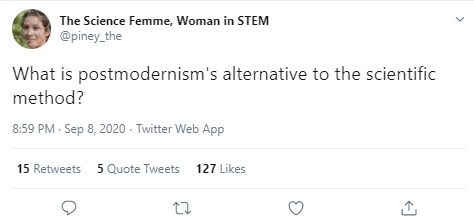
The Science Femme poses a simple question. The many comments are worth a careful read. Some of them might keep you up at night in that the humor is laced with deep concern.
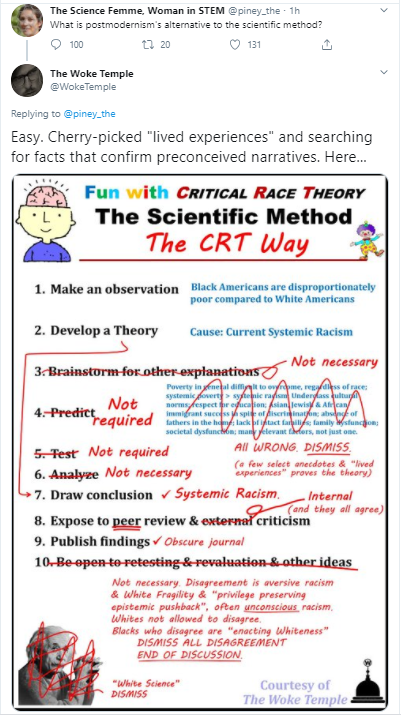
The Woke Temple provides an illustration of the Woke alternative to the scientific method using a real-life problem. This type of "reasoning" is ubiquitous these days:
Creator Ida Bae Wells argues that the 1619 Project should be "taught" yet she also admits that it is not "a history." Is she saying that it is not true? Is she saying that ideology should be taught in our schools?
Here are some of her own words:
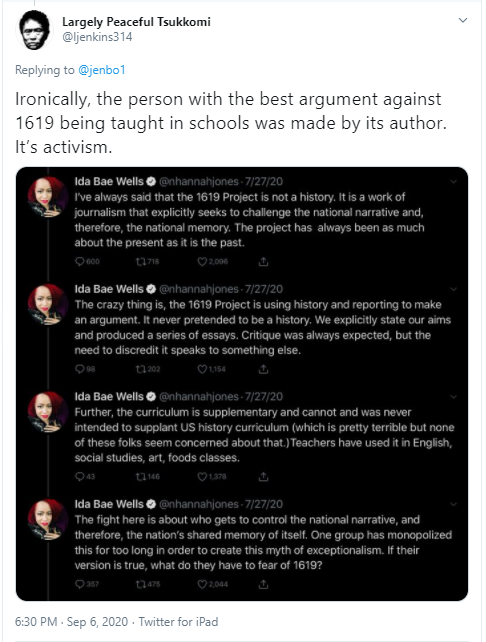
1619 is clearly a false history:
Here is one more Tweet:
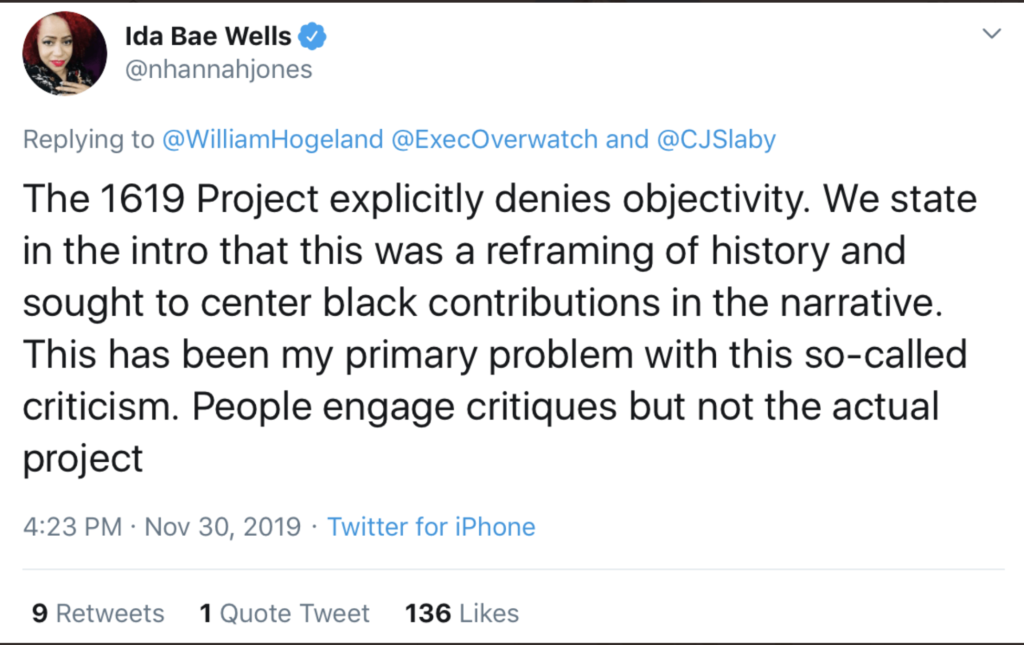 1619 is clearly a false history:
The project has sparked criticism and debate among prominent historians and political commentators.[5][6] In a letter published in The New York Times in December 2019, historians Gordon S. Wood, James M. McPherson, Sean Wilentz, Victoria Bynum and James Oakes expressed "strong reservations" about the project and requested factual corrections, accusing the project of putting ideology before historical understanding.
John McWhorter summarizes some of the many problems with the 1619 project:
The New York Times’ 1619 Project is founded on empirical sand. The fundamental claim that the Revolutionary War was fought to preserve slavery simply does not correspond with the facts, too conclusively for the point to be dismissed as mere hair-splitting. The issue is not differing interpretations of history, but an outright misinterpretation of it.Yet the project lives on. Its spearheaders blithely dismiss the charges of inaccuracy as mere natterings that at least verge on racism, while school districts nationwide eagerly received pedagogical materials based on the idea of offering students a fresh, revealing take on American history.
We must ask: Is there some broader aspect of the 1619 Project that justifies a certain slippage between its claims and actual fact? Just what does this project have to teach students? What does it have to teach us? And if the answer to those questions is “nothing much,” then how is it that brilliant, high-placed people can be so serenely unruffled in promulgating this material to innocent young minds?
In the end, the 1619 Project is more than a history lesson. It is founded on three basic principles, none expounded with a great deal of clarity, but all of them pernicious to a truly constructive black American identity.
...
To accept the implication of the 1619 ideology that heroic figures should be dismissed for not fully understanding the horrors of slavery, and that the American story is defined by nothing except the treatment of black people, would be to disrespect them as infantile minds. As such, we must evaluate the project on what it portends for forging socio-political change. Sadly, here the project would seem to yield nothing. A revivification of the reparations argument is longer on theatre than politics. The concern with whites understanding that “It isn’t our fault” may seem a form of political engagement but in fact is quite irrelevant to change in actual lives. . . . evaluated honestly, the 1619 Project is a kind of performance art. Facts, therefore, are less important than attitude. Hannah-Jones has predictably dismissed serious and comprehensive empirical critiques, as if for black thinkers, truth is somehow ranked second to fierceness and battle poses. For many, questioning the 1619 Project elicits irritation, of a kind that suggests personal insult rather than difference of opinion. This is because the 1619 Project is indeed all about personality, a certain persona that smart black people are encouraged to adopt as a modern version of being a civil rights warrior.
For this 2.0 version of civil rights warrior, authentic blackness, significant blackness, requires eternal opposition, bitter indignation, and claims of being owed. Whether all of this is rooted in reality in a way that can create change for actual human beings is of less concern than whether all of this is expressed, on a regular basis. It keeps The Struggle going, we are told.