
Back to Separate But Equal, and Other Recent Manifestations of Woke Culture

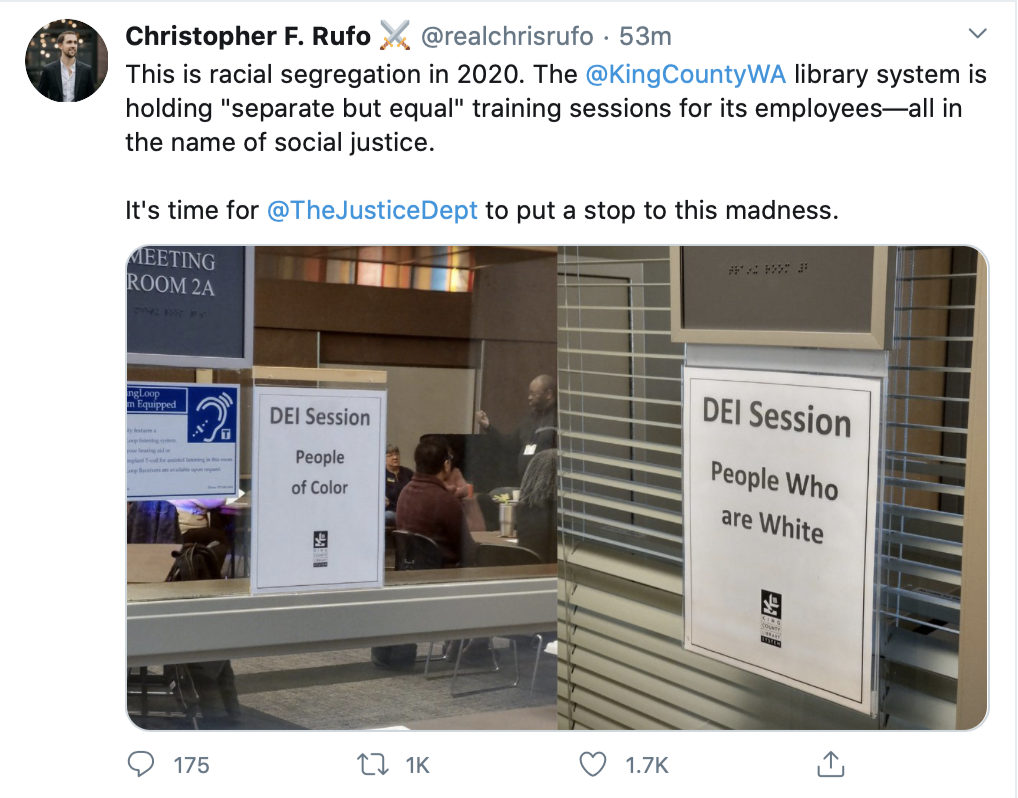
I hate to keep writing about Woke issues, but this ideology increasingly concerns me as the 2020 election approaches.  It is  an issue that mainstream Democrats ignore or downplay, yet the Republicans have recognized it for the cultural cancer that it is.  Woke ideology has successfully entrenched itself deeply into many of our meaning-making institutions and this has positioned it well to spread far, which is unfortunate. Here's a recent example:
Making things worse, far too many Woke advocates are willing to tap into authoritarian tactics.
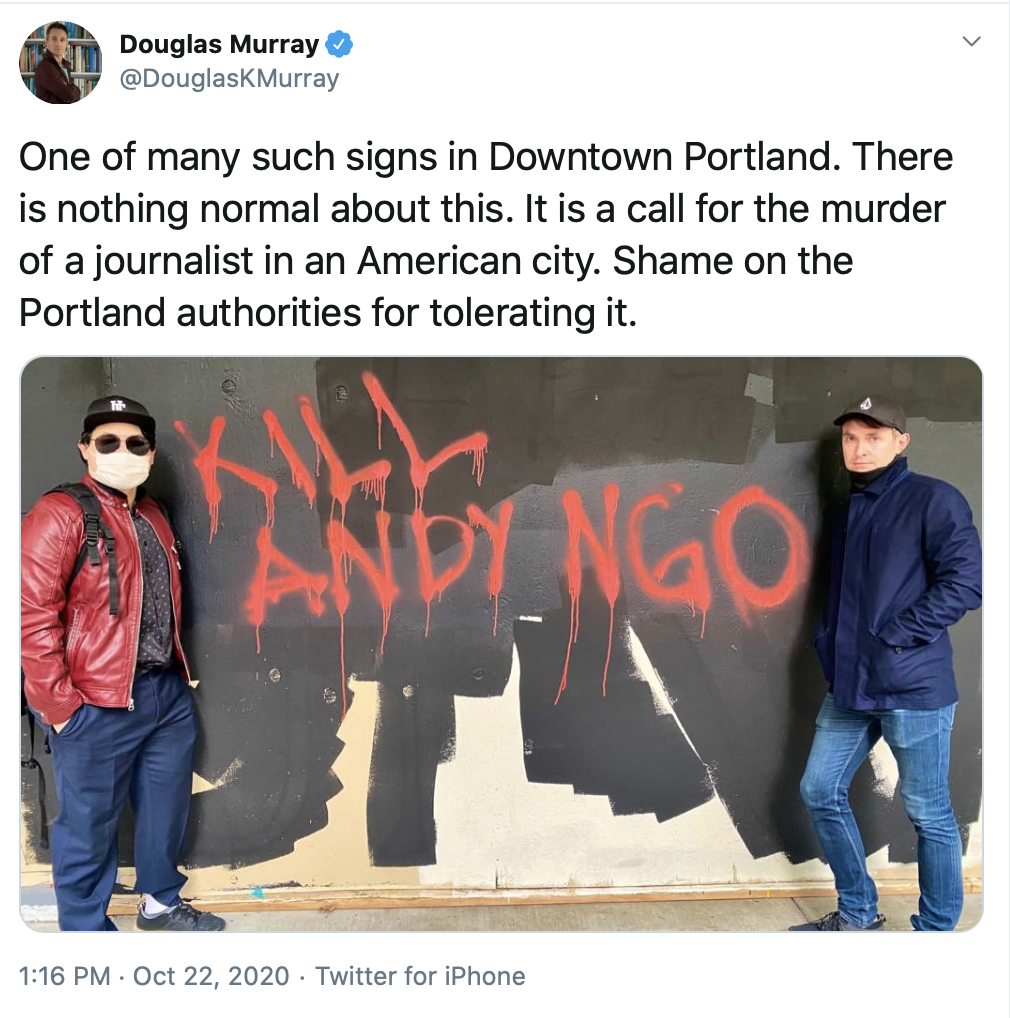
Andy Ngo's "crime" is that he is reporting on what he is seeing on the streets in Portland, including ongoing attempts to damage or destroy federal property.  The NYT thought this sort of thing was a worthy topic, even when it occurred in a much milder form, when right wing zealots merely occupied federal property for a month in 2016 (see here, for example), but "America's newspaper of record" has barely any interest in Portland or Seattle.  Because of this vacuum, these stories and concerns critical of Woke culture are being covered mostly by conservative media and without sufficient discussion or nuance. As I noted above, it is my concern that these issues are keeping the upcoming election close. This unwillingness by people on the political left to criticize "their own" is unfortunate.  Those relatively few socially brave traditional liberals who are willing to speak out, many of whom consider themselves well-entrenched on the political left, are often being accused of being conservatives/Republicans by others on the political left, merely because they are willing to speak out. This has left many traditional liberals (like me) feeling like we no longer have a political home.

One must usually seek out alternative news sources to find thoughtful discussion about the Woke movement. For those who are trying to get up to speed, consider visiting New Discourses (founded by James Lindsay) and Quillette.

Woke ideology is disproportionately affecting younger adults, people who are increasingly coming into positions of power.  This phenomenon was rather predictable based on The Coddling of the American Mind, by Greg Lukianoff and Jonathan Haidt. For another thoughtful discussion about the correlation of age and receptiveness to Woke ideology, see this Wiki letter exchange between Sarah Haider and Ayaan Hirsi Ali (the following excerpt was written by Sarah Haider):

Wokeism is, perhaps, an anti-ideology—a will to power that can be most concretely identified not by what it values or the future it envisions, but by what it seeks to destroy and the power it demands. This makes it especially disastrous. For, when an existing organizing structure is destroyed with no replacement, a more brutal force can exploit the resulting power vacuum. . . . Once liberal institutions have been delegitimized by the woke, what will replace them?

But while its philosophy is empty, the psychology of wokeism is deeply satisfying to our baser instincts. For the vicious, there is a thrill in playing the righteous inquisitor, in mobbing heretics and demanding deference—brutal tactics that keep the rest of us in line, lest we be targeted next. Meanwhile, the strict social hierarchies of the woke are reassuringly simple to navigate: one always knows one’s place.

By contrast, liberalism flies in the face of human nature. “I disapprove of what you say, but I will defend to the death your right to say it” is a phrase so often repeated that we have forgotten how deeply counterintuitive it is. We want to punch the Nazi (or gag him), not defend his right to march. Liberalism might ultimately be good, but it doesn’t feel good. And this is why it may find itself vulnerable to public abandonment, especially in times where it is most necessary. . . .

You rightly point out that liberalism has formidable champions in Sam Harris, Richard Dawkins, Christopher Hitchens and J. K. Rowling. Yet Hitchens is gone and all the others are over fifty. Likewise, this summer, when I co-signed an open letter in defense of free debate, I was disconcerted to see how few of the other signatories were even close to my age.

Bari Weiss recently noted that:

The civil war inside The New York Times between the (mostly young) wokes and the (mostly 40+) liberals is the same one raging inside other publications and companies across the country. The dynamic is always the same. The Old Guard lives by a set of principles we can broadly call civil libertarianism. They assumed they shared that worldview with the young people they hired who called themselves liberals and progressives. But it was an incorrect assumption.

This has been my experience too. Woke adherence can be predicted by generation - where true liberals exist, they exist primarily among the old guard. If the woke have won over the young, they have captured the future.

This ideology manifests in many other ways too.  For instance, insincere and dishonest debate about the unprecedented surge in (mostly) young girls who are being convinced that they were born in the wrong body, leading to permanent body-altering surgery, hormones and other treatments.  You won't find honest discussion about these issues in mainstream media--certainly not in the NYT. Instead of wide-open discussion based on a foundation of biology and medicine, you will only hear discussions where the "factual" foundation is ideology.  This is insane. There is a war going being waged to protect young girls (progress being made in Great Britain), yet many media outlets are afraid to cover the story. To learn young girls are being physically damaged by this ideology, you'll need to go to places like Joe Rogan's podcast. His recent episode featuring Abigail Shrier and her excellent book, Irreversible Damage: The Transgender Craze Seducing Our Daughters, resulted in an attempt by employees of Spotify to muzzle Rogan on this issue and other Woke issues. Refreshingly, Rogan counter-attacked by posting this video on Twitter, suggesting that he has carefully anchored his right to speak freely in his Spotify contract:

There are some bright spots--some well-placed people calling out Woke ideology for the illiberal, dysfunctional and mostly dishonest cult that it is. For instance, check out this recent discussion between Sam Harris and John McWhorter. That said, for each of these well-placed people willing to speak out, there are many other people who believe in a vigorous and open discussion, a willingness to consider dissenting speech and a dispassionate determination of the facts as the basis for conversation. Unfortunately, most of these people are lesser known than Joe Rogan (and J.K. Rowling) and more vulnerable to cancellation (see the comments here).

I could go on, but I won't do that here.  I'll try to move on to other topics for awhile . . .
Continue ReadingBack to Separate But Equal, and Other Recent Manifestations of Woke Culture

Deborah Tannen’s Observation that The Argument Culture Has Been Brewing for a Long Time

Deborah Tannen, The Argument Culture (1998), well before social media took over:

This is not another book about civility. “Civility”suggests a superficial, pinky-in-the-air veneer of politeness spread thin over human relations like a layer of marmalade over toast. "This book is about a pervasive warlike atmosphere that makes us approach public dialogue, and just about anything we need to accomplish, as if it were a fight. It is a tendency in Western culture in general, and in the United States in particular, that has a long history and a deep, thick, and farranging root system. It has served us well in many ways but in recent years has become so exaggerated that it is getting in the way of solving our problems. Our spirits are corroded by living in an atmosphere of unrelenting contention— an argument culture.

The argument culture urges us to approach the world— and the people in it— in an adversarial frame of mind. It rests on the assumption that opposition is the best way to get anything done: The best way to discuss an idea is to set up a debate; the best way to cover news is to find spokespeople who express the most extreme, polarized views and present them as “both sides”;the best way to settle disputes is litigation that pits one party against the other; the best way to begin an essay is to attack someone; and the best way to show you’re really thinking is to criticize.

Our public interactions have become more and more like having an argument with a spouse. Conflict can’t be avoided in our public lives any more than we can avoid conflict with people we love. One of the great strengths of our society is that we can express these conflicts openly. But just as spouses have to learn ways of settling their differences without inflicting real damage on each other, so we, as a society, have to find constructive ways of resolving disputes and differences. Public discourse requires making an argument for a point of view, not having an argument— as in having a fight."

Continue ReadingDeborah Tannen’s Observation that The Argument Culture Has Been Brewing for a Long Time

The Effects of the FB Filter-Bubble re Attitudes of Trump Voters

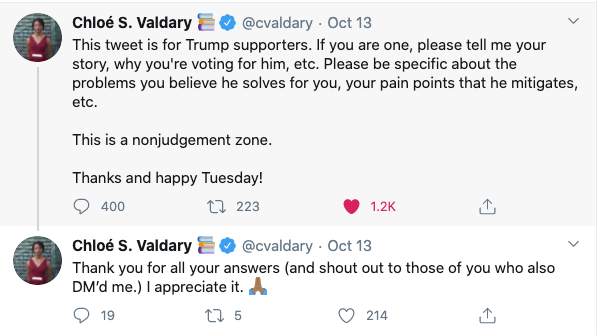
On Facebook, I recently posed a Tweet by Chloe Valdary, a kind-hearted even-keel peace-making thinker who is most definitely not pro-Trump.  She is willing to call out problems on the political left as well as the political right. I find her opinions thoughtful and instructive.

Here is how I introduced Chloe's Tweet (above) on FB:

I won't be voting for Trump, but I'm still concerned he might win re-election. I think many people feel similarly -- otherwise, why do so many people keep talking about the election and the polling? I've often wondered why so many people will vote for Trump, despite his many cataclysmic negative personal qualities. I'm glad that Chloe Valdary asked Trump voters to respond to her Twitter account by stating why they support Trump. She has received more than 300 responses that I found interesting to review. These responses don't change my mind about Trump, but I do see many Trump supporters in a different light.

In response, I saw a firestorm of anger from people on the political left. People who were angry with me that I would even consider what Trump voters think.  Many of them seem to be assuming that Trump voters are perfectly aligned with Trump. They vented at Trump voters as close-minded people who are, seemingly, identical to Trump in everything they think.

I see a big tent on on the right as well as on the left. Just as there are people who are going to hold their nose and vote for Biden, there are people on the right who are going to hold their nose and vote for Trump. I think it is a worthy project to ask those Trump supporters why they are voting for a man who I find to be so personally despicable. Yes, there are many Trump supporters who I do find deplorable (and some of those people on the left too), but there are many other people (some I know personally) who I like as human beings, who I disagree with on many issues, but who are going to vote for Trump.

Instead of curiosity in reaction to my FB post, I'm seeing lots of hostility for even asking the question, for inquiring. This unwillingness to be curious about the facts troubles me on many levels. In fact, this is self-defeating behavior suggesting an "analysis" that has been contaminated by roiling emotions. I understand the emotions and I understand the stakes of this election, but it seems that many of us could do much better. Rather than being smart, they are getting drunk on anger. They need to listen to Yoda:

“Fear is the path to the dark side. Fear leads to anger. Anger leads to hate. Hate leads to suffering.”

“Once you start down the dark path, forever will it dominate your destiny. Consume you, it will.”

Anger… fear… aggression. The dark side are they. Easily they flow, quick to join you in a fight. If once you start down the dark path, forever will it dominate your destiny, consume you it will, as it did Obi-Wan’s apprentice.

They also need to consider this idea by Sun Tzu, from the Art of War":

If you know the enemy and know yourself, you need not fear the result of a hundred battles. If you know yourself but not the enemy, for every victory gained you will also suffer a defeat. If you know neither the enemy nor yourself, you will succumb in every battle.

Continue ReadingThe Effects of the FB Filter-Bubble re Attitudes of Trump Voters

Sales, By the Book

At one point in my life, I was thinking of writing a non-fiction book. It's something I always wanted to do. My plan was to use some of the articles I've written for this website as a foundation.  But then I looked at the average sales of non-fiction books from this article:  "The 10 Awful Truths about Book Publishing." Ugh.

3. Despite the growth of e-book sales, overall book sales are still shrinking. After skyrocketing from 2008 to 2012, e-book sales leveled off in 2013 and have fallen more than 10% since then, according to the AAP StatShot Annual 2015. Unfortunately, the decline of print sales outpaced the growth of e-book sales, even from 2008 to 2012. The total book publishing pie is not growing—the peak sales year was in 2007—yet it is being divided among ever more hundreds of thousands of print and digital books.

4. Average book sales are shockingly small—and falling fast. Combine the explosion of books published with the declining total sales and you get shrinking sales of each new title. According to BookScan—which tracks most bookstore, online, and other retail sales of books (including Amazon.com)—only 256 million print copies were sold in 2013 in the U.S. in all adult nonfiction categories combined (Publishers Weekly, January 1, 2016). The average U.S. nonfiction book is now selling less than 250 copies per year and less than 2,000 copies over its lifetime.

5. A book has far less than a 1% chance of being stocked in an average bookstore. For every available bookstore shelf space, there are 100 to 1,000 or more titles competing for that shelf space. For example, the number of business titles stocked ranges from less than 100 (smaller bookstores) to up to 1,500 (superstores). Yet there are several hundred thousand business books in print that are fighting for that limited shelf space.

It's stunning to me that the total number of copies of non-fiction print books sold each year is less than the number of Americans.  Someday I might again reverse, but these numbers put the kibosh on my book-publishing passion.  For now, It's good to know that I have a website where I can publish my ongoing, evolving, thoughts on a number of topics.  I can write about anything that interests me.  At a minimum, it serves as a personal diary.  As a bonus, there is a fair amount of traffic coming to the site, which leads me to hope that some others are finding some of my thoughts to be useful.  I started this website in 2006 and it has served well as a platform for developing my ideas and interacting with others who show an interest.

I have a lot of new ideas I've been working on (including many dichotomies that I had intended to feature in my book). Most of these ideas concern cognitive science and philosophy. If my work life cooperates,  I'll be carving out more time in a typical day to work on my ideas - - I hope to publish more ideas to which I can lay personal claim, though everything I write is with a heavy debt to hundreds or thousands of other people I've encountered in person or through their writings.

Onward!

Continue ReadingSales, By the Book

Bertrand Russell’s Test: Is your Belief Based on Reason?

Bertrand Russell had this to say:

If you think that your belief is based upon reason, you will support it by argument, rather than by persecution, and will abandon it if the argument goes against you. But if your belief is based on faith, you will realize that argument is useless, and will therefore resort to force either in the form of persecution or by stunting and distorting the minds of the young in what is called ‘education.’This last is peculiarly dastardly, since it takes advantage of the defencelessness of immature minds. Unfortunately it is practised in a greater or less degree in the schools of every civilized country.
Human Society in Ethics and Politics - 1954

Continue ReadingBertrand Russell’s Test: Is your Belief Based on Reason?