The Big Things that Aren’t Obvious, Until They Are

Rather than staring at the things in front of you, it’s sometimes better to step back and ask yourself what is missing in order to understand what happened. Sometimes, the things that you can directly see and hear simply don’t add up.

My favorite illustration of this process involves one of Charles Darwin’s epiphanies:

On this tour I had a striking instance of how easy it is to overlook phenomena, however conspicuous, before they have been observed by any one. We spent many hours in Cwm Idwal, examining all the rocks with extreme care, as Sedgwick was anxious to find fossils in them; but neither of us saw a trace of the wonderful glacial phenomena all around us; we did not notice the plainly scored rocks, the perched boulders, the lateral and terminal moraines. Yet these phenomena are so conspicuous that, as I declared in a paper published many years afterwards in the 'Philosophical Magazine' ('Philosophical Magazine,' 1842.), a house burnt down by fire did not tell its story more plainly than did this valley. If it had still been filled by a glacier, the phenomena would have been less distinct than they now are.


Sometimes it takes the first person to recognize a two-step process and only then does it become always obvious for everyone who follows. Sometimes the person who first "gets it" is you. You might have tried to figure something out for a month or more before you finally saw it for what it was. And then, of course, it's obvious for you and for everyone else you mention it to, whether it be a puzzle solution, how to make your software do a task or figuring out a person's secret motivation.

"The obvious is that which is never seen until someone expresses it simply." Khalil Gibran

Because I work as a trial lawyer, this also reminds me that many people assume that circumstantial evidence is "second rate" evidence; that it is not as persuasive as the things and events that people observe directly. There is no basis for believing this. Some circumstantial evidence is sometimes much more persuasive than some direct evidence. A well-known example of powerful circumstantial evidence is a “smoking gun.” Circumstantial evidence is often sufficient to convict a criminal defendant even when the burden of proof for guilt is "beyond a reasonable doubt." A multi-step puzzle involving circumstantial evidence can evoke such an "A-ha!" moment that it can even leave you no doubt at all.

If you want a great example of how something can suddenly become obvious, go to Andy Clark's Edge video on Predictive Processing, Minute 11:30, and listen to the sine wave speech pattern examples. It will hit you like a ton of bricks. The entire lecture is phenomenal, but the examples will only take a couple minutes and it's worth your while.

The (obvious) take-away: Don't give up, even where the solution is not obvious.

Continue ReadingThe Big Things that Aren’t Obvious, Until They Are

Peering Into the Past Thanks to Old Sears Catalogs

Ancestry.com recently emailed me an offer to look through archived Sears Catalogs. I searched the year 1922 and found it to be a worthwhile portal into the past.

I decided to focus on toys. Notice that some toys are specifically marked "Girls Toys" and "Boys Toys." The prices are always interesting. Also, many toys from 1922 seem to still be excellent toys, superior to many modern blinking bleeping toys. Those excellent toys from the past include my childhood favorite, wooden blocks.


Go to full article to see a small sampling of pages from the 1922 Sears Catalog

Continue ReadingPeering Into the Past Thanks to Old Sears Catalogs

Expiration Dates for Claims That Things Are Good Things or Bad Things?

It’s rather amazing that we continue to use the words “good” and “bad.” Can you think of any words that are less precise than these? Do these words even have valid or reliable meanings? “Good” and “bad” often seem to serve only as hazy placeholders for shots in the dark or ineffable emotions. Philosophers have struggled to define good and bad things for millennia with very little of practical use to show for all of their labor. Except for such fundamental things as having food and shelter and avoiding unwanted physical pain and death, people constantly disagree about what is good and bad. The subjects of these disagreements are everywhere. They include such things as good and bad food, cities, politicians, cars, jobs, art, children, pets, technology, habits, websites, books, moral choices, friends and romantic partners.

But let’s set aside our ubiquitous disagreements for a moment. Let’s assume that within our own particular comfy community we can somehow find a general consensus that something is a “good” thing. If that were possible, it would reveal an equally big problem that is the focus of this article: Good things often only seem good only until they play out in real in the real world. To our dismay, good things often turn out to be bad things with the passage of time. And things that seem bad today often turn out to be good.

• You got fired from your job (bad), which opened up a better opportunity (good).

• You got that job you always wanted (good), but two months after beginning that job, you hated it (bad).

• WWII caused terrible suffering for millions of people (bad), but that hellacious war inspired countless acts of heroism and resulted in the defeat of tyranny (good things).

• You were late to the airport and missed the plane (bad), but the plane crashed (good for you that you weren’t on it).

Continue ReadingExpiration Dates for Claims That Things Are Good Things or Bad Things?

WTSocial: Alternative to Facebook is Announced by Jimmy Wales, Founder of Wikipedia


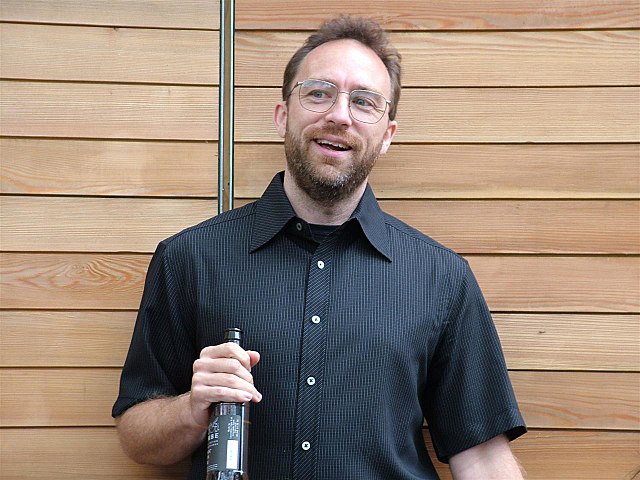
Jimmy Wales' (founder of Wikipedia) has a new project, WTSocial  

I'm going to presumptively speak for "the World" here:  The World is ready for an alternative social gathering spot that respects users' privacy, discourages acrimony and tamps down hard on misinformation. I'm an early financial supporter because I really want this project to take off. This will be a fundamentally different business model than Facebook in that it will be funded through user donations. Here's are a few excerpts from a Financial Times article about WTSocial:

“It won’t be massively profitable but it will be sustainable,” [Wales] said . . . Wales said he believes the time is now right for a new venue that is free from what he calls “clickbait nonsense”. “People are feeling fed up with all the junk that’s around,” Mr Wales said.

Regarding his goals for numbers of users, Wale stated: “Obviously the ambition is not 50,000 or 500,000 but 50m and 500m.”

Photo Credit:  Photograph: ed g2s - Own work, CC BY-SA 3.0, https://commons.wikimedia.org/w/index.php?curid=15707

Continue ReadingWTSocial: Alternative to Facebook is Announced by Jimmy Wales, Founder of Wikipedia

Not-For-Sale Advocates Shed Light of Suspicious Privatization Process Regarding Lambert St. Louis Airport

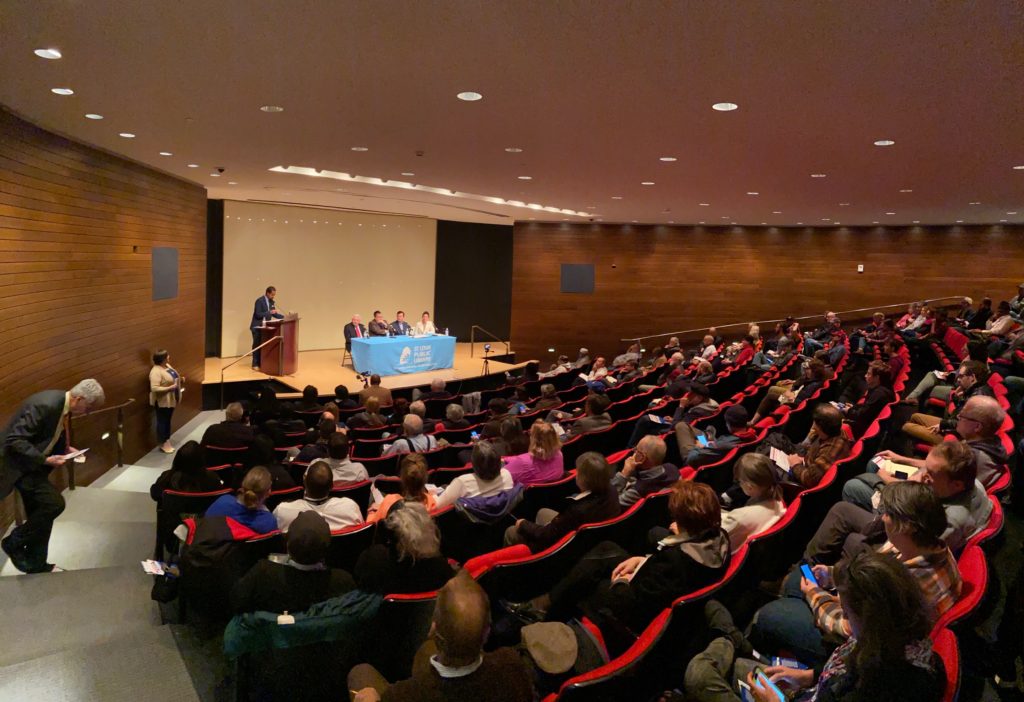
Last night, the "Not for Sale" (anti-privatization) group sponsored a town hall meeting at the St. Louis Central Branch Library. The meeting was well attended, as you can see from the photo in the comments

I'm posting all of my notes here, given that this a critical community issue and that this "public" process is rife with secrecy. The entire process also reeks of conflicts of interest.

But tonight was a chance for the good guys to talk, and I learned a lot. Notably, none of tonight's speakers was being paid to take the positions that they were taking. This is in stark contrast to positions being taken by members of the airport Working Group. None of the speakers criticized the current public airport management. Many went out of their way to compliment the way the airport commission is running the airport. And how could that be otherwise, based on the following statistics (reflecting events from July 1, 2017 through June 30, 2018):

  • 29% increase in enplanments
  • 6.2% more departures
  • 20% decrease in cost per passenger
  • 5.9% more overall passengers
  • 30% debt paid off ($276 million) new line
  • $6.68 million paid into the city's general revenue fund.


The meeting started with an announcement by a representative of Congressman Lacy Clay. Congressman Clay supports a public vote regarding any privatization effort regarding the airport.

The next speaker was Dr. Ray Mundy, the Executive Director of the Airport Ground Transportation Association. Dr. Mundy stated the following: He has never seen a process like this in 40 years. For instance, $1 million is available to conduct a study of feasibility or privatization. The money is offered by the FAA. The working group didn't even apply for this money, suggesting they don't want to know what such a study would show.

Continue ReadingNot-For-Sale Advocates Shed Light of Suspicious Privatization Process Regarding Lambert St. Louis Airport