
Consumer Report’s blind spot re human-powered lawn mowers

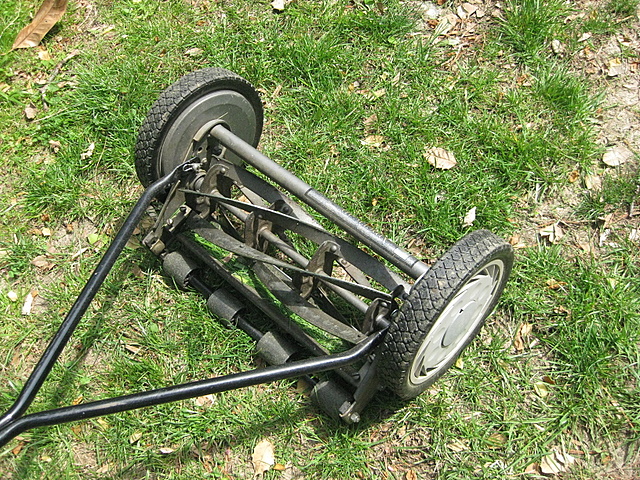
The May 2009 issue of Consumer Reports evaluates more than 80 models of lawn mowers. Incredibly, the printed magazine version of the article completely omits any mention of human-powered reel lawn mowers. It doesn’t test any of them and it doesn’t even mention them, despite the fact that non-motorized push mowers are perfect for most people with small to medium sized lots. We’ve used a push mower for 15 years to cut a lot that is almost ¼ acre. Millions of people have lots that are this size or smaller. The question in my mind is why. Why would a “consumer” magazine refuse to tell (refuse, because this is not an oversight) consumers that there are $100 lawn mowers that would be perfectly good for millions of people. Is Consumer Reports feeling market pressure to evaluate the $200 – 800 lawn mowers that its readers are used to (tractors cost up to $3,600)? Shame on them for encouraging needless sales of these noisy exhaust-spewing status symbols. Or is Consumer Reports disoriented by the paradox of choice, striving to find the perfect mower instead of satisficing (recognizing good-but-not-perfect choices)? After all, the non-motorized push mowers I’m recommending are only good for people who consider themselves stewards of the planet, people who prefer to use no gasoline, create no noise and create no danger of spewing rocks and sticks that can cause serious injuries. Why mention that there are $100 mowers that can be sharpened repeatedly with a $15 kit and otherwise require almost no maintenance. [caption id="attachment_6454" align="alignright" width="150" caption="image by Erich Vieth"]image by Erich Vieth[/caption] They are capable of slicing through thick zoysia grass? Is it because those suburban readers might work up a little sweat? Not much, I assure you—even my 8-year old daughter uses ours. These person-powered lawn mowers are MUCH lighter than the mowers your grandparents used. Here are numerous additional reasons to give up on gasoline and electric lawn mowers. In this month’s lawn mower evaluation article, Consumer Reports completely dropped the ball. This failure by CR is one of numerous instances where we Americans need to wake up and start doing things differently. Our world is changing in hundreds of ways and we need to change with it or get left behind.
Continue ReadingConsumer Report’s blind spot re human-powered lawn mowers

Computer souls

[A kitchen table conversation between a parent and a child]

Daddy, if my computer burned up in a fire, would it still compute? No, Mary. Programs don't simply run by themselves. They depend upon extremely complicated hardware and software. If your computer burns up in a fire, there would be no hardware and no software with which to run your favorite programs. But I've used my computer for a long time. I've grown emotionally attached to it. It makes me sad that it won't actually compute if it were to be destroyed. Doesn't my computer have a soul that continues running my programs somewhere else after my computer burns up on Earth? I'm sorry, Mary. There is no computer heaven and there is no computer soul. There is no evidence of either of these. But we can't prove that it won't keep computing after it burns up in a fire, right? No. Sorry, Mary. Without hardware and software, no computing will happen. The ashes of your burned up computer would lack any systematic structure. They certainly lack the complex organization required to run programs. It is impossible for any computation to occur without the hardware and the software intact. Your claim that a computer would keep computing even though it is completely destroyed is an extraordinary claim that would require extraordinary proof. We have no such proof whatever. But Lisa Jenkins says that burned up computers do keep computing. She says that you only need to have faith and that no one can disprove that burned up computers live on in a parallel world. She says destroyed computers keep working, but not in a physical way. She goes to a special building on Sunday where thousands of people all believe that computers keep computing even after they are completely destroyed. No, Mary. The same thing happens to computers as happens to your own body. As you know, when your body dies, your entire body rots, including your brain. As you know, when your brain is rotted, you don't have any more thoughts because there is no intact functional neural structure anymore, and therefore no basis for any continuing thoughts. Oh, daddy! It's not the same! Yes, I know that when my body dies, it will be impossible for me to think anymore. My computer is different, though. I just can't believe that my amazing computer would stop computing just because it gets completely destroyed! Don't try to compare my beautiful computer to a human brain! It's not a matter of what you want to believe, my child. It's a matter of what actually happens in the real world. You can continue using your computer for now and loving the way it works, but it would be unhealthy to believe that it would keep computing even if it was destroyed. As a parent, it's my job to level with you regarding difficult topics like this. I'm so sorry.

Continue ReadingComputer souls

Eve Ensler asks “What is security?”

In this TED talk, Eve Ensler (who wrote "The Vagina Monologues") addresses the question, "What is security?" According to Ensler, security is elusive and impossible, and that's the good news, "unless your whole life is about being secure." If you're one of those people who obsess about security, you will become a cultural and intellectual recluse. You will become a frozen and numbed to the possibility of change/growth and you will perceive enemies to be everywhere. All you'll have time for is to worry about protecting yourself. The talk then moves to engaging stories about women who have created real versions of security. Real security is "hungering for connection rather than power."

Continue ReadingEve Ensler asks “What is security?”

ANZAC Day – lest we forget

Today, April 25, is ANZAC Day in Australia & New Zealand. A most reverent & sacred day in this part of the world, it commemorates the day in 1915 when Australia and New Zealand Army Corp troops (the nominal ANZACs) made a landing at Gallipoli on the coast of Turkey (a place now called ANZAC Cove). The day certainly isn't a celebration of a great victory - the Gallipoli campaign (the brainchild of a young Winston Churchill, then chief of the navy) was an abject failure and cost tens of thousands of ANZACs their lives before their eventual withdrawal by British high command after having gained mere yards. A mistake by the planners meant that instead of landing at a lightly defended beach, the ANZACs landed at a steep, mountainous cove peppered with Turkish machine-gun positions. With the advantage of height and numbers, the Turkish guns made a complete mess of the troops storming the beach. The ANZACs were tenacious, made small gains, dug in and held on as they were ordered to for months, but made no appreciable ground and were pulled out months later, their ranks decimated by superior numbers and by the privations of trench warfare. But why remember such horror? Our troops had certainly been involved in military action before and with more success, in places like the Crimea and during the Boer War. Well, despite having first been colonised by the British in 1788, Australia didn't become a federated nation until 1901. ANZAC Day marks the first time Australian troops went into battle representing their own nation and not just a colony of Imperial Britain. It is considered by some an important step in the building of our national character - the baptism by fire of our fledgling democratic nation in international conflict. Others see it as a warning not to simply do the military bidding of another nation (a warning that's rarely been heeded). These days it has chiefly become a day of rememberance and for thanksgiving for the sacrifices of all our fallen soldiers, sailors & airmen and a day to spare a thought for those currently serving around the world. Today, Australians & New Zealanders will be attending parades or watching them on TV, having barbecues (thought it is autumn and getting chilly), playing two-up, going to church services, many will be in Turkey at ANZAC Cove itself for a dawn service, or just taking a minute whenever they can to remember Australians that risked or gave their lives for our country. Far from glorifying war or violence, ANZAC Day is a day of quiet reflection, of appreciation of sacrifice ... and to remember how those bastard Brits shafted us at Gallipoli.

Continue ReadingANZAC Day – lest we forget