New scientific center to study altruism

Consider the mission statement of CCare:

[T]he Center for Compassion and Altruism Research and Education, is an innovative initiative of the Stanford School of Medicine within the Stanford Institute for Neuro-Innovation and Translational Neurosciences that will employ the highest standards of scientific inquiry to investigate compassion and altruism.

The Center will draw on many disciplines (including psychology, neuroscience, economics and contemplative traditions, including Buddhism) in order to

To explore ways in which compassion and altruism can be cultivated within an individual as well as within the society on the basis of testable cognitive and affective training exercises.

The center will be run by James Doty, a physician who is also a professor of neuroscience at Stanford. According to a recent article in Science (April 24, 2009, p. 458), the Dalai Lama provided $150,000 of the start-up funding. Unknown to many, the Dalai Lama has long has a keen interest in cognitive science. According to the article in Science, the aim of the Center seems to be finding that part of at least one religious tradition that actually works to make people compassionate:

[t]o take a centuries-old religious practice and extract from it a set of mental exercises with no religious overtones that can be scientifically proven to change the way people treat each other.
Continue ReadingNew scientific center to study altruism

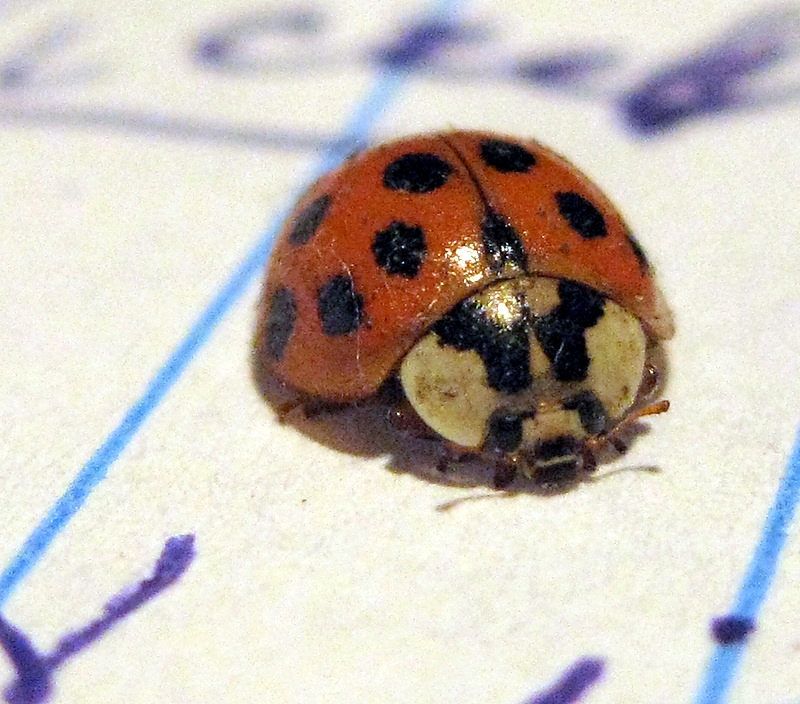
A photo of another one of my cousins

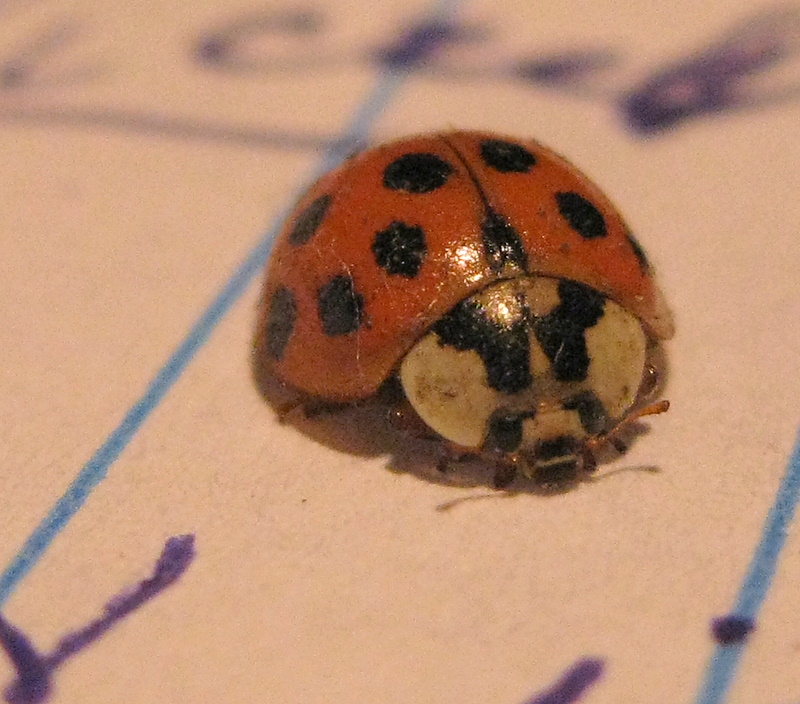
As I worked tonight, this little beetle landed on my pad of paper. Hello, Cousin! You fit so easily between the lines of my pad of paper. You make my pen strokes look quick thick!

beetle-on-pad-of-paper

[For this shot, I was using a Canon SD1100IS (which only costs about $150 now), using the digital macro feature. This bug let me park my camera lens less than an inch away for this photo.]

Continue ReadingA photo of another one of my cousins

Scamming the Nigerian scammers

Paul Kinsella is a fascinating fellow. Though he is not with any branch of law enforcement, he has taken it on himself to delve into the tactics of the Nigerian scammers. You know, they might as well be called Nigerian spammers. And, believe it or not, though most of us simply delete those emails, over the course of a year many people fall for the scam and they lose substantial money in the process. Kinsella is featured in "Master Baiter," a detailed and entertaining article written by Nicolas Phillips and published in this week's Riverfront Times. Kinsella, a 37-year old Illinois native as well as a father of two, scams the scammers with gusto. And he loves to tell them that they've been scammed by him. Kinsella has often tried (and sometimes succeeded) in convincing the scammers that he wants to work with them to rip off victims. Check out Kinsella's website (419hell.com)to see many of the flavors of the scams, along with the people running them. Quite impressive. He must spend incredible numbers of hours running his operation. The payoff? He has learned of the identities of 26 potential victims and prevented 14 of them from actually paying the money. To see the FTC's warnings about the Nigerian scams, go here. Kinsella is multifaceted. He intentionally dropped 100 fake-lost-wallets to see how honest people were (74 were returned), resulting in a lot of publicity. He's also a cartoonist and . . . oh yeah, consider this other service he offers:

He also created AfterLifeTelegrams.com, which works like this: For $5 a word, you write a telegram to a deceased loved one. Kinsella then arranges for a terminally ill person to memorize the message and pass it along.

As I learned from my days working as an Assistant Attorney General, it takes a scammer to catch a scammer. Check out the article in the RFT. It's full of facts, figures and entertaining vignettes about Kinsella, the Nigerian scams and much more.

Continue ReadingScamming the Nigerian scammers

Culture and Copyright in the 21st Century

On 24 March, 2009 Lawrence Lessig delivered the keynote speech, Getting the Network the World Needs, at the OFC Conference in San Diego, CA. This is a revision of a REMIX talk, distinguishing between parts of the 20th Century that were Read-Only and parts that were Read-Write. His brilliantly delivered thesis discusses how culture prior to the 20th century was essentially read-write, everyone consumed and created the culture interactively. During the 20th century centralization and control of media and distribution transformed our culture to a read only - where creation was almost exclusively the province of professionals and professional distribution channels (tv, movies, music). He then suggests that the 21st century brings the promise and the demand for building a read-write culture once more, and for moving far beyond the mash-up of the past decade. He also discusses the necessary legal and infrastructural changes needed to accommodate this changed reality. Warner Music has tried to serve a DCMA takedown, based on his inclusion of some music and media clips - despite the obvious and clear "fair use".

Continue ReadingCulture and Copyright in the 21st Century