
Compelling gossip

I was on a two-hour bus ride today, surrounded by people chattering loudly on their cell phones. From the large man with the goatee (in front of me, to my left), I leaned that he had bacon and eggs this morning at a little restaurant and that it was good. It took him five minutes to describe his meal to the person with whom he was conversing (I do wonder whether that person was really listening to the entire thing). The woman in front of me was getting angry at the person to whom she was talking--she insisted that there was a closer Wal-Mart, and that that person ought to turn her car back immediately and go there, not to the Wal-Mart down the road. A man behind me was making a wide variety of calls, reassuring people that he would be visiting someday, and apparently trading much chit-chat. The woman behind me was discussing various movies with her conversant. Again, there were lots of details, and it seemed as though each of these conversations ended because the people got tired of talking, not because they traded any significant information. All of this chattering was irritating to me, because I have a difficult time filtering out one-sided conversations. Every time the person near me stops talking, an internal warning kicks in and I automatically replay my buffer (as best I can) in order to jump in and respond. It's all automated, and it turns out, time after time, that they are not talking with me at all. My little sub-routine, which works rather well in many situations where someone has paused for the purpose to allow me to respond, is merely an annoyance in these situations. Now multiply this gossipy chatter by hundreds of millions, all across America, and you have an enormous amount of time and energy dedicated to gossip. Whenever you see so much energy going into an activity, red flags should go up: it is likely that such a ubiquitous activity is serving some important biological function. But what could possibly be important about gossiping? Based upon much study, Robin Dunbar has proposed the answer that gossip is verbal grooming. I described his position in some detail here. His bottom line is that even though the content of the gossip seems relatively unimportant, the exchange is critically important. Engaging in gossip is social sonar. It is our way of determining the identities of our allies and foes, not simply by determining who is willing to gossip with us, but through many subtle clues dropped in the course of the gossip. We learn the identities of the people who talk about us and our friends, and bits and pieces about their attitudes toward us. We learn who has resources, social and material, and their willingness to share these resources, and with whom. Gossip is a powerful use of language, but it is often not focused on the truth-content of the words used. In modern times, gossip is likely to be seen as a Gouldian spandrel. But just maybe, as Dunbar suggests, gossip is truly verbal grooming and thus arguably the original impetus for the development of all human languages. As I see it, gossip but one of several non-prototypical uses of language. I suspect that we see another such use in most religions, where language can be critically important, even though ambiguous, untrue or even oxymoronic.
Continue ReadingCompelling gossip

It’s lonely at the top

Pity Tony Hayward, erstwhile boss of BP. He's really had it rough. He's been "demonized and vilified", to use his own words. The poor CEO was so busy dealing with the massive oil spill perpetrated by his company that he almost missed watching his yacht race in a very important race! Almost, but he was able to watch the race anyway. Because, you know, someone else was probably working on cleaning up the oil fouling the Gulf of Mexico. It's not really the CEO's job, you see. It's more of a job for the "small people" of the world. "Life isn't fair. Sometimes you step off the pavement and get hit by a bus," Hayward said recently. Yes, that's true. And sometimes, you end up the CEO of one of the most powerful oil companies in the world. A company that has a long history of criminal and ethical violations that should make them unfit to operate a lemonade stand, much less a major multinational corporation with power to contaminate the entire Gulf of Mexico-- and perhaps, Beyond!

Continue ReadingIt’s lonely at the top

Founder of Wikileaks explains why he published secret U.S. documents regarding Afghanisgtan

At Common Dreams, WikiLeaks founder Julian Assange explains why he published the confidential U.S. military documents regarding Afghanistan:

These files are the most comprehensive description of a war to be published during the course of a war -- in other words, at a time when they still have a chance of doing some good. They cover more than 90,000 different incidents, together with precise geographical locations. They cover the small and the large. A single body of information, they eclipse all that has been previously said about Afghanistan. They will change our perspective on not only the war in Afghanistan, but on all modern wars . . . This material shines light on the everyday brutality and squalor of war. The archive will change public opinion and it will change the opinion of people in positions of political and diplomatic influence. . . We all only live once. So we are obligated to make good use of the time that we have, and to do something that is meaningful and satisfying. This is something that I find meaningful and satisfying. That is my temperament. I enjoy creating systems on a grand scale, and I enjoy helping people who are vulnerable. And I enjoy crushing bastards. So it is enjoyable work.
Here is the location of the Wikileaks Afghanistan documents. Glenn Greenwald applauds the leak, and condemns the U.S. governments failure to be forthright about the waste of lives and money regarding the U.S. adventure in Afghanistan:
WikiLeaks has yet again proven itself to be one of the most valuable and important organizations in the world. Just as was true for the video of the Apache helicopter attack in Baghdad, there is no valid justification for having kept most of these documents a secret. But that's what our National Security State does reflexively: it hides itself behind an essentially absolute wall of secrecy to ensure that the citizenry remains largely ignorant of what it is really doing. WikiLeaks is one of the few entities successfully blowing holes in at least parts of that wall . . .

Continue ReadingFounder of Wikileaks explains why he published secret U.S. documents regarding Afghanisgtan

Cognitive surplus- what else could you do besides watch TV?

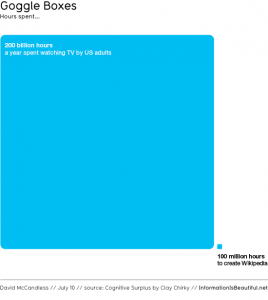
David McCandless created an amazing graphic recently, contrasting the amount of time Americans spend watching television each year with the cumulative amount of time it has taken to create Wikipedia. Check this out:

Image via InformationisBeautiful.net, with permission. The graphic illustrates what author Clay Shirkey calls "cognitive surplus", or spare brainpower that exists, simply waiting to be engaged. How much of that brainpower is being wasted watching television? This got me thinking, and I remembered a recent Newsweek article which pointed out that creativity is declining in America. Even as intelligence (measured by IQ) is rising, creativity (measured by CQ) is declining:
Like intelligence tests, Torrance’s test—a 90-minute series of discrete tasks, administered by a psychologist—has been taken by millions worldwide in 50 languages. Yet there is one crucial difference between IQ and CQ scores. With intelligence, there is a phenomenon called the Flynn effect—each generation, scores go up about 10 points. Enriched environments are making kids smarter. With creativity, a reverse trend has just been identified and is being reported for the first time here: American creativity scores are falling.
What's at fault for this phenomenon? Television and video games share at least part of the blame:
It’s too early to determine conclusively why U.S. creativity scores are declining. One likely culprit is the number of hours kids now spend in front of the TV and playing videogames rather than engaging in creative activities. Another is the lack of creativity development in our schools. In effect, it’s left to the luck of the draw who becomes creative: there’s no concerted effort to nurture the creativity of all children.
So, how much time is spent watching television, and how do people feel about the use of their time? Check out these statistics (source): [More . . . ]

Continue ReadingCognitive surplus- what else could you do besides watch TV?