
Life manufactured in space

Every once in a while, I would read an article that claimed that life originated somewhere else and then came to earth on an asteroid. This claim puzzled me, because it sounded like an eternal regress. If life began on some other planet and then came to earth, how did it originally develop on that other planet? It turns out that I misunderstood the claim, and I have been set straight by a recent article called "Cosmic Blueprint of Life," by Andrew Grant, published in the November 2010 edition of Discover Magazine (this particular article is not yet available on the Internet). The claim is not that life developed on some other planet and then eventually came to earth on asteroid. Rather, the claim is that many of the basic chemicals necessary for life were manufactured in space, and then showered upon earth (and presumably other planets where--presumably--life exists). In this article, Grant writes that:

[The notion that the] underlying chemistry of life could have begun in the far reaches of space, long before our planet even existed, used to be controversial, even comical. No longer. Recent observations show that nebulas throughout our galaxy are bursting with prebiotic molecules. Laboratory simulations demonstrate how intricate molecular reactions can occur efficiently even under exceedingly cold, dry, near vacuum conditions. Most persuasively, we know for sure that organic chemicals from space could have landed on Earth in the past--because they are doing so right now. Detailed analysis of a meteorite that landed in Australia reveals that it is chock-full of prebiotic molecules. Similar meteorites and comets would have blanketed earth with organic chemicals from the time it was born about 4.5 billion years ago until the era when life appeared, a few hundred million years later. Maybe this is how Earth became a living world.
According to Grant, there's two ways to look at the famous 1953 experiment by Stanley Miller and Harold Urey. They prepared a closed environment with the gases they assumed constituted the early Earth atmosphere (methane, ammonia, hydrogen and water). They then simulated lightning strikes through the use of electric sparks. Within a week, the process had produced a variety of prebiotic compounds. As Grant points out, however, the experiment did not show that "all the building blocks of life could have emerged on Earth from non-biological reactions."

Even the simplest lifeforms incorporate two amazingly complex types of organic molecules: proteins and nucleic acids. Proteins perform the basic task of metabolism. Nucleic acids (specifically RNA and DNA) encode genetic information and pass it along from one generation to the next. Although the Miller-Urey experiment produce amino acids, the fundamental units of proteins, it never came close to manufacturing nuclear bases, the molecular building blocks of DNA and RNA.

Grant points out that space was long considered to cold and too low-density to form molecules, but this has now been disproved. Scientists have now found ammonia molecules near the center of the Milky Way using a radiotelescope. They have also found formaldehyde, formic acid and methanol. Laboratory simulations of the environment of outer space had produced "dozens of prebiotic molecules, among them the same amino acids that Miller and Urey found." Further, these experiments have produced "intricate molecular rings containing carbon, nitrogen and hydrogen: fatty acid like molecules that look and behave like the membranes protecting living cells; and nucleic acids or nucleotides, the primary components of RNA and DNA. [More . . . ]
Continue ReadingLife manufactured in space

AM radio shows as broken windows

In an 1982 article, James Q. Wilson and George L. Kelling announced their "broken windows" theory of crime:

Broken windows theory is a criminological theory of the normsetting and signalling effects of urban disorder and vandalism on additional crime and anti-social behavior. The theory states that monitoring and maintaining urban environments in a well-ordered condition may prevent further vandalism as well as an escalation into more serious crime.

Here's more from Wikipedia:

Consider a building with a few broken windows. If the windows are not repaired, the tendency is for vandals to break a few more windows. Eventually, they may even break into the building, and if it's unoccupied, perhaps become squatters or light fires inside.

Or consider a sidewalk. Some litter accumulates. Soon, more litter accumulates. Eventually, people even start leaving bags of trash from take-out restaurants there or breaking into cars.

[More . . . ]

Continue ReadingAM radio shows as broken windows

Beware HP Photosmart Premium printer software – access denied

We brought home our new HP Photosmart Premium printer two days ago. It prints, scans, faxes and copies. Pretty cool. We installed the DVD full of software that came with the printer (and it was an immense installation). We tested the printer, but our new printer ate the copy paper. It chewed it up and ruined it. Bad start. OK. Even good companies sometimes make defective products. It doesn't mean that the design is bad. Sometimes it's just an isolated bad machine. Therefore, I exchanged it for a new printer of the same model: HP Photosmart Premium printer. This one printed very nicely, including the printing of photos on special photo paper. Quite impressive. [More . . . ]

Continue ReadingBeware HP Photosmart Premium printer software – access denied

On seeing farther

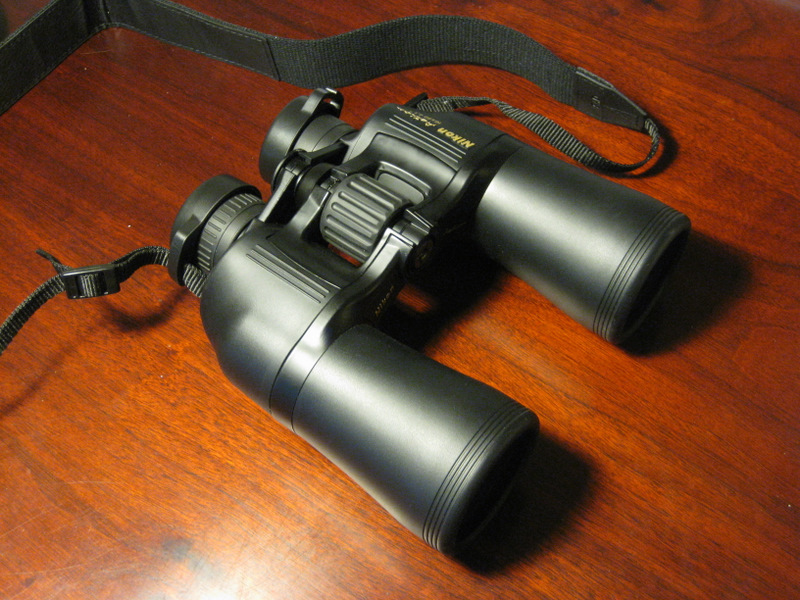
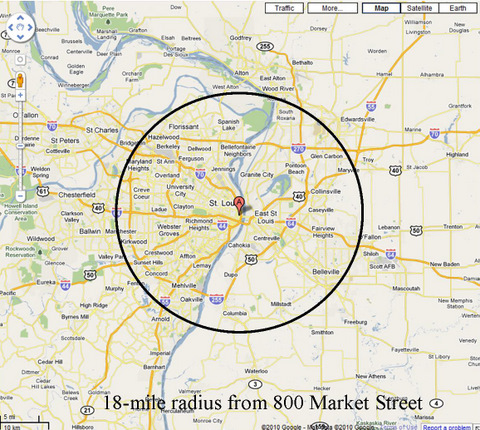
My law office recently moved to a new building in downtown St. Louis, Missouri. We're now on the 17th floor, and we have unobstructed views in many directions. That led to conversations about how far we could actually see. That led to the purchase of a good set of binoculars (we bought a pair of Nikon 7223 16 x 50 mm binoculars at Amazon for about $100). We also invested in a tripod for the binoculars (another $24). This equipment has led to some rather surprising discoveries. For instance, we can clearly see the McKinley Bridge, which is almost three miles away. Aiming upwards, we can clearly see the Chain of Rocks Bridge, which is almost ten miles away. We can clearly see the Mississippi water flowing under both of these bridges. Looking even further in the distance, we can see several manmade structures in Alton, Illinois. That is 35 miles away by car, at least 25 miles away by air. Alton is also on the Mississippi River. We can't see the river itself in Alton; the structures we can see are on elevated land past the river on the Illinois side. These sites are all to the north--we have yet to explore the other vistas. I didn't know that you could see so far with a good set of binoculars. Rumor has it that one can even see the moon, which is a quarter million miles away. More seriously, and much more impressive, I'm waiting for a clear night to train the binoculars onto Jupiter; it is apparently easy to see the four largest moons of Jupiter from Earth using only binoculars. Back down to earth the question arises: how far can one see, before the Earth's curvature drops the scene too far down? There are formulas to calculate this distance. Assuming the land is relatively flat, the answer depends on how high one's eye are above the ground. Up on the 17th floor, we can supposedly see more than 16 miles over flat ground. Assuming most of that view is not blocked by other buildings, this gives us the ability to "see" (based upon the formula A= pi times r(squared). With a radius of 16, we can see an area of more than 800 square miles, an impressive area of land (I designated a reference-area based upon an 18 mile radius on the attached map). I'll end this post here. I'm now a king ruling over a large kingdom, and my subjects need me to keep a careful lookout.

Continue ReadingOn seeing farther

Neocon Catholics

As I’ve indicated in my previous posts, I am a practicing Roman Catholic who lives in St. Louis, Missouri. Therefore, the topic I'm addressing today is one that I find especially distressing. An extremely conservative element in the Catholic Church seeks to re-affirm values and traditions not wholly consistent with Church doctrine and traditions. These Catholic “neo-cons” are revisionist and likely to adopt other tactics which served Karl Rove and his ilk well at forming governing majorities for the GOP. These Catholic neo-cons are trying to subvert Vatican II and also pander to the rich conservative supporters which have made up for the fall-off in the numbers of contributors to the various yearly Catholic Appeals. The Catholic neo-cons don’t care about facts; they just spout platitudes and rely upon deliberate lies or appeals to false authority to have their way. The recent elevation of Archbishop Dolan of New York to preside over the National Conference of Catholic Bishops (NCCB) instead of Archbishop Chaput, OFM. Cap. of Denver is a sign of the ascendancy of the neo-cons. So too is the recent elevation of former Archbishop of St. Louis Raymond Burke to cardinal and to head of the Vatican Courts. [More . . . ]

Continue ReadingNeocon Catholics