Human imperfections as proof that we evolved

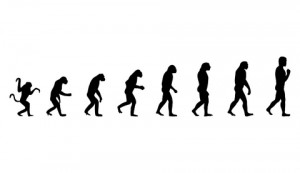
Rob Dunn of the Smithsonian highlights ten human perfections as evidence that we evolved. "From hiccups to wisdom teeth, the evolution of homo sapiens has left behind some glaring, yet innately human, imperfections." What human features made the list? 1. The fact that mitochondria became the prey for our cells. 2. Hiccups. The original function? Our ancestors who were fish and early amphibians "pushed water past their gills while simultaneously pushing the glottis down." 3. Backaches. Learning how to stand up gave us the ability to see farther, and it gave us freedom to make better use of our hands. But the resulting "S" shaped back is not a good design for supporting our considerable weight. 4. Unsupported intestines. Standing up made them hang down "instead of being cradled by our stomach muscles." this often leads to hernias. 5. Choking. In most animals, the esophagus is below the trachea. This allows us to speak, but allow falling food and water "about a 50-50 chance of falling in the wrong tube." 6. We're cold in the winter. We lost our fur, and this proves that evolution is blind as to where we will end up. 7. Goosebumps. They are good for making our fur stand up when we look bigger to scare away a potential predator. But See #6: we lost our fur. 8. Our brains squeeze our teeth. Bigger brains left less room for big jaws. I'm not convinced that the big brain came first, however. I've read accounts that suggest that fire lead to less need for big jaws to chew uncooked food, which lead to more room for the brain. 9. Obesity. Those strong cravings for sugar, salt and fat were great when we lived on the savanna, where these things are scarce. In our current food-rich environment, these ancient cravings are toxic for most of us. 10. Rob Dunn makes this the miscellaneous category. He includes male nipples, blind spots in our eyes, and our coccyx (a bone that used to be our tail).
Continue ReadingHuman imperfections as proof that we evolved

A complex cell’s best friend

When I first studied mitochondria, back when I was a high school student, I didn’t appreciate their importance or their origin. I got a lot smarter recently, especially after reading "The Energetics of Genome Complexity," by Nick Lane and William Martin, in the October 21, 2010 edition of Nature (available online only to subscribers). I now realize that Mitochondria are organelles that generate energy in the form of ATP, and that without mitochondria, humans wouldn't exist. Lane and Martin begin their article by asking: "Bacteria made a start up virtually every avenue of eukaryotic complexity, but then stopped short. Why?” As I indicated, in this article, I learned many things about mitochondria. I have inserted excerpts from the Lane/Martin article in several locations. Mitochondria formerly existed as their own independent life form (they were proto-bacteria), but they now reside within other cells. This combining of mitochondria happened only once about four billion years ago and all eukaryotes descended from that symbiotic occurrence. All Eukaryotes had mitochondria (or once did but lost them).

All eukaryotes share a common ancestor, which arose from prokaryotes just once in 4 billion years. Genomic chimaerism points to the origin of eukaryotes in an endosymbiosis between eukaryotes. All eukaryotes either possessed mitochondria, or once did and later lost them, placing the origin of mitochondria and the eukaryotic cell as possibly the same event.

The host mitochondria were also prokaryotes. This was determined by Russian botanist Konstantin Mereschkowski in 1905 and, as you might expect, he was not believed. [More . . . ]

Continue ReadingA complex cell’s best friend

God as a scientific explanation

Whenever I consider the magnificent structures of cells, I wonder “How could this possibly be?” There is no answer forthcoming, despite the incredible insight offered by scientists. What is, simply is, and I don’t have a reasonable answer for how such exquisite complexity can arise from a cosmic explosion and…

Continue ReadingGod as a scientific explanation

Books, books and more books

I love libraries. More to the point, I love books. My wife also loves books, though now prefers her phone app to read when she gets the chance. I do read texts occasionally on my phone, and used to on my Palm, and I reluctantly read on/offline docs, but I prefer tradition. There are many reasons for going to libraries. I rarely use them for research anymore. I only go for a specific book maybe 20% of the time. I delight in taking in the experience and seeing where it leads me. I might have an objective in mind, but there are so many opportunities awaiting me, it’s hard to choose just one, or two, or several! My own library is not dissimilar from a public or university library in that respect, save perhaps its scale. That and it also serves as a music room (drum set, guitars, keyboard...) and an occasional media room. We have more than 5,300 books, though about 1,000 of them are for very young children (and mostly packed away now) and another 500 for young adults – combination homeschooling and love of books. I was putting books away the other night and looking for some references on homeschooling for a couple of pieces I am writing and went on a mini-adventure (every re-shelving trip up to my library results in armfuls coming back down with me)…. ...I rediscovered Masters of Deception, compiled by Al Seckel, is a wondrous collection of works of optical illusion by such well-known artists as Escher, Dali, and Arcimboldo, but also including Shigeo Fukuda’s incredible sculptures, and Rob Gonsalves’ realistic paintings. Scott Kim (whose work I first saw in Omni magazine in 1979) and his ambigrams, Ken Knowlton, Vik Muniz, Istvan Orosz, John Pugh, and Dick Termes are also among the 20 artists featured in this visual treat. The foreword was written by Douglas Hofstadter, which led me to… …Gödel, Escher, Bach, from which I first gained consciousness of the math in music, and of the music in math (math was something you do, not appreciate, even though I was quite good at “doing” it.) It’s been more than 25 years since I first discovered Hofstadter’s gem, and it occurred to me that I don’t recall finishing it…so that goes on the list; maybe sooner than later. Ooh! There’s John Allen Paulos, and Innumeracy: Mathematical Illiteracy and Its Consequences – a fantastic book of concepts, although at times disjointed like many of his works (A Mathematician Reads the Newspaper, Irreligion: A Mathematician Explains Why the Arguments for God Just Don’t Add Up, and more – all most excellent, if a little scattered). And Friedman's "The World is Flat"... Hmm, Mark Tiedemann wrote a note on Heinlein recently (Robert A. Heinlein In Perspective)...but I only have six Heinlein books, and I promised myself I'd read Asimov's entire Foundation series from I, Robot to Foundation and Earth before I re-tried Heinlein. And I really do love Chalker, Farmer, Clarke, ... ... and Jared Diamond, and Richard Dawkins, and Martin Gardner, and Stephen Hawking,... ...Michael Shermer, Bart Ehrmann, Uncle Cecil, Gary Larson... No matter whether you get your education from electronic or print means, aural or visual, don't ever stop.

Continue ReadingBooks, books and more books

The health care “free market”

Many American conservatives argue that we need to step back and allow the "free market" continue to offer the most efficient health care system in the world. The facts on the ground starkly conflict with this way of thinking. The International Federation of Health Plans recently released its 2010 Comparative Price Report detailing medical costs per unit. The study starkly illustrates that health care costs are much higher in some countries than others. The average U.S. prices for procedures are the highest of those in the 12 countries surveyed for nearly all of the 14 common services and procedures.

For example, total hospital and physician costs for delivering a baby are $2,147 in Germany, $2,667 in Canada, and an average of $8,435 in the United States. The survey shows that the cost for a hospital stay is $1,679 in Spain, $7,707 in Canada, but these costs can range from an average of $14,427 to $45,902 in the United States. The survey also found that the cost of a widely prescribed drug like Nexium can range from $30 in the United Kingdom to $186, the average cost in the United States. In addition to providing comparative cost data across the countries, the survey provides information about the wide range of costs being charged in the United States for common services, procedures and drugs. One example from the survey is hip replacement surgery which cost $12,737 in the Netherlands, but ranged from a low of $21,247 to a high of $75,369 in the United States. Five percent of U.S. prices are higher than $75,369. The differential between unit prices was greatest for surgery, according to the survey data. One of the highest differentials was for cataract surgery hospital and physician costs. The range for cataract surgery ran from $1,667 in Spain to an average of $14,764 in the United States.

Continue ReadingThe health care “free market”