Rocks, Friendships and the Power of Triangulation

There are so many smart, interesting and kind-hearted people out there! They are everywhere and all you need to do is meet them, but how do you meet them? My friend Dahven has a rule. She assumes that even at a drab party, there is someone else there who has a good story. Dahven reminds herself that she will inevitably come away from every party enriched. She only needs to start her treasure hunt to find that person and to hear that story. She tells me that she has never been disappointed.

But some of us struggle with the task of walking up to talk with strangers. Journalist Kio Stark has made a career out of urging people to talk with strangers and her best technique is triangulation. Simply put, rather than walking up to directly talk to a stranger, identify some interest that you might have in common to talk about, such as the stranger’s dog or a book they are reading. Stark’s TED talk is well worth watching (see also, James Hamblin’s video at The Atlantic--a controlled study in triangulation).

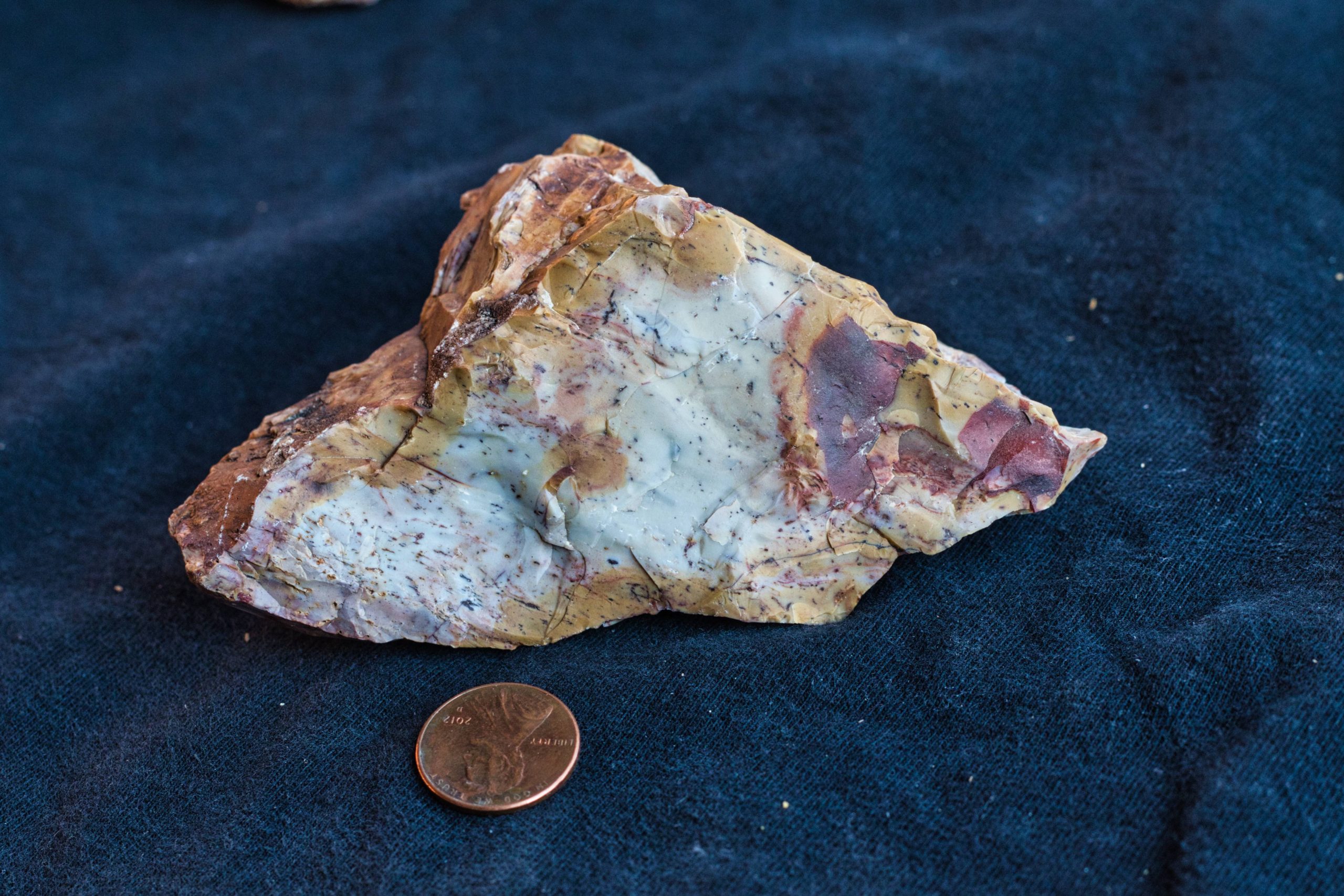
I’ve was reminded how powerful triangulation can be. I’ve recently rekindled a childhood passion: rockhounding. Most people love beautiful rocks and they serve well as objects for triangulation. I recently finished tumbling my first batch of rocks from Missouri creeks. Almost without fail, when I show these smooth colorful tumbled rocks to others, this results in smiles and good conversation. I’ve seen it over. I love rocks, other people tend to love rocks, and I really enjoy getting to know new people.  It’s a winning combination. Rocks are powerful catalysts for social interactions. Here are three quick examples.

#1: After posting my photos of tumbled rocks on FB, I was PM’d by a woman named Patti Kemper, who asked for my house address. Why? She explained that she saw how much I enjoyed rocks and she wanted to send me some exotic rocks that she had found near her home in Las Vegas. A few days later a big box of beautiful rocks, including some raw chalcedony. Wow! Why did Patti send these to me? Because she was delighted to see on FB that I was so excited about tumbled rocks. I’ve also seen this at FB rockhounds groups, where members share in each others’ discoveries and offer each other advice how to identify rocks and where to find new rocks.



[More . . . }

Continue ReadingRocks, Friendships and the Power of Triangulation

Spontaneous Conversation with Curbside Artist

Martha Ferdinand has been one of my favorite people ever since I began working with her at Arch City Defenders. More recently, we have made a habit of walking briskly through Forest Park while catching up with each other. And, of course, we often contemplate the human condition. We haven’t yet figured that out . . .

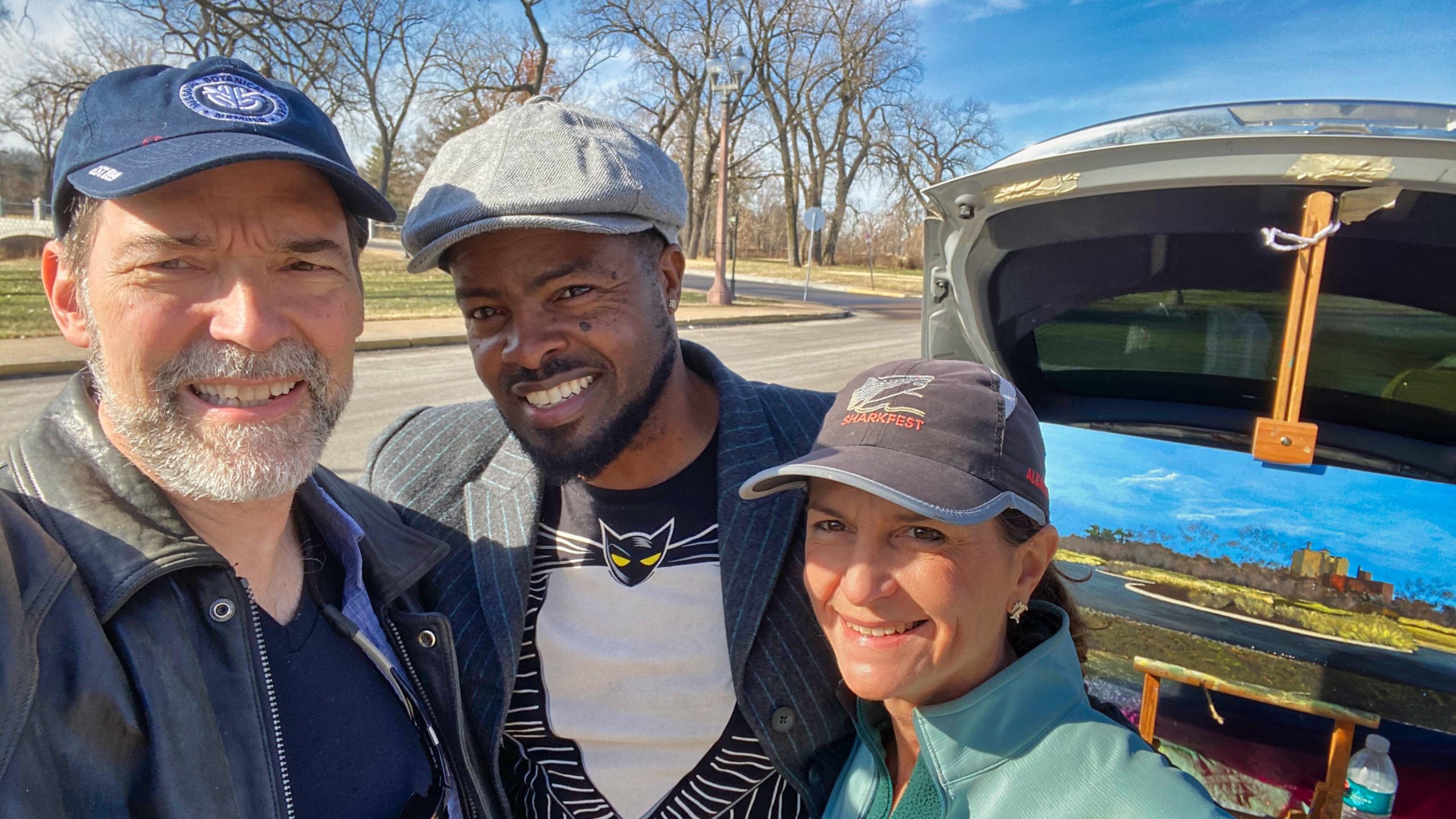
Today we took a little side-trip from our planned walk. I spotted a man painting a park scene across the street and suggested to Martha that perhaps it would be fun to go check out his work. Martha nodded, and that’s how we met “Frank James, Curbside Artist.” Frank explained that he has made a living of painting scenes of Tower Grove Park and, more recently, Forest Park. He pulled out other examples of his work from his car: several impressive detailed 30” wide panoramas of park scenes in acrylic paint. Frank offered far more than art today, however. He looked us over and offered an off-the-cuff character analysis of Martha with a big smile and lots of laughs, especially when she agreed that he was somewhat accurate. All of this while smooth music played quietly on his car stereo, but not an entire song. He only liked the first part of that song, so he cut off part where the “irritating” singer began to sing. He loops the pre-vocals beginning of the tune over and over. He explained that this is a significant part of his creative process.


We chatted for awhile about many things, not just painting, but also about his outlook on life, our thoughts on race relations and discussions about music we all enjoy (including Wes Montgomery and George Benson's Breezin’). Good vibes all around.

My friend John Simon often says, “It’s all about relationships.” I agree that this is an excellent default position for understanding almost any life situation. Certainly, my memory of Forest Park on this day will be dominated by the spirited conversations with both Martha and with that ebullient stranger-no-more, “Frank James, Curbside Artist.”

I have a theory too. It seems to me that unplanned spontaneous conversations are often the best, the most memorable. Those who know me well know that it’s hard to hold me back when I get the sense that a quirky

Continue ReadingSpontaneous Conversation with Curbside Artist

The Season for Trying to Step off the Treadmill

My 19-year old daughter Charlotte recently commented: "Time seems to go by faster now than it did when I was in high school." Yes, indeed! And it speeds up more and more, especially if you love what you are doing with your life, and if you treasure your family and friends.

This seems to be the perfect time of year to try to step off that ever-accelerating treadmill in order to live in the moment, to appreciate the many things that went extraordinarily well this year but to also appreciate lessons learned where things didn't go as planned. What better way to kick off this season of contemplation than to spend time with your people and to share stories with each other. That's what many of us are doing tonight, of course. To me, that is the magic of the season. My family's tradition is to celebrate Christmas Eve with a feast of tacos and other Mexican food at my house in South St. Louis. My immediate family includes my 87 year old mother, who lives independently, and her five children (I have four wonderful sisters). My mom would proudly add that she has many grandchildren and also some great-grandchildren. But wow, is time ever flying by . . .


Continue ReadingThe Season for Trying to Step off the Treadmill

The Catastrophic Story-Telling Failure of “How the Grinch Stole Christmas.”

When they stop celebrating “How the Grinch Stole Christmas,” I’ll pause my efforts to reframe this story as having one of the worst endings in the history of story-telling.

Just when the Whos of the Who Village almost learned an extremely important lesson, just when they were having an epiphany that all of that Christmas kitsch and all those baubles actually corrupted the holiday and distracted from the meaning of the celebration, that’s when the Grinch got three times more evil that day.

A proper way to end the story would be for the Grinch to confidently dump all of that glittery tinselly crap into the abyss high above the village. He would then triumphantly ride down into the Who Village to be welcomed as a hero. They would sing odes praising the Grinch for conducting his dramatic intervention. They would deeply embrace the idea that Christmas would proceed in a more pristine and sincere form because the materialistic cravings--those jingtinglers, whohoopers and glumbloopas--had been exorcised from the process. The Whos might even celebrate that the Grinch was channeling the Jesus who drove the money-changers out of the temple. Instead of singing the “Twelve Days or Christmas,” the Whos would compose a new carol called “O Little Town Where Less is More.”

The actual story ending is a sad one, however. Because the Grinch allowed schmaltzy emotion to prevail over principle, he decided that Christmas should NOT become like traditional Thanksgiving (before the concept of Black Friday). He decided that the celebration needed thousands of materialistic distractions after all. The Whos, glitch-addicts that they were, put up no resistance. The story ending consisted of a lesson almost learned. No denouement here—that metaphorical sleigh just couldn’t quite get over the crest of the hill. This kind of almost-story could inspire a remake of “A Christmas Story” where Scrooge almost learned his lesson. In that revised ending, post-nightmare Scrooge would march back to the Cratchit house and spray paint anti-Cratchit graffiti on the walls.

Damn. The story of the Grinch was almost such a great story. See you next year for more of the same.

Continue ReadingThe Catastrophic Story-Telling Failure of “How the Grinch Stole Christmas.”

What To Do About Your Broken Heart

A broken heart can really hurt. It can physically hurt and it can be distracting, obsessive, depressing and unrelenting. The internet offers a lot of advice about what to do when your heart is broken, but this advice is anecdotal, hit and miss at best. That's why I then searched for articles based on science and I found one the offered an effective way to lessen the pain of a broken heart.

At Scientific American, Psychologist Guy Winch discusses a study that considered three strategies, to see which of these best helped heartbroken subjects reduce their love feelings.

In the first condition, subjects focused on negative reappraisals of their ex-partner (eg, by responding to prompts about their ex’s annoying habits). In the second condition they were asked to reframe their loving feelings as less problematic (eg, by endorsing prompts such as ‘It’s okay to love someone I’m no longer with’). The last condition used distraction (eg, questions about the subjects’ favorite food) to get the participants’ mind off their heartbreak. The researchers found that only negative reappraisals were truly effective in reducing love feelings. However, doing so did increase feelings of unpleasantness.

According to Winch, although this unpleasantness might seem to be a big price to pay to reduce feelings of love, there are two ways to address this unpleasantness: 1) Remember that "when we are heartbroken, our mind is likely to bombard us with highly idealized snapshots, memories and thoughts both about our ex and about our relationship." When we force ourselves to remember the downsides of the relationship, we are correcting for these untrue idealized images that are causing the pain 2)  We shouldn't contemplate only the person to whom we were attracted. Instead, we should force ourselves to think of the dynamics  of the relationship itself.  That's where we can best see the problem, because quite often a relationship consists of two smart good-hearted people who merely lack the chemistry to be a pair.

In my experience, it might take some work to see the downside to a relationship, especially when one is the dumpee rather than the dumper. But it's not always difficult.  There might be low-hanging fruit, things like addictions or rampant dishonesty, things that would have been absolute deal-breakers on Day One.  If only your lover had revealed these things at the very beginning of your relationship.  Imagine a Match.com profile indicating: "I will tell you the opposite of what I'm really feeling when we discuss important issues."  Or "I will become annoyed when you come over to spend time with me because I'd rather spend time with my other friends, who like to get drink heavily."  For most of us, dysfunctions like these, if revealed up front, would destroy the possibility of ever having a first date.  Once a romance has been going on for months, the confirmation bias encourages us to overlook any evidence pointing to major problems like these.  Once the relationship fractures apart, major issues like these often become obvious, sad and embarrassing memories.  But once the relationship is over, stark bad memories like these are also the best medicine to lessen the pain of your broken heart.  The better the hurt, the better the cure.

Even in the absence of major issues, there are doubtless various reasons why any particular relationship failed.  There had to be friction and frustration, even if nothing "major," and even if the cause is ineffable. Even where one doesn't understand why the relationship was not smooth sailing, one certainly experienced that it was not smooth sailing.

Winch suggests the following as the best salve for a broken heart, whether the issues were major or minor:

If you are trying to get over heartbreak, make a list of the person’s faults as well as of the shortcomings of the actual relationship and keep that list on your phone. Whenever you find yourself having idealized thoughts and memories, whip out your phone and read a few reminders in order to balance your perceptions and remind yourself that your ex was not perfect and neither was the relationship.

I have tried this approach to the letter and I highly recommend it.  Reviewing your own long list of real grievances turns a wonderful movie about you and your ex-lover into a sad and frustrating movie that makes you want to throw popcorn at the screen and walk out.  Once you see your ex-lover as they were, not merely as you crave them, it's much easier to turn the page to a new chapter of your life.

What follows is Winch's TED talk on this same topic:

Continue ReadingWhat To Do About Your Broken Heart