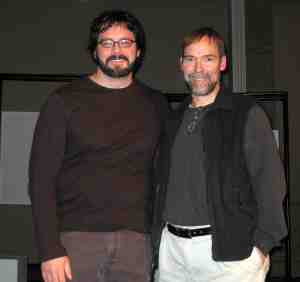
George Lakoff’s Expansive Lecture: How Linguistics Relates to Everything Else.

This talk by George Lakoff has got to be one of the most ambitious 40-minute talks I’ve ever watched. Lakoff is a linguist who has spent his life studying language, but not merely language. He has also drilled down into the brain using neuroscience, connecting our use of language to such things as neural binding and mirror neurons. He has also looked upward from conceptual metaphors to point out their personal and cultural ramifications.

Metaphors begin taking root in three-year old children based on physical activities. As adults, we employ these metaphors ever-so-easily in order to understand complex social phenomena such as romantic relationships, art, teaching and politics. Whenever we employ these metaphors (and we are always doing this) we are thinking with our bodies. Further, without these metaphors we would have an impoverished understanding of essentially everything that is important to us. If you don’t want to invest in the entire 40-minute talk, I would urge you to go to the 24-minute mark to hear Lakoff’s story how the explosion of research on conceptual metaphors began with a tearful graduate student’s comment, “I’ve got a metaphor problem with my boyfriend.” After hearing this story and watching the short audience participation segment where Lakoff connects up romantic love with the physical act of traveling, the field of conceptual metaphor will likely become vivid and compelling for you. Conceptual metaphors are invisible to most of us, but once you see how they work, you will see them everywhere.  You might even feel that you have new superpowers for seeing how people talk, think and attempt to persuade each other.

Lakoff is probably best known for his work on metaphors (with philosopher Mark Johnson), beginning (but by no means ending) with the book, “Metaphors We Live By.” I’ve written on the importance of metaphors in many other places, including here, here and here.  Conceptual metaphors are critical to my own profession, the legal profession. I’ve published my own analysis on the critical connection between metaphors and the legal doctrine of stare decisis here: "The Exaggerated Importance of Stare Decisis." 

Continue ReadingGeorge Lakoff’s Expansive Lecture: How Linguistics Relates to Everything Else.

What to Say When You Notice Someone Sneezing in the Age of COVID-19

The traditional response to noticing another person sneeze has never worked well for me. Why would I invoke the name of a deity in such a situation?

Even if a such deity actually existed, why would he/she/it/they care about someone sneezing? Path dependance explains a lot of things we do and the "God Bless You" people often say (often with a concerned look) is one of those many things we do merely because we've always done it that way. 

COVID-19 has made our concerns about sneezing much more legitimate. I noticed this yesterday while I was outside in my backyard (alone) eating pretzels. I had a mouthful of pretzel when I had a strong urge to sneeze came upon me. Maybe God made me do it. I didn't hold back, even with my mouth filled with mostly-chewed pretzel. It was a world class sneeze, I can proudly say, but it was also a science experiment. I watched as the pretzel particles sprayed several feet from me. If I were contagious, that would have been pretzels AND COVID-19 micro-particles and I assume that the virus would have sprayed even much farther than the pretzel dust. This was a visual reminder that it is good advice to sneeze into your elbow these days, if you can't hold back your sneeze while with others.

I've had long been puzzled about the traditional sneeze response ("God bless you"). A bit of research today showed me that the phrase might have first been uttered around 600 A.D. to try to protect people from the plague.  For many years, however, we've used that same expression when there was no fear of any plague.  

In modern pre-COVID times, however, the phrase has been an overly-quaint response to a perfectly natural and harmless bodily action, especially around allergy season. Sneezing is one of those fascinating complex series of coordinated actions that our bodies do (along with swallowing, vomiting, and orgasms) where our animal bodies seem to take on a life of their own for a short period, independent of our control once they reach the point of no return.

But what, exactly, is it that a God would supposedly do by "blessing" me following a sneeze? The obvious answer (it would seem) is to help me to stop sneezing in the future. Armed with this speculative conclusion a few years ago, I asked my nephew Dan whether he could help me with a new logical yet pretentious thing to say to a person who just sneezed. Dan had recently majored in Latin as well as computer science. His suggestion was to say: "Consiste sternuere!" He assured me that this phrase is Latin for "Stop sneezing!"  If you say this phrase with a stern face, carefully pronouncing each syllable, it might appear (to certain credulous people) that you are saying something useful and that you might even be wielding other-worldly powers.

If you are interested in joining me to help to make this new cutting edge expression viral, simply utter "Consiste sternuere!" instead of "God bless you." It is pronounced. ConSIStay stern-you-AIR-eh.

Thank you, Nephew Dan.

Continue ReadingWhat to Say When You Notice Someone Sneezing in the Age of COVID-19

Darrin Patrick’s Final Sermon: Life is Precious and Fleeting

A friend of mine, Darrin Patrick, was a pastor of a St. Louis Church called "The Journey." He died suddenly two days ago. The Post-Dispatch reports this: [N]o official cause of death has been released. The gunshot wound appeared to be self-inflicted; foul play is not suspected." I don't know anything further than this cryptic account.

I hadn't seen Darrin for several years, but I could have tried harder to connect with him again. That's one of the crazy things that life does, right? You don't make enough effort and then, suddenly, it's too late. This is not the first time this has happened to me. Perhaps this was Darrin's last sermon: life is truly precious and fleeting and you need to seize the day and make real efforts to maintain your connections to your people. He would likely add that it is critically important to be creative in those connections, because it was a significant part of his mission to support artists and writers.

When we last visited, Darrin spoke highly of his wife Amie and their kids, but I hadn't met them. Yesterday, Amie posted a sad sweet announcement on his FB page, and I just posted a short comment, which I will paste below. Mine was the 918th comment to her announcement. For another glimpse at what an unusual and innovative person Darrin was, check out this post at Dangerous Intersection.  In fact, I'm going to spoil it: I would bet you don't know of any other pastor who invited an atheist to discuss skepticism in front of hundreds of parishioners as part of a church service.

Amie, you and I have never met, but I am one of the many people touched by Darrin. By no means am I the sort of person that would be expected to fit into Darrin's flock, but I suspect that Darrin was surrounded by such people. He challenged me and I challenged him back and that's how he wanted it. That's because he was a real person, filled with intelligence, good-heartedness and energy but also nuance. I'm so sorry for your loss. Please know that I will miss him too. He changed me for the better and that's the bottom line.

Continue ReadingDarrin Patrick’s Final Sermon: Life is Precious and Fleeting

Kathryn Schulz Discusses the Possibility of Being Wrong at TED

It's difficult to imagine that I, at this very moment, am wrong about anything. Yet we all know, in retrospect that we were often wrong about many things. But it never felt like it at the moment. At TED, Kathryn Schulz discusses the dangers and opportunities of looking more closely at these moments.

Most of us do everything we can to avoid thinking about being wrong, or at least to avoid thinking about the possibility that we ourselves are wrong. We get it in the abstract. We all know everybody in this room makes mistakes. The human species, in general, is fallible -- okay fine.

But when it comes down to me, right now, to all the beliefs I hold, here in the present tense, suddenly all of this abstract appreciation of fallibility goes out the window -- and I can't actually think of anything I'm wrong about.

And the thing is, the present tense is where we live. We go to meetings in the present tense; we go on family vacations in the present tense; we go to the polls and vote in the present tense. So effectively, we all kind of wind up traveling through life, trapped in this little bubble of feeling very right about everything.

I think this is a problem. I think it's a problem for each of us as individuals, in our personal and professional lives, and I think it's a problem for all of us collectively as a culture. So what I want to do today is, first of all, talk about why we get stuck inside this feeling of being right. And second, why it's such a problem. And finally, I want to convince you that it is possible to step outside of that feeling and that if you can do so, it is the single greatest moral, intellectual and creative leap you can make.

So this is one reason, a structural reason, why we get stuck inside this feeling of rightness. I call this error blindness. Most of the time, we don't have any kind of internal cue to let us know that we're wrong about something, until it's too late . . .

Continue ReadingKathryn Schulz Discusses the Possibility of Being Wrong at TED

Front Porches Come Alive During the Pandemic

How many thousands of dissertations will be written about the many ways that this Pandemic has affected us as a society? Here's something that many of us are noticing in my neighborhood. I live in a diverse St. Louis City neighborhood with houses that are often more than 100 years old. These house typically have front porches designed with lots of room for people to spend time on them, but (I suspect) some combination of air conditioning and TV has caused many of these porches to be vacant much of the time. My neighbors and I are seeing a resurgence in the use of these front porches by people seeking to socialize. Increasing numbers of families are out of their porches visiting with each other, visiting with neighbors and chatting with strangers passing by on foot.

I haven't quantified this, but it is apparent and it's a beautiful thing to behold. As a photographer, I would be tempted to use my long range camera to capture a collage of these highly-social images, but I don't want to invade the privacy of my neighbors. Are other people in other neighborhoods around the U.S. noticing anything similar?

Continue ReadingFront Porches Come Alive During the Pandemic