
On the Asymmetry of Scientific Bullshit

Cleaning up false claims is a lot more work than making false claims.  That fact puts an immense burden on those of us who strive to correct the record.  From "The Unbearable Asymmetry of Bullshit," by Brian D Earp.

As the programmer Alberto Brandolini is reputed to have said: “The amount of energy necessary to refute bullshit is an order of magnitude bigger than to produce it.” This is the unbearable asymmetry of bullshit I mentioned in my title, and it poses a serious problem for research integrity. Developing a strategy for overcoming it, I suggest, should be a top priority for publication ethics.

Earp urges that we (and especially, journalists) need to stay vigilant about the possibility that impressive looking scientific findings are severely flawed.  In his article, he identifies some of the telltale signs of science badly done, for instance, the Gish Gallop, the technique by which one spews forth torrents of error cannot be easily refuted in the format of a debate short form debate. That said, Earp succinctly explains that attacking flawed scientific claims is a completely different thing than honoring the scientific method. In fact, attacking science badly-done is an excellent way to honor the scientific method:

[S]cience is flawed. And scientists are people too. While it is true that most scientists — at least the ones I know and work with — are hell-bent on getting things right, they are not therefore immune from human foibles. If they want to keep their jobs, at least, they must contend with a perverse “publish or perish” incentive structure that tends to reward flashy findings and high-volume “productivity” over painstaking, reliable research. On top of that, they have reputations to defend, egos to protect, and grants to pursue. They get tired. They get overwhelmed. They don’t always check their references, or even read what they cite. They have cognitive and emotional limitations, not to mention biases, like everyone else.

At the same time, as the psychologist Gary Marcus has recently put it, “it is facile to dismiss science itself. The most careful scientists, and the best science journalists, realize that all science is provisional. There will always be things that we haven’t figured out yet, and even some that we get wrong.” But science is not just about conclusions, he argues, which are occasionally (or even frequently) incorrect. Instead, “It’s about a methodology for investigation, which includes, at its core, a relentless drive towards questioning that which came before.” You can both “love science,” he concludes, “and question it.”

I agree with Marcus. In fact, I agree with him so much that I would like to go a step further: if you love science, you had better question it, and question it well, so it can live up to its potential.
Continue ReadingOn the Asymmetry of Scientific Bullshit

When U.S. Race Relations Soured

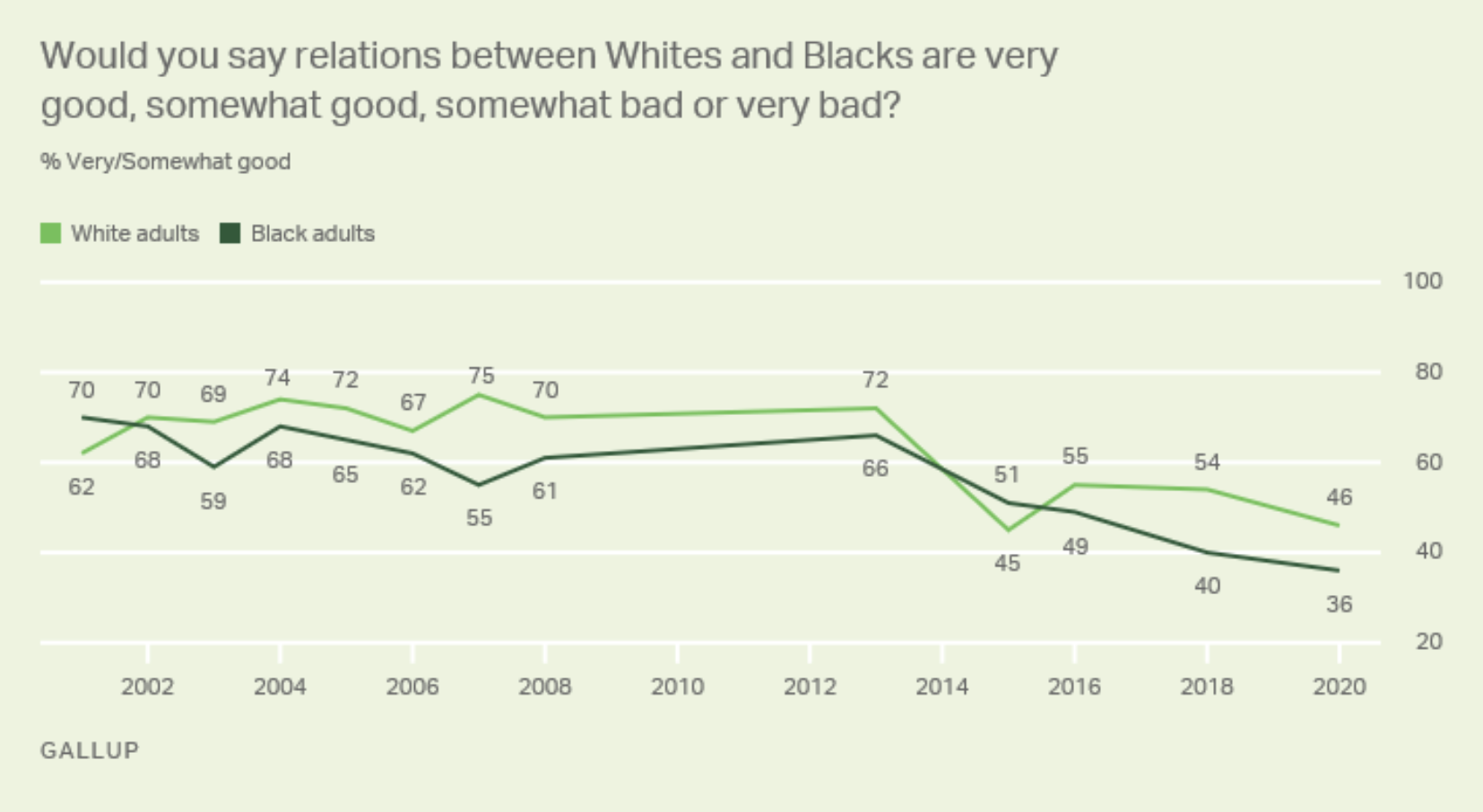
I recently read a thread on another forum in which 100 out of 140 posts declared that we became a divided nation under Trump and it was Trump's fault. I then found Gallop data that tracked opinions on race relations historically. I found it fascinating. What jumped out at me was the legacies of the last two presidents, when things began to fall apart, and the disappearance of the "No Opinion" response.

Obama, who took office in 2009 inherited a relatively united country from Bush. A majority of both blacks and whites felt similarly that race relations were "very/somewhat good." When Obama left office, a majority of both races felt that race relations were no longer "very/somewhat good." Things started falling apart around 2013 and the downward trend line simply continued under Trump. Over time, the number of people expressing no opinion shrank to near-zero.

The lines moved in parallel. Even when the gap reached 20% in 2007, both groups were still positive. Joe Biden will inherit a divided nation. If we focus on blame without understanding that this trend began in 2012, we will not reunite.

I understand that attitudes on racism are extremely complex. That said, my first significant indication of coming trouble was John Lewis's characterization of John McCain in 2008 as a "racist." I had always respected both men, and although by then I was becoming accustomed to hearing Democrats cut off debate by pointing at the nearest white Republican and yelling, "Racist!," that was unlikely to apply to McCain. He had matured in the US military, arguably one of the least racist institutions in the country.

My second indication came in 2011, when prominent civil rights leaders repeatedly proclaimed that the only reason to disagree with Obama was racism. His approval rating at inauguration was 70%. Less than three years later it was in the low 40s. One-quarter of Americans had become racists in very short order, apparently.

Bureau of Justice Statistics is not, IMO, intentionally obfuscatory, it's simply standard bureaucratic denseness. It's difficult to tease out, but the numbers don't support a narrative of black victimization at the hand of whites. Interracial violence is unusual, and while black-on-white crime is more common than the inverse, it's still relatively rare.

In 2014 Michael Brown was shot and killed by white police officer Darren Wilson in self-defense. The "hands up, don't shoot" false narrative came out of this. Some forty FBI Agents were dispatched to Ferguson, Missouri, and three White House representatives attended the funeral. The town of Ferguson was seriously damaged and the "Ferguson Effect" was born, with police officers hesitant to approach black suspects not for fear of being shot, but for fear of criminal charges.

Events occurring during the Obama presidency put U.S. race relations on a downward track. Trump, to his discredit, has only made things worse. My point is that we shouldn't be focusing on Trump alone, overlooking events from the preceding years. We need to acknowledge the longer duration and complexity of this unfortunate trend to begin to fix what has gone wrong.

Continue ReadingWhen U.S. Race Relations Soured

Misc Thoughts . . .

I'm subscribed to Greenwald and Taibbi. I haven't felt this good about being a liberal in more than a decade.

I have serious difficulty dealing with people dying from Trump Derangement Syndrome, all convinced that I am a committed Trump supporter. I'm opposed to the Far Left which styles itself Progressive, and claims it's the same thing as liberal. It is fundamentally illiberal.

A friend is a committed Christian and committed Trump supporter. He sent me a message asking if I knew what 2020 divided by 666 was. I did the math in my head, knew the answer instantly. It's 3.0330. I replied that I had no idea that God was limited to Base 10. He's furious. Just assume for a second that there is a God. Why would he ever use Base 10? Binary or Base Eight is infinitely more sensible.

As you know, there are 10 kinds of people: Those who understand binary, and those who don't.

Continue ReadingMisc Thoughts . . .

Daniel Dennett’s Technique for Criticizing a Position

I'm reading Intuition Pumps and Other Tools for Thinking, by Daniel Dennett (2013). This approach for criticizing a claim caught my eye:

How to compose a successful critical commentary:

1. You should attempt to re-express your target’s position so clearly, vividly, and fairly that your target says, “Thanks, I wish I’d thought of putting it that way.” 2. You should list any points of agreement (especially if they are not matters of general or widespread agreement). 3. You should mention anything you have learned from your target. 4. Only then are you permitted to say so much as a word of rebuttal or criticism.

One immediate effect of following these rules is that your targets will be a receptive audience for your criticism: you have already shown that you understand their positions as well as they do, and have demonstrated good judgment (you agree with them on some important matters and have even been persuaded by something they said).

This passage is at page 33.

Continue ReadingDaniel Dennett’s Technique for Criticizing a Position

Tristan Harris and Joe Rogan Discuss “The Social Dilemma” in Depth

Tristan Harris:

The film, "The Social Dilemma," is really about how it makes the worst of us rise to the top, right, so our hate, our outrage, our polarization, what we disagree about, black and white thinking, more conspiracy-oriented views of the world Qanon, Facebook groups, things like--that and i can we can definitely go into there's a lot of legitimate conspiracy theories i want to make sure I'm not categorically dismissing stuff--the point is that we have landed in a world where the things that we are paying attention to are not necessarily the agenda of topics that we would say in a reflective world is most important.

Joe Rogan:

There's a lot of conversation about free will and about letting people choose whatever they choose, whatever they enjoy viewing and watching and paying attention to, but when you're talking about these incredibly potent algorithms and the incredibly potent addictions that the people develop to these these things . . . and we're pretending that people should have the ability to just ignore it and put it away right and use your willpower.

--

Joe Rogan Look at this [pointing to website news], Apple working on its own search engine as Google ties to be cut soon. I started using DuckDuckGo for that very reason. Just because they don't do anything with [your data]. You know, they give you the information, but they don't they don't take your data and do anything with it.

Tristan Harris Let's say we get all the privacy stuff perfectly, perfectly right, and data protection and data controls and all that stuff. In a system that's still based on attention, in grabbing attention and harvesting and strip mining our brains, you still get maximum polarization, addiction, mental health problems, isolation, teen depression, suicide, polarization, breakdown of truth, right? So we really focus in our work on those topics because that's the direct influence of the business model on warping society.

We need to name this mind-warp when we think of it, like "the climate change of culture. We think these seem like different disconnected topics, much like with climate change. You'd say like, Okay, we've got species loss in the Amazon, we're losing insects, we've got melting glaciers, we've got ocean acidification, we've got the coral reefs dying, these can feel like disconnected things, until you have a unified model of how emissions change all those different phenomena, right? In the social fabric, we have shortening of attention spans, we have more outrage driven news media, we have more polarization, we have more breakdown of truth, we have more conspiracy-minded thinking. These seem like separate events, and separate phenomena, but they're actually all part of this attention extraction paradigm, that the company's growth--as you said--depends on, extracting more of our attention, which means more polarization, more extreme material, more conspiracy thinking and shortening attention spans.

Because we also say if we want to double the size of the attention economy, I want your attention to be split into two separate streams. Like I want you watching the TV, the tablet and the phone at the same time, because now I've tripled the size of the amount of extractable attention that I can get for advertisers, which means that by fracking for attention and splitting you into more junk, so attention that's "thinner." We can sell that as if it's real attention, like the financial crisis, where you're selling thinner and thinner financial assets as if it's real, but it's really just a junk asset.

And that's kind of where we are now, where it's sort of the junk attention economy. Because we were we have shortened attention spans and we're debasing the substrate of that makes up our society because everything in a democracy depends on individual sense-making and meaningful choice, meaningful for you, meaningful independent views. But if that's all basically sold to the highest bidder that debases the soil from which independent views grow, because all of us are jacked into this sort of matrix of social media manipulation, that's ruining integrating our democracy. And that's really, there's many other things that are ruining and hurting our democracy. That's a sort of invisible force, it's upstream, that affects every other thing downstream. Because if we can't agree on what's true, for example, we can't solve any problem.

Joe Rogan Your organization highlights all these issues in an amazing way. And it's very important. But do you have any solutions?

Tristan Harris It's hard, right? So I just want to say that this is as complex a problem as climate change, in the sense that you need to change the business model. I think of it like we're on the fossil fuel economy and we have to switch to something beyond that thing, right? Because so long as the business models of these companies depend on extracting attention, can you expect them to do something different?

Joe Rogan You can't, but how could you? There's so much money involved and now they've accumulated so much wealth that they have an amazing amount of influence.

Tristan Harris And the asymmetric influence, can buy lobbyists, can influence Congress and prevent things from happening. I think we're seeing signs of real change. We had the antitrust case that was just filed against Google. In Congress. We were seeing more hearings . . .

Continue ReadingTristan Harris and Joe Rogan Discuss “The Social Dilemma” in Depth