
The Experts are Now Certain that COVID Infection is Rare Via Surface Contamination

The evidence, we are now told, is strong that COVID infection through surface contamination is rare. How long now before we repurpose some of those surface sanitizers and double down on better ventilation? But not so fast . . .

Do you remember some of those early videos where doctors warned that we "must" wipe down all of our groceries with sanitizer or let them sit for three days? I know it was all well intended, but looking back, it is striking that this expert advice, like so much other advice we've heard from the "experts" on COVID and the economy, was delivered earnestly, confidently and (now we know) wrongly. In short, bad advice looks a lot like good advice. The experts rolled out for public presentations are always confident that they are correct. I suspect that this is the Dunning-Kruger effect in action.

That said, the following excerpt is from a Feb 2, 2021 article in Nature, "Coronavirus is in the air — there’s too much focus on surfaces: Catching the coronavirus from surfaces is rare. The World Health Organization and national public-health agencies need to clarify their advice":

A year into the pandemic, the evidence is now clear. The coronavirus SARS-CoV-2 is transmitted predominantly through the air — by people talking and breathing out large droplets and small particles called aerosols. Catching the virus from surfaces — although plausible — seems to be rare (E. Goldman Lancet Infect. Dis. 20, 892–893; 2020). Despite this, some public-health agencies still emphasize that surfaces pose a threat and should be disinfected frequently. The result is a confusing public message when clear guidance is needed on how to prioritize efforts to prevent the virus spreading.

This lack of clarity about the risks of fomites — compared with the much bigger risk posed by transmission through the air — has serious implications. People and organizations continue to prioritize costly disinfection efforts, when they could be putting more resources into emphasizing the importance of masks, and investigating measures to improve ventilation. The latter will be more complex but could make more of a difference.
I'm still going to wash my hands after being in a public place. I'll do that because It's such a simple measure and there are other germs out there in addition to COVID, but I'll be doing it with increased suspicion that this effort is unnecessary. I'm also looking forward to getting a vaccine--I've registered with the City of St. Louis and with two hospitals, but I'm not a priority. I'll probably be waiting for many months. I hope anyone reading this has better luck with getting the vaccine . . .

Continue ReadingThe Experts are Now Certain that COVID Infection is Rare Via Surface Contamination

“Follow the Science” is not a Panacea

At Quillette, Ilana Redstone thinks science is a very good thing, but wonders why so many of our disputes are not solved by the adage "Follow the Science." This is a thoughtful article well worth a read. Here's an excerpt from "Why ‘Just Follow the Science’ Won’t Solve All Our Problems":

I’m not arguing that there’s no truth out there. For many issues, there is—although we could certainly do a better job of recognizing when we simply don’t know what that truth is yet. And for issues that touch on morality and ideology, in particular—often topics on which opposing sides all claim the mantle of science—we might do well to pause before digging in our heels. Sometimes, what we have isn’t “science” per se, but rather a strong conviction tethered to a set of scientific data and propositions. True dialogue requires a willingness to recognize that occasionally our opponents do, too.

Continue Reading“Follow the Science” is not a Panacea

The Many Dangers of Loneliness

For months, I have been contemplating the destructiveness of the COVID pandemic, including the pain many people are feeling from loneliness. How dangerous is loneliness? Tonight I spotted this quote by Dr. Vivek Murthy:

During my years caring for patients, the most common pathology I saw was not heart disease or diabetes; it was loneliness. Loneliness and weak social connections are associated with a reduction in lifespan similar to that caused by smoking fifteen cigarettes a day and even greater than that associated with obesity. Loneliness is also associated with a greater risk of cardiovascular disease, dementia, depression, and anxiety. At work, loneliness reduces task performance, limits creativity, and impairs other aspects of executive function such as reasoning and decision making. For our health and our work, it is imperative that we address the loneliness epidemic quickly.

Continue ReadingThe Many Dangers of Loneliness

Chloé Valdary’s Kind, Gentle and Honest Diversity Program

Are you tired of hearing about the bullying, divisiveness and unvarnished bigotry pushed by many players in the diversity, equity, and inclusion industry? Players like Robin DiAngelo and Ibram X. Kendi, who freely misrepresent the facts and statistics and hide behind abstruse terminology?

Are you frustrated that many so-called programs in the booming diversity industry completely fill the time of their sessions with preaching and refuse to leave any time for questions and criticisms from the audience? That is what I've noticed about two recent mandated continuing education diversity programs I attended (now required for all lawyers in Missouri).

I'm not claiming that all diversity programs are deficient. I don't know enough about all diversity programs. Based on many programs about which I am familiar, however (including programs like this), this is an industry that needs to be vigorously investigated for its numerous lapses in integrity. No doubt we live in a country that includes racists, but the extent to which these increasingly popular "diversity" programs solve the problem (rather than making things worse) is a troubling question.

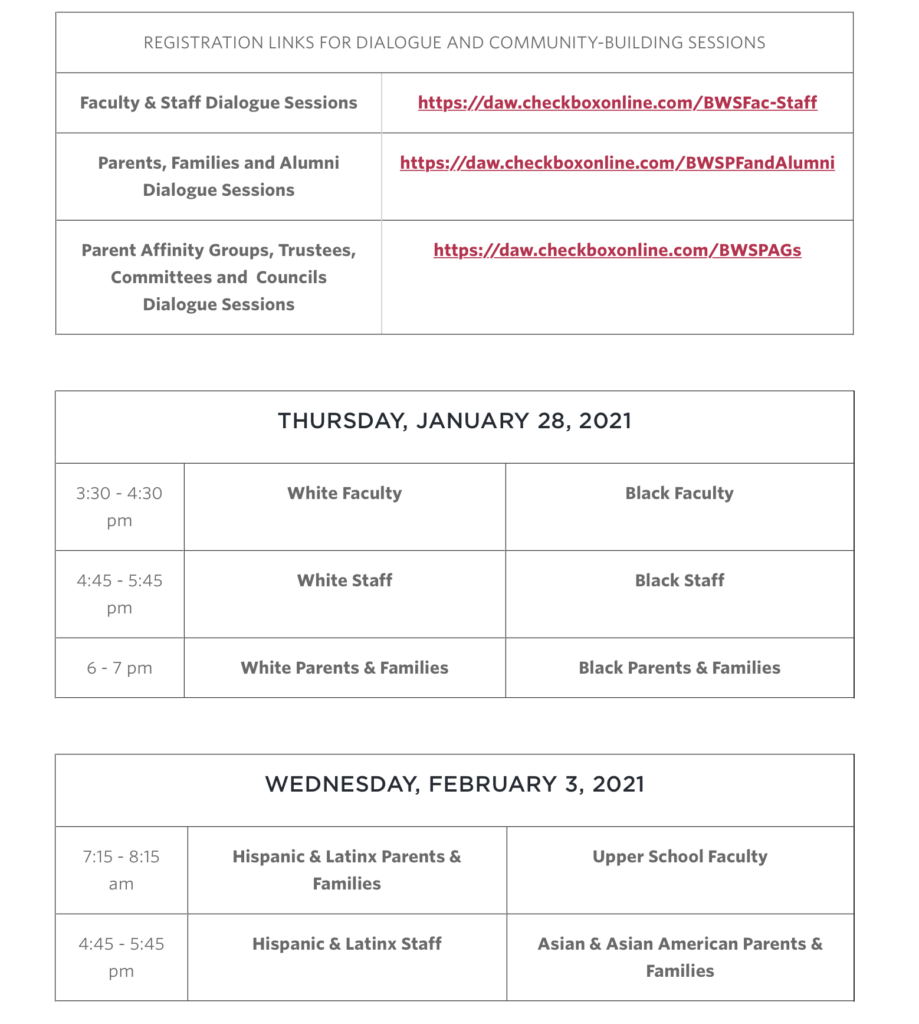
Are you dismayed that today's social justice warriors and critical race theorists have abandoned and ridiculed Martin Luther King's dream for a color blind society? So am I, and many "diversity" programs also ridicule MLK's dream. I've learned of several programs that explicitly segregate the participants by skin color. Here is a recent instance, the Brentwood School in Los Angeles:

And especially if you have had your fill of the types of "diversity" programs exposed by Christopher Rufo, you'll find this article in The Atlantic to be a breath of fresh air: "Can Chloé Valdary Sell Skeptics on DEI? Valdary’s Theory of Enchantment elicits unusual openness, trust, and engagement from ideologically diverse observers." Here is an excerpt:

Chloé Valdary is the founder of Theory of Enchantment, a diversity and resilience training company that the 27-year-old African American entrepreneur runs from Downtown Brooklyn. Its website lists clients including TikTok, WeWork, the Federal Aviation Administration, and Greenwich High School, and asks potential customers a loaded question: “Looking for an antiracism program that actually fights bigotry instead of spreading it?” . . .

Three principles guide all of the coursework [Chloé Valdary's] company offers:

    • Treat people like human beings, not political abstractions.
    • Criticize to uplift and empower, never to tear down, never to destroy.
    • Root everything you do in love and compassion.

Continue ReadingChloé Valdary’s Kind, Gentle and Honest Diversity Program