Hearing damage and iPods
To what extent is your hearing at risk when you listen to an iPod? As you might expect, it depends on how loud you play it and for how long. Here's the data.

To what extent is your hearing at risk when you listen to an iPod? As you might expect, it depends on how loud you play it and for how long. Here's the data.
Over the past three years of writing for DI, I have discussed evolution with many creationists who have posted comments at this site. These exchanges have been good for me. They have forced me to think harder about exactly what it is that I understand about evolution and what evidence supports my understanding. These exchanges have also helped me to understand the concerns and mental gymnastics of creationists. I now find myself getting increasingly impatient with the creationists, however. It was initially interesting to banter with creationists because I enjoyed the challenge of trying to understand why they claimed the things they claimed. I’m now getting annoyed with these creationists arguments, and it mostly has to do with the refusal of creationists to acknowledge relevant scientific observations from the real world. My frustration also stems from the anti-scientific mindset of creationists. As a group, creationists refuse to argue even-handedly. They become skeptical only when it suits their immediate needs—they don’t apply skepticism equally both to their own claims and to the claims of those with whom they disagree. As a group, they scurry to find disingenuous arguments to support points that they actually learned in churches, not in science books. Many of them are consciously dishonest, and when you call attention to their obvious untruths, they try to change the subject. There are exceptions to this rule. There are some creationists who aren’t consciously being dishonest, but those creationists tend to be so incredibly ignorant of the principles of the scientific theory of evolution that they lack the ability to meaningfully criticize evolution. Their arguments are aimed at things that no competent scientist has ever claimed. For numerous excellent examples of this problem, see these videos by AronRa here and here. It is well-established that humans are susceptible to committing errors caused by the confirmation bias. We seek out evidence that supports our current beliefs. Scientists are imminently aware of this danger and they work hard to design experiments to counteract this bias. Creationists (who don’t even try to run experiments) excel at feeding their confirmation biases. They proudly exclude evidence that threatens their opinions. Creationists come to mind when I consider David Hume’s quote: “Reason is and ought only to be the slave of the passions, and can never pretend to any other office than to serve and obey them.” [A Treatise of Human Nature, (2nd Ed.), Book II, Part I, Section III (“Of the influencing motives of the will”) (1739)].
Why is this fire hydrant in the middle of Forest Park, in St. Louis, Missouri? Is it there for the firefighters in case an ant hill catches fire? A flower?
If I used the logic employed by Creationists, I might simply say that God put that fire hydrant there. To the extent that anyone accepts such an explanation, there would be no need for further inquiry (nor any real possibility for further inquiry).
To the extent that someone accepts the "explanation" that "God did it," he or she would miss out on a rich factual history, teaming with direct evidence upon which one can build an incredibly strong circumstantial case. One really can explain the presence of this hydrant, even without direct evidence (presumably, no one who saw this hydrant being installed is still alive).
I'm working on a post regarding creationism (including its modern version, "intelligent design"). Yesterday's walk in the park reminded me that circumstantial evidence can be strong, indeed. In fact, circumstantial evidence can make for airtight cases. Circumstantial evidence can even be much stronger than authority (because authorities--e.g., the park police--are often wrong). Therefore, people who really want to know don't simply throw up their hands and declare that the hydrant is there "Because God put it there" even when a person in a position of authority tells them this story.
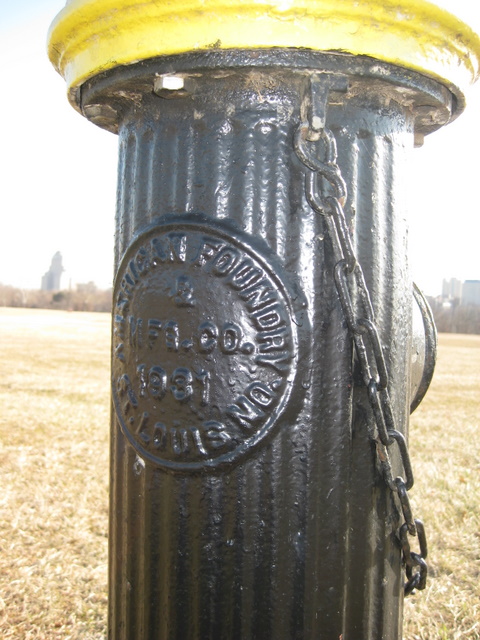 An inspection of this hydrant shows that it was manufactured in 1887 (or is that number 1881?). It was thus installed sometime after 1881. Why would it be installed in the middle of a park? Perhaps it wasn't just a park back then. Perhaps it was installed because that land was to be the location of a huge construction project: the 1904 World's Fair held in St. Louis. Perhaps, after the Fair was over, this hydrant was not removed. Perhaps there are some photos of the Fair that would include this little fire hydrant, a vestigial reminder that something much more elaborate once occupied this place. All of these questions can be answered if one takes the time to examine real evidence that is currently available. If one looked further for evidence, one would find tons of corroboration, including a huge "Flight Cage" that now houses a bird exhibit at the St. Louis Zoo, also an original part of the 1904 World's Fair. Of course, one could also find numerous books filled with photos, names, dates and interviews. Notice that I'm referring to corroborative written materials--many sources that overlap--not simply reading one book over and over until one is more and more convinced.
Creationists are happy to employ these open-minded investigative methods almost always, in almost every aspect of their lives. This method of asking questions and then following the evidence wherever it leads is actually an extension of common sense. It's a shame that when it comes to one particular incredibly important aspect of their lives, determining what kind of beings we are, creationists refuse to use this direct extension of common sense.
Ron Paul made an impassioned speech today. One of his points is that we can't simply re-inflate the bubble. He further claimed that we certainly can't solve our crisis by attempting to create "capital" with a printing press. He claims that we are at a sea change, and that we need to learn to live within our means. He's got my attention.
Based on a new study reported by the NYT, people who do things badly
are usually supremely confident of their abilities -- more confident, in fact, than people who do things well.
Humor-impaired joke-tellers rated themselves as funny . . .
One reason that the ignorant also tend to be the blissfully self-assured, the researchers believe, is that the skills required for competence often are the same skills necessary to recognize competence.
It would seem, then, that you shouldn't ever ask someone whether they are good at what they do. This is a good reason to downplay the importance of oral interviews.