Halloween: Whence the pursuit of horror?

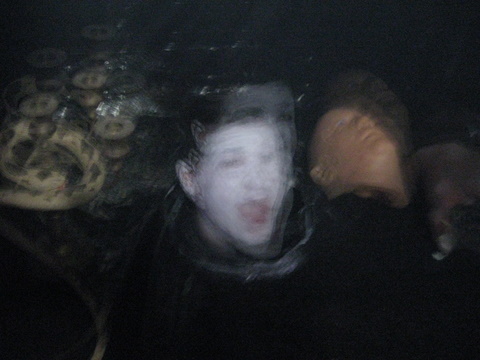
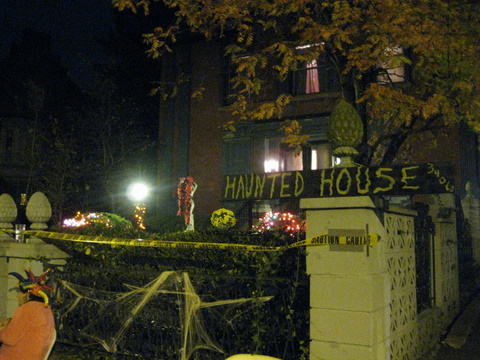
Some of the neighborhoods near my house in St. Louis have already celebrated Halloween. For instance, my street celebrates Halloween on the Sunday afternoon prior to Halloween. Celebrating in the daylight makes it easier for us to visit with little neighborhood children and their parents. The nearby Compton Heights neighborhood celebrates Halloween on the Saturday night prior to Halloween. Our family was invited to venture over to Compton Heights a few nights ago, and we weren’t disappointed. head Amidst all of the traditional candy-giving, we stumbled upon one particular house where the family had put together its own haunted house. The family owns a big old house, but also owns a separate large two-story carriage house in the back. They hired an electrician to wire up the carriage house with sophisticated lighting and they assembled a team of 20 friends and family to pose as various types of dead people inside the house. Not typical dead people, mind you. Dead people who stand still in the dim lighting and come alive just when you are convinced that they are mannequins (and there were quite a few mannequins too, some of them dismembered). When selected dead people came alive, they yelped, or they screamed; some of them reached out and grabbed you. There were ghouls and ghosts, a vampire, a mummy, floating bones, a guy with a “chainsaw,” and a beheaded guy who suddenly moaned, all of this horror looking rather real and all of these characters lurking carefully amidst the dim lighting as we toured this incredible house. front-of-haunted-houseEach of the photos in this post is from this house. Note that it’s not always easy to take photos in a darkly lit haunted house. While I was taking a photo of a decapitated head on a table, for instance, a dead man reached out and tugged on my sleeve, smudging the long exposure. How good was it? I stood outside for 30 minutes after I toured the haunted house, and every ten minutes or so, I saw a panicky grown child running from the haunted house crying. Bravo! I then learned that the haunted house family has been putting on this magnificent show, for free, for 15 years. Double Bravo! But as I walked away from the haunted house, I wondered two things.
Continue ReadingHalloween: Whence the pursuit of horror?

The Monsanto monster

Monsanto has been a target for many years. They have a terrible environmental and health record, they have harassed small farmers for years, they've bribed officials in Indonesia, and they've joked about performing "rural cleansing" (a play on the words "ethnic cleansing", i.e. genocide), and told small seed cleaners that rather than buy them out, "We'd rather put you out of business, it's more fun that way." All this from the company that brought Agent Orange to Vietnam, resulting in 400,000 deaths and disabilities, as well as 500,000 children born with birth defects. However, in the world of corporate PR, no sin is too big. Monsanto has sought to remake its image as the company that's helping to feed the world. Their website claims that "We apply innovation and technology to help farmers around the world produce more while conserving more. We help farmers grow yield sustainably so they can be successful, produce healthier foods, better animal feeds and more fiber, while also reducing agriculture's impact on our environment." High claims, to be sure. Too bad we don't know if they hold up to scrutiny. A new article by the editors of Scientific American explains the situation:

To purchase genetically modified seeds, a customer must sign an agreement that limits what can be done with them. (If you have installed software recently, you will recognize the concept of the end-user agreement.) Agreements are considered necessary to protect a company’s intellectual property, and they justifiably preclude the replication of the genetic enhancements that make the seeds unique. But agritech companies such as Monsanto, Pioneer and Syngenta go further. For a decade their user agreements have explicitly forbidden the use of the seeds for any independent research. Under the threat of litigation, scientists cannot test a seed to explore the different conditions under which it thrives or fails. They cannot compare seeds from one company against those from another company. And perhaps most important, they cannot examine whether the genetically modified crops lead to unintended environmental side effects.

Continue ReadingThe Monsanto monster

If the Methodists can do it, why can’t everyone?

While shooting footage for a documentary in Brooklyn this past weekend I came upon this sign outside of a Methodist church and felt compelled to share it with you. It made me feel good to see tolerance so boldly stated. parkslope2

Continue ReadingIf the Methodists can do it, why can’t everyone?

What if there weren’t any other living great apes?

During my recent visit to the St. Louis Zoo, I wondered how it would have been had humans been the only species of great ape still alive on the planet. I suspect that there would have been quite a few preachers out there suggesting that the animals represented by the fossils of other species of great apes were not at all similar to humans. I can imagine them preaching with great confidence that there wasn't any credible evidence that any other living animal was ever remotely similar to humans in physical appearance or facial expressions, regardless of the fossils. Image by Erich Vieth They would call it laughable to suggest that any other species of great ape was a tool user, or that any other species of great ape exhibited emotions akin to those displayed by humans. And they would have argued without any doubt that it was silly to suggest that communities of the other great apes would have ever exhibited such things as reconciliation, empathy and proto-morality.

Continue ReadingWhat if there weren’t any other living great apes?