
Another dose of quotes

A reader named Mike Baker kindly sent me a huge batch of terrific quotes that he has been gathering. Here's a sampling, the first of several, from Mike's collection: There is one tradition in America I am proud to inherit. It is our first freedom and the truest expression of our Americanism: the ability to dissent without fear. It is our right to utter the words, "I disagree." We must feel at liberty to speak those words to our neighbors, our clergy, our educators, our news media, our lawmakers and, above all, to the one among us we elect President. - The Nation (15 July 1991) "Americans are the best entertained and the least informed people in the world." --Neil Postman, author, and from Amusing Ourselves to Death, Penguin Books, 1985 "It is difficult to produce a television documentary that is both incisive and probing when every twelve minutes one is interrupted by twelve dancing rabbits singing about toilet paper." - Rod Serling "By far the most dangerous foe we have to fight is apathy - indifference from whatever cause, not from a lack of knowledge, but from carelessness, from absorption in other pursuits, from a contempt bred of self satisfaction" ~ William Osler (Canadian Physician, 1849-1919) "Apathy is the glove into which evil slips its hand." ~ Bodie Thoene “How can we worship a homeless man on Sunday and ignore one on Monday” – Anonymous The important thing is this: To be able at any moment to sacrifice what we are for what we could become. ~ Charles DuBois “We must become the change we want to see in the world” ~ Mohatma Gandhi Happiness in intelligent people is the rarest thing I know. Ernest Hemingway (1899 - 1961) Too many people spend money they haven't earned, to buy things they don't want, to impress people they don't like. - Will Rogers Unthinking respect for authority is the greatest enemy of truth. ~Albert Einstein The death of democracy is not likely to be an assassination from ambush. It will be a slow extinction from apathy, indifference, and undernourishment. ~ Robert M. Hutchins "Your failure to be informed, does not make me a wacko." --John Loeffler, host Steel on Steel radio program It is the duty of the patriot to protect his country from his government. —Thomas Paine The price of apathy towards public affairs is to be ruled by evil men. ~ Plato "Most Americans aren't the sort of citizens the Founding Fathers expected; they are contented serfs. Far from being active critics of government, they assume that its might makes it right." Joseph Sobran (1946- ) Columnist It may well be that our means are fairly limited and our possibilities restricted when it comes to applying pressure on our government. But is this a reason to do nothing? Despair is not an answer. Neither is resignation. Resignation only leads to indifference, which is not merely a sin but a punishment. ~ Elie Wiesel

Continue ReadingAnother dose of quotes

Skin color as evidence of natural selection

In this TED talk, author Nina Jablonski (Skin: A Natural History) suggests that whenever someone demands proof of evolution by natural selection, you should roll up your sleeve and show them your skin color. You carry this evidence around with you every day. You should point out that skin color changes depending on where one's ancestors lived. Check out the dramatic world map image at about 4:20 of the video. Darker skin colors can be found near the equator and lighter skin colors abound in higher latitudes. There is a fundamental and undeniable relation between skin color and latitude. But that is just the beginning of her story. We all have melanin: nature's sunscreen. It protected equatorial people from harmful UVB rays, but nonetheless allowed their skin to produce vitamin D, which is now recognized as essential for proper skin, bones and immune system function. When humans moved to higher latitudes, their skin tones lighted up to allow better production of Vitamin D. Jablonski warns, however, that the angle at which sunlight hits the earth at higher latitudes blocks most UVB rays, allowing only UBA rays which cannot produce Vitamin D. Hence, those of us living in the northern latitudes, no matter what our skin color but especially those of us who work indoors, are at risk for lack of vitamin D. She urges doctors to do a better job warning patients in higher latitudes about the potential damage to skin, bones and immune system caused by their lack of vitamin D.

Continue ReadingSkin color as evidence of natural selection

Carried away in Cincinnati

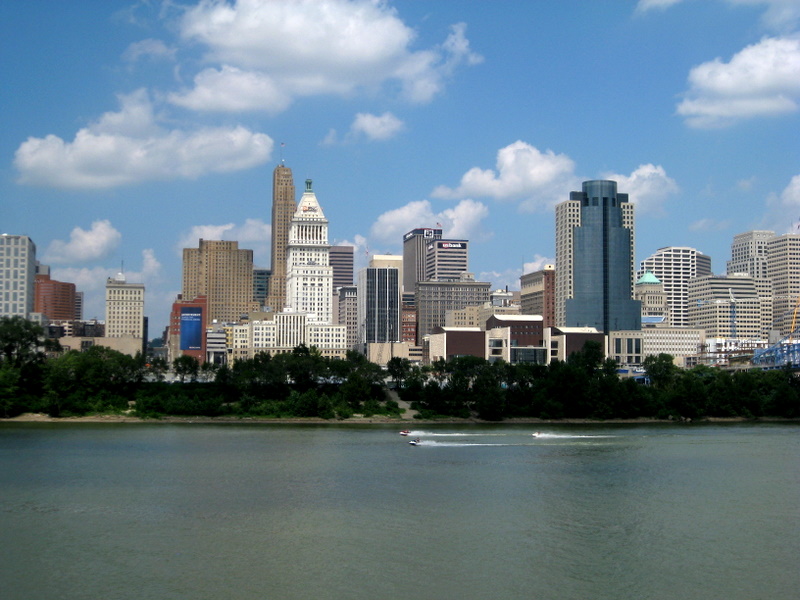
I was doing business in Cincinnati yesterday and today. It's a notably friendly city (I'm not being facetious) with a beautiful riverfront. The airport is only a few miles from the infamous Creation Museum. I was tempted to visit, but I really didn't want to hand over a big chunk of money, which would further encourage the gaudy intellectual dysfunction on display. Others have already done a thorough job of exposing the silliness. On a related note, a friend of mine stated that a few weeks ago, Cincinnati's well-touted Underground Railroad Museum was almost empty. After driving out to the Creation Museum (on that same day), he noticed that the Creation Museum's parking lot was packed with upward of 300 vehicles. Perhaps it is my iconoclastic attitude that instigated this rather unusual cloud formation, also near the airport. Was it a supernatural being trying to tell me something? Or maybe nature was rebelling because of my unrestrained love of hamburgers? It was in Kentucky, just south across the river from Cincinnati that I got carried away with my craving for burgers, though Big Boy maintained his goofy grin as I tried to take that big burger.

Continue ReadingCarried away in Cincinnati

Matt Taibbi: What Wall Street accomplished

Through his hard-charging and entertaining investigative pieces in Rolling Stone, Matt Taibbi has repeated snuffed out that little spark of hopefulness in me. His latest article in Rolling Stone was the most crushing of all: "Wall Street's Big Win: Finance reform won't stop the high-risk gambling that wrecked the economy - and Republicans aren't the only ones to blame." Taibbi proposes that the recent Wall Street "reform" fixed about 10% of the problem, and that it was designed primarily to cover up an uncomfortable political truth:

The huge profits that Wall Street earned in the past decade were driven in large part by a single, far-reaching scheme, one in which bankers, home lenders and other players exploited loopholes in the system to magically transform subprime home borrowers into AAA investments, sell them off to unsuspecting pension funds and foreign trade unions and other suckers, then multiply their score by leveraging their phony-baloney deals over and over. It was pure ­financial alchemy – turning ­manure into gold, then spinning it Rumpelstiltskin-style into vast profits using complex, mostly unregulated new instruments that almost no one outside of a few experts in the field really understood. With the government borrowing mountains of Chinese and Saudi cash to fight two crazy wars, and the domestic manufacturing base mostly vanished overseas, this massive fraud for all intents and purposes was the American economy in the 2000s; we were a nation subsisting on an elaborate check-­bouncing scheme. And it was all made possible by two major deregulatory moves from the Clinton era: the Gramm-Leach-Bliley Act of 1999, which allowed investment banks, insurance companies and commercial banks to merge, and the Commodity Futures Modernization Act of 2000, which ­exempted the entire derivatives market from federal regulation. Together, these two laws transformed Wall Street into a giant casino, allowing commercial banks to act like high-risk hedge funds, with a whole new galaxy of derivative bets to lay action on. In fact, the laws made Wall Street even crazier than a casino, because in a casino you have to put up actual money to make bets. But thanks to deregulation, financial companies like AIG could bet billions, if not trillions, without having any money at all to back up their gambles.
The Republicans are to blame, right? That's only half right. Consider what happened to the "Volcker rule," a proposal designed to restore the firewall between investment houses and commercial banks. It never had a chance . . . [More . . . ]

Continue ReadingMatt Taibbi: What Wall Street accomplished

Most Americans: no concerns with slow internet connections

Apparently, most Americans are OK with the idea that many Americans have slow internet connections:

A majority of Americans believe the government's plan to deliver a high speed internet connection to every citizen by 2020 is either not important or should not be embarked upon.The Pew Internet Project said 52% of survey respondents felt that way while 40% felt the issue was a top priority.

Keep in mind that the $7.2 Billion in stimulus grants dedicated to national broadband are the equivalent of only a few weeks of funding for the American adventures in Afghanistan. Keep in mind that this $7.2 Billion stimulus is far less than 1% of the U.S. in defense spending for 2010.

Continue ReadingMost Americans: no concerns with slow internet connections