
Why are Journalists Demanding More Censorship?

Why are Journalists Demanding More Censorship?

Michael Shellenberger writes at Public:

The reason that many in the media demand censorship is because they believe it is in their self-interest to do so. Many journalists want censorship for the same reason as their owners: to protect their market share.

These are likely to be journalists who believe that they cannot make a living as independent journalists and must instead work for a large media corporation whose revenue comes from large corporate advertisers. Pro-censorship journalists are thus likely to be more insecure, more envious of successful independent journalists, and more deferential to governmental and corporate authority.

And the pro-censorship journalists are likely to be the most dogmatically Woke activist journalists. TikTok banned ads by a new athletic clothing company, XX-XY Athletics, started by the former COO of Levi, Jennifer Sey, because her company recognizes the reality of biological sex. TikTok banned Riley Gaines, the collegiate swimmer trying to protect girls’ and women’s sports. And Meta has blocked pro-female sports posts and hashtags, including ones critical of the victory of a biological male in this summer’s Olympics.

Meanwhile, the platforms allow the promotion of the trans agenda. TikTok allows ads for minors to perform irreversible surgeries. As such, it is censoring the truth and demanding that the public believe the lie that physically different trans-identified boys and men can and should participate fairly and equally in girls’ and women’s sports.

Ultimately, what motivates governments, the news media, and societal elites to continue to demand more censorship? Some of it has to do with plain ignorance as to what is constitutional and what is unconstitutional. Some of it is Woke dogma. Another part of it is the fear that societal elites have of losing control of the government, the economy, and society. As for the professional journalists and editors who demand censorship, their main motivation appears to be envy of free thinkers who have attracted an audience because they had something to say and the courage to say it.

Continue ReadingWhy are Journalists Demanding More Censorship?

The Elites are Increasingly Saying What They Are Thinking.

They are increasingly saying the quiet part out loud. The problem is that too many Americans want to think for themselves and they think that they are in some sort of democracy. And then there is that damned First Amendment that keeps us elites from controlling all the information.

I fear that they are brashly saying these things because they are confident that they are about to take down X (Twitter), which would mean they actually would control essentially all national dialogue.

Continue ReadingThe Elites are Increasingly Saying What They Are Thinking.

Because We Needed More Dangerous People in the United States

Totally unvetted immigration. We need immigration to keep American strong, but not this type.

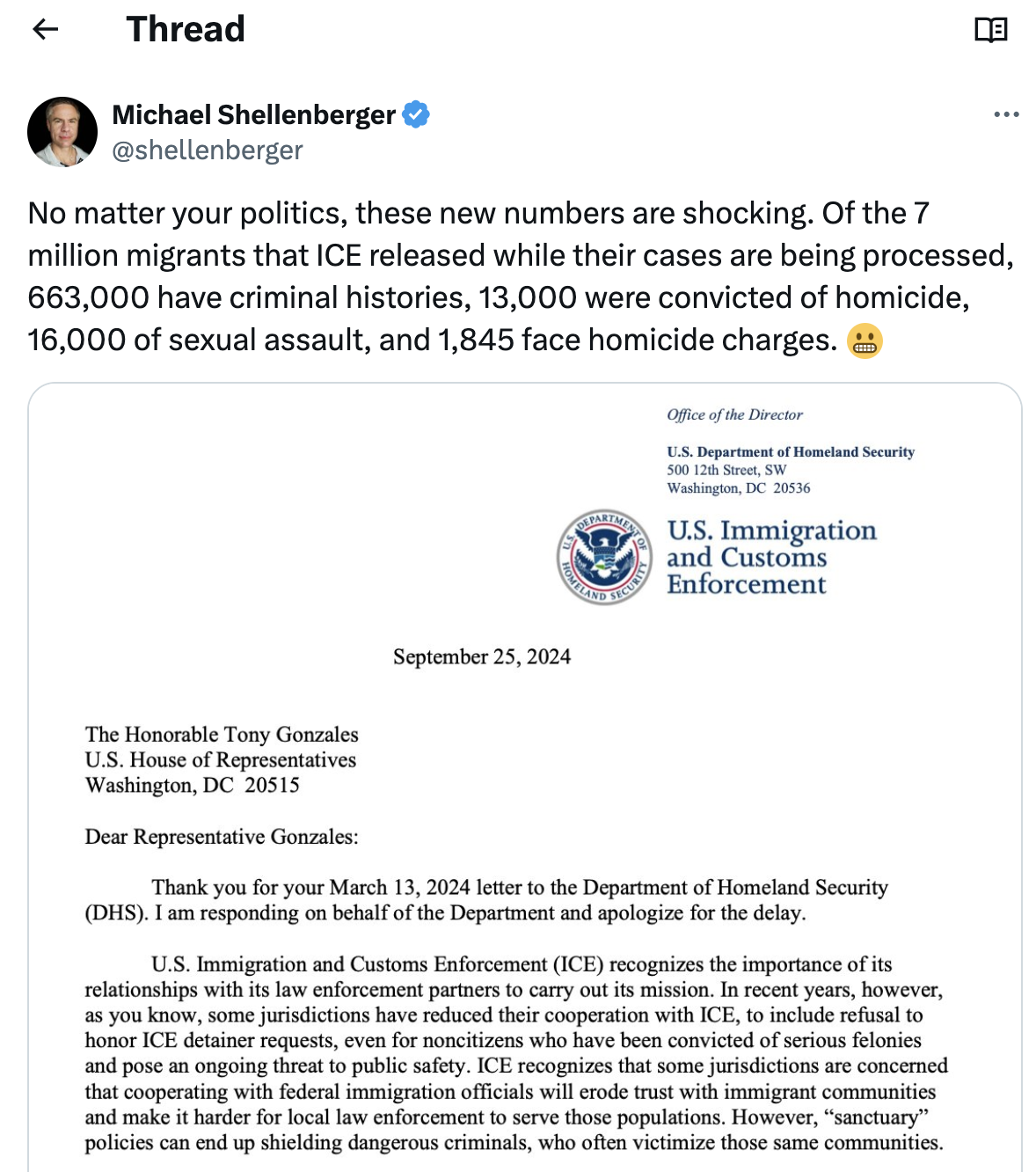
Michael Shellenberger: "No matter your politics, these new numbers are shocking. Of the 7 million migrants that ICE released while their cases are being processed, 663,000 have criminal histories, 13,000 were convicted of homicide, 16,000 of sexual assault, and 1,845 face homicide charges."

Continue ReadingBecause We Needed More Dangerous People in the United States

Immigration: Who and How Much?

Christopher Rufo asks these two questions regarding immigration. I agree with his positions. What follows is an excerpt. Full article here.

Yes, all men are born equal—that is, they are all born with the same human fundamentals—but this does not imply that all cultures, or civilizations, are equal. Culture is the product of tradition, not unmediated nature. Among the principles that cultures adopt and inculcate in their members, some are better, others are worse; some are compatible with America’s traditions, some are not. For American immigration policy, this means that the “who” matters.

The question of “who” has historically involved considering migrants’ national origin. A more refined approach would include other characteristics, such as educational attainment, employment history, language skills, and cultural values. The United States, which has an interest in admitting immigrants capable of integration and economic productivity, is well within its rights to prefer, say, an English-speaking software developer from Venezuela over a violent, uneducated gang member from the same country.

On the same principle, we must acknowledge that immigrants from some cultures are more capable than others of assimilating to America. In much of the Muslim world, for example, majorities believe that honor killings are justified and that Sharia law ought to be enforced by the state. While many Muslim immigrants embrace Western values, some emphatically reject them, as demonstrated by the widespread pro-Hamas protests that have broken out in the aftermath of the October 7 massacre in Israel. Pluralism is valuable, but it has limits, and America ought to select newcomers who share its core values.

The next question is “how.” The answer is not to be found at our southern border today, which has become an anarchic, free-for-all zone. While there will always be some degree of undocumented migration—the United States is, after all, still the land of opportunity—the numbers we have seen in recent years are unprecedented. Americans have the right to insist on a rational, orderly process of immigration, with clearly defined standards and a carefully crafted selection process.

The final question is “how much.”

Continue ReadingImmigration: Who and How Much?