What to feel humble? Consider the ultra-deep field in 3D
My favorite line in this short video discussing deep field images: These images are all contained in an area as big as a grain of sand at arm's length.

My favorite line in this short video discussing deep field images: These images are all contained in an area as big as a grain of sand at arm's length.
At Media Matters, Eric Boehlert discussed FOX "news" with a former employee of FOX. Bottom line, FOX "news" is not "news" at all. Disturbing, if not unsurprising, insider observations about the total lack of objectivity.
I think that this useful article is misnamed. It's called "10 ways you know you're with smart people," but I don't think of people as "smart" unless they are hard-working, they have kind hearts and they know how to work well with those around them. I've repeatedly learned over the years to simply being "smart" doesn't cut it. Ever. Further, I don't think that the items in the list ways to necessarily know you're with "smart" people. What it does seem to be is a good collection of some of the important characteristics of highly functional people. I haven't always worked with highly functional people, but I've noticed the characteristics of the article's list in the people I currently work with (I'm fortunate to work with a highly regarded law firm in St. Louis). Every day is an exciting and rewarding (sometimes exhausting) experience, and we have a lot to show for our efforts. But very little of this could have happened simply by having "smart" people around. It takes much more to have a functional workplace. Many people are "smart" in the sense that they know a lot of things, but this article contains a list of some of the important things that "smart" people do in order to truly get the job done. Some of the main things they do is to keep their focus, think innovatively, be ready to risk failure and work hard to draw the best performances out of each other. For those of you who are in highly functional workplaces, I suspect that you see many of these sorts of things in your co-workers too.
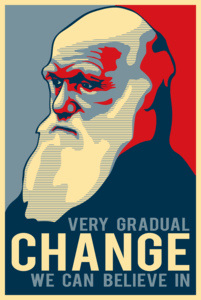 As Darwin Day approaches (February 12), it is obvious that times are changing. America may be getting ready to face the Enlightenment, only a few centuries after our founders tried to encapsulate its principles in our government.
On HuffPo, Paul Pardi recently wrote Religion is Evolving Before Our Eyes, about how American Fundamentalism and even Protestantism in general is suffering from ubiquitous communication. Few kids are exposed to only one point of view any more, so they are more likely to spot the discomforting inconsistencies of any given dogma. Small churches are closing their doors for lack of parishioners, and mega-churches pander to the basest prejudices just to pay the bills.
But on NPR, in the wake of Obama's "Sputnik Moment" comment, Ursula Goodenough wrote It's Time For A New Narrative; It's Time For 'Big History' as a plea to create a more evocative narrative for science, to better win hearts to engage their minds. This is a real problem, as those best trained to understand an issue are rarely well equipped to explain it from the ground up. We need Sagans and Tysons for every school district; those who can evoke the excitement of understanding the universe.
More and more people are turning away from their ancestral religions. Too many toward New Age woo, and some toward rationality. So the marketing arms of the churches work feverishly. They know that rational families tend to stay that way, but woo begets woo, and can be won back to the fold. They tirelessly try to pass laws to insert a religious wedge in science and history classes.
Several states currently have bills pending to make it harder to teach 19th and 20th century biology or geology by inserting stories from ancient texts that contradict every discovery of the last 200 years.
Here is a link with a list of current bills to establish anti-evolution state laws. Missouri, Kentucky, New Mexico, and other states all have at-risk public school syllabi. This may be a desperate last gasp of Fundamentalist anti-intellectualism. Or their fast grasp of schools could succeed, and leave America behind as other nations quickly accept the progressive mantle we are letting slide from our shoulders.
One could see this as the epic battle of the end times. But it is not the world ending, but an ancient and arguably obsolete world view. But the battle may be a messy one. The forces of ignorance are tireless and prolific. After all, an unreasoning populace is easier to lead.
Remember how we solved our healthcare problems with the reform measures promoted by Barack Obama? Not true. Our politicians aren't being honest about the extent of the problem we face, and it threatens our entire economy, according to this detailed and thoughtful article from Wilson Quarterly. Here's an excerpt:
Last year, Medicare and Medicaid made up almost 22 percent of the federal budget, about $500 billion and $250 billion, respectively. By 2050, together with the additional costs of the new health care law, they will expand to 48 percent of the budget (excluding interest payments on the national debt). At about $4.8 trillion (in today’s dollars), that sum will dwarf that year’s projected spending on Social Security by a factor of more than two, even though the retirement program, at $680 billion, is currently much larger.