The NYT Presents the “News”

This paragraph from an article in the New York Times speak for itself:

Mr. Kennedy has singled out Froot Loops as an example of a product with too many artificial ingredients, questioning why the Canadian version has fewer than the U.S. version. But he was wrong. The ingredient list is roughly the same, although Canada’s has natural colorings made from blueberries and carrots while the U.S. product contains red dye 40, yellow 5 and blue 1 as well as Butylated hydroxytoluene, or BHT, a lab-made chemical that is used “for freshness,” according to the ingredient label.

Continue ReadingThe NYT Presents the “News”

Elon Musk’s Role at Tesla

I keep seeing this meme on FB. I suspect it's an attempt to argue that Elon Musk hasn't done anything significant at Tesla. I hear this all the time from people who don't like Musk. But facts first: Courtesy of Grok, here's a summary of what Musk does at Tesla:

Elon Musk holds the position of CEO at Tesla, where he is also referred to as the "Technoking of Tesla," a title he adopted in 2021. His responsibilities at Tesla include:

Product Design and Engineering: Musk leads all product design, engineering, and global manufacturing of Tesla's electric vehicles, battery products, and solar energy products. This involves overseeing the development from concept to production.

Strategic Direction: As CEO, he sets the strategic direction for the company, focusing on Tesla's mission to accelerate the world's transition to sustainable energy.

Innovation and Technology Leadership: Musk is deeply involved in the innovation process, often directly contributing to technological advancements, especially in areas critical to Tesla like autonomy (Full Self-Driving or FSD), battery technology, and robotics (like the Optimus project).

Corporate Governance: Although he stepped down as chairman of Tesla's board in 2018 due to an SEC settlement, he remains a significant influence in corporate governance decisions due to his role as CEO and his ownership stake.

Public Representation: Musk represents Tesla publicly, including at investor meetings, product launches, and on social media platforms like X, where he communicates with customers, fans, and critics alike, influencing public perception and company culture.

Operational Oversight: Recent reports indicate that Musk now oversees Tesla's sales operations in several key regions including North America, Europe, the Middle East, and Africa, highlighting his hands-on approach in operational aspects of the business.

His role has been described as integral to Tesla's identity and success, with some suggesting that his influence is so significant that Tesla thrives largely due to his direct involvement in innovation and management.

What happened to Tarpenning ad Eberhard. Grok's explanation is much more nuanced than the meme: "Did musk push out Mark Tarpenning and martin Eberhard from tesla?

Grok's Answer

The narrative around Elon Musk's relationship with Tesla's co-founders, Martin Eberhard and Marc Tarpenning, involves several perspectives:

Foundation of Tesla: Martin Eberhard and Marc Tarpenning founded Tesla in 2003. Musk joined the company as an investor in 2004, bringing in significant capital and becoming chairman of the board.

Musk's Involvement: Musk's role quickly grew beyond that of an investor. He was instrumental in shaping the vision and direction of Tesla, not just with his financial investment but also through his involvement in product design and strategic decisions.

Eberhard's Departure: Eberhard was removed as CEO in 2007. According to various accounts:

Musk's Perspective: Musk has stated that Eberhard was removed due to operational issues, particularly related to the production delays of the Tesla Roadster. He has described Eberhard as difficult to work with, labeling him as "the worst person I've ever worked with" in some interviews.

Eberhard's Perspective: Eberhard has claimed that Musk tried to rewrite history by claiming to be a founder of Tesla. After his departure, Eberhard sued Musk for libel, slander, and breach of contract in 2009, alleging that Musk pushed him out and attempted to diminish his contributions to Tesla. The lawsuit was settled, with part of the agreement recognizing Musk and others as co-founders alongside Eberhard and Tarpenning.

Tarpenning's Departure: Marc Tarpenning left Tesla in 2008, not under the same contentious circumstances as Eberhard. Reports suggest that Tarpenning's departure was more amicable; he stepped down around the time when the first Roadsters were being finalized for production. He has expressed no regrets about his time at Tesla and continues to be involved in the tech and startup ecosystem.

Public and Internal Perception: There's a split in perception. Some view Musk's actions as aggressive takeover tactics, while others see his involvement as crucial for Tesla's survival and growth. Musk himself has noted that his involvement was essential beyond just his financial investment, claiming that without his input, the company might not have succeeded.

Given this background, while Musk didn't "push out" Tarpenning in the same manner as Eberhard (Tarpenning's exit was less dramatic), Musk's growing influence and direct involvement in key decisions did lead to significant changes in leadership at Tesla. Eberhard's departure was indeed contentious, involving legal action, whereas Tarpenning's was more about transitioning from his role at a pivotal time in Tesla's development.

The situation reflects a complex interplay of ambition, vision, and business strategy, where Musk's assertive leadership style and vision for Tesla played a critical role in these transitions.

Continue ReadingElon Musk’s Role at Tesla

What People are Missing if They Aren’t reading X (Twitter)

It's wild out there in the lands of Politics and Culture. I've been doing some collecting and I'd like to offer some of the things that especially caught my attention recently.

Glenn Greenwald is on fire. Here he is once again pointing out DNC/Corporate Media Hypocrisy:

I've lost count of the people who have told me that they don't know what Robert F. Kennedy actually says and they don't want to find out. And then They claim that he is "anti-vax" and a "conspiracy theorist," as though saying that is a substitute for knowledge. Michael Shellenberger comments:

This really happened. How could EVERYONE in the corporate media forget?

The Ukraine war (which has killed 600,000 Ukrainians so far) must must must go on because . . . trust us . . . says Anthony Blinken, neocon in Joe Biden's cabinet and one of the architects of the Iraq War.

Tulsi Gabbard was really put on this list this year after she expressed a political position in support of Trump. Everything else here is absolutely true. Does this sound like America?

It's guaranteed won't hear these things about Matt Gaetz at your favorite corporate media outlets. Independent journalist Lee Fang will tell you:

If really you'd like to learn RFK, Jr's positions on important topics (and you should want to know them), here are some of his main points, succinctly set out and annotated:

Continue ReadingWhat People are Missing if They Aren’t reading X (Twitter)

Big Pharma (Merck) and Vioxx: A Case Study

Dr. Aseem Malhotra Presents:

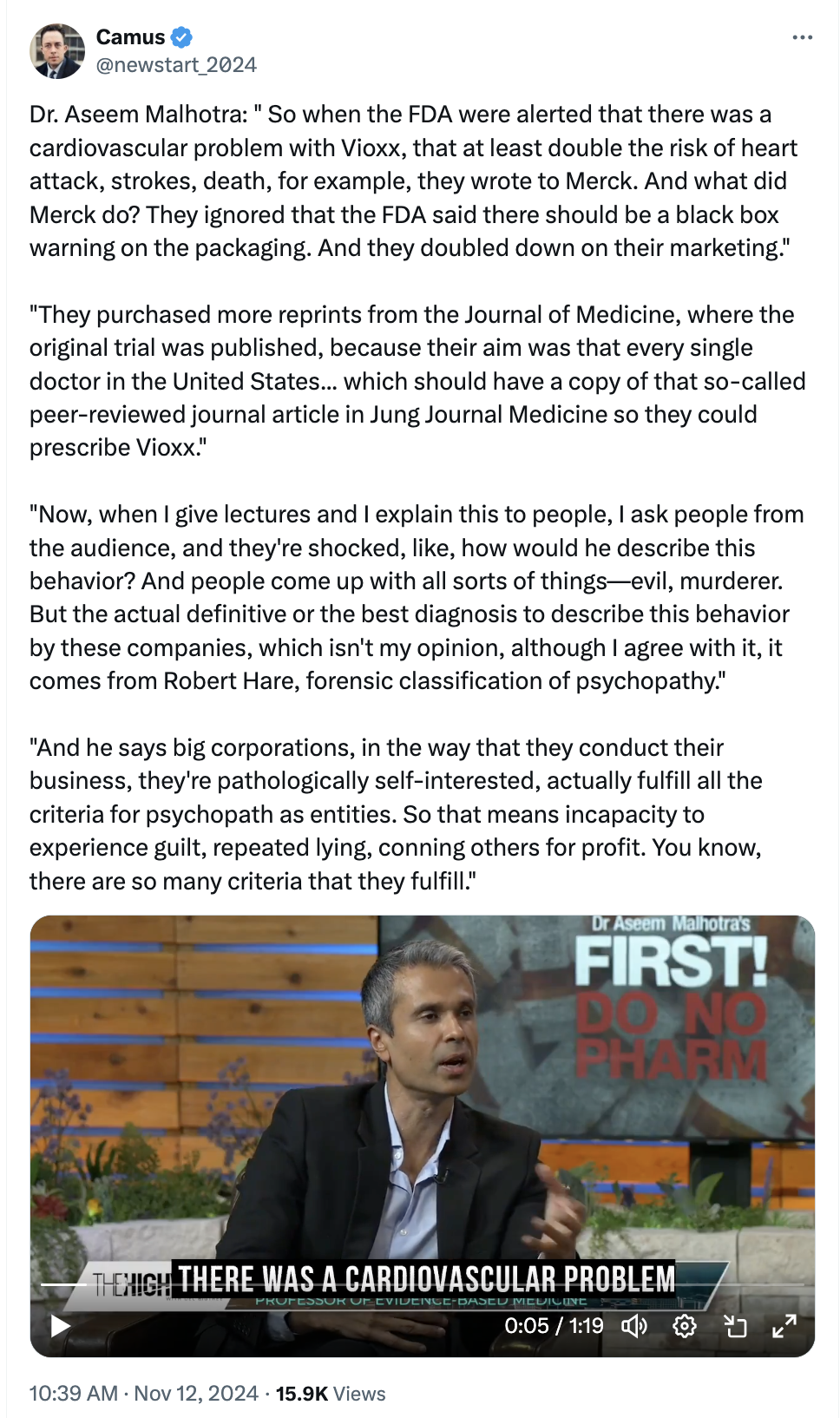
Dr. Aseem Malhotra: " So when the FDA were alerted that there was a cardiovascular problem with Vioxx, that at least double the risk of heart attack, strokes, death, for example, they wrote to Merck. And what did Merck do? They ignored that the FDA said there should be a black box warning on the packaging. And they doubled down on their marketing."

"They purchased more reprints from the Journal of Medicine, where the original trial was published, because their aim was that every single doctor in the United States... which should have a copy of that so-called peer-reviewed journal article in Jung Journal Medicine so they could prescribe Vioxx."

"Now, when I give lectures and I explain this to people, I ask people from the audience, and they're shocked, like, how would he describe this behavior? And people come up with all sorts of things—evil, murderer. But the actual definitive or the best diagnosis to describe this behavior by these companies, which isn't my opinion, although I agree with it, it comes from Robert Hare, forensic classification of psychopathy."

"And he says big corporations, in the way that they conduct their business, they're pathologically self-interested, actually fulfill all the criteria for psychopath as entities. So that means incapacity to experience guilt, repeated lying, conning others for profit. You know, there are so many criteria that they fulfill."

Continue ReadingBig Pharma (Merck) and Vioxx: A Case Study

RFK, Jr.: The Problem with Experts

RFK, Jr.:

Newsweek asked RFK Jr. "why he doesn't stop promoting conspiracy theories".

This was his reply:

"My father told me when I was a little boy that people in authority lie and the job in a democracy is to remain skeptical. I've been science-based since I was a kid. Show me the evidence and I'll believe you, but I'm not going to take the word of official narratives."

"The way you do research is not by asking authoritative figures what they think. Trusting experts is not a feature of science, and it's not a feature of democracy. It's a feature of religion and totalitarianism."

Compare with this passage from The Constitution of Knowledge by Jonathan Rauch (p.88):

I argue that liberal science’s distinctive qualities derive from two core rules, and that any public conversation which obeys those two rules will display the distinguishing characteristics of liberal science. The rules are

- The fallibilist rule: No one gets the final say. You may claim that a statement is established as knowledge only if it can be debunked, in principle, and only insofar as it withstands attempts to debunk it. That is, you are entitled to claim that a statement is objectively true only insofar as it is both checkable and has stood up to checking, and not otherwise. In practice, of course, determining whether a particular statement stands up to checking is sometimes hard, and we have to argue about it. But what counts is the way the rule directs us to behave: you must assume your own and everyone else’s fallibility and you must hunt for your own and others’ errors, even if you are confident you are right. Otherwise, you are not reality-based.

- The empirical rule: No one has personal authority. You may claim that a statement has been established as knowledge only insofar as the method used to check it gives the same result regardless of the identity of the checker, and regardless of the source of the statement. Whatever you do to check a proposition must be something that anyone can do, at least in principle, and get the same result. Also, no one proposing a hypothesis gets a free pass simply because of who she is or what group she belongs to. Who you are does not count; the rules apply to everybody and persons are interchangeable. If your method is valid only for you or your affinity group or people who believe as you do, then you are not reality-based...

Here is a problem, though, with the funnel metaphor. The boundaries of the reality-based community are fuzzy and frothy, not hard and distinct, and the same is true of knowledge itself. What has and The Constitution of Knowledge has not been validated? Who qualifies as an expert reviewer? Who is doing good science or journalism, who is doing bad science or journalism, and who is not doing science or journalism at all? Distinguishing science from pseudoscience and real news from fake news and knowledge from opinion will never be cut and dried. Among philosophers of science, a debate over what kind of thing is and is not science, the so-called demarcation problem, has been going on for a long time without resolution, which makes philosophers unhappy.

In fact, however, efforts to define who is or is not a scientist or what science does or does not do miss the point. The beauty of the reality-based community is that it can acquire all kinds of propositions and organize all sorts of arguments, and it can do all kinds of things to resolve those arguments, so long as its methods satisfy the fallibilist and empirical rules. In the real world, checking does not need to mean falsifying a factual statement in some precise, authoritative way. It means finding a replicable, impersonal way to persuade people with other viewpoints that a proposition is true or false. The reality-based community is thus not limited to handling factual disputes. It can work its will on any kind of proposition which its members and rules can figure out how to adjudicate, and it can drive many kinds of conversation toward consensus.

Continue ReadingRFK, Jr.: The Problem with Experts