Ingroup v outgroup – a primer

In my quest to better understand basic principles of group behavior, I reviewed Intergroup Relations, by Maryland B. Brewer and Norman Miller (1996) [this work appears to be out of print].  The stated focus this book is to better understand “the causes and consequences of the distinctions between ingroups (those groups to which an individual belongs) and outgroups (social groups that do not include the individual as a member).  At the outset, the authors note “the apparently universal propensity to differentiate the social world into ‘us’ and ‘them.’”  (Page xiii).

It was my suspicion that basic principles of social psychology would give me a deeper context for understanding many modern conflicts.   I was not disappointed.  By the way, these same principles appear in all basic social psychology books.  Nothing I mention here is tentative or controversial among social scientists.

According to Sherif (1966) “whenever individuals belonging to one group interact, collectively or individually, with another group or its members in terms of their group identification, we have an instance of Intergroup behavior.”  (Page 2)   Such social categories “tend to be less rational than other categorizations in that the beliefs we hold about social groupings often do not rest on firm evidence of actual Intergroup differences.”  (Page 6)  Once we establish categories, “we are biased toward information that enhances the differences between categories and less attentive to information about similarities between members of different categories.”  (Page 7).

We live in a pluralistic society.  Therefore, individuals are simultaneously members …

Share

Continue ReadingIngroup v outgroup – a primer

Rumsfeld again claims link between 9/11 and Iraq invasion during his farewell tour

It makes me wonder whether anyone is buything this line of bull anymore.  I wonder how the families of the soldiers killed in Iraq are reacting to this lie these days.  Maybe it gives some of them solace, because the alternative would be so incredibly crushing. My thoughts?  Good-bye.  Good riddance. 

Continue ReadingRumsfeld again claims link between 9/11 and Iraq invasion during his farewell tour

Who is to blame for Iraq, Bush’s poor execution or neoconservativism?

Vanity Fair has published an extraordinary article including interviews with many architects of America's foreign policy.  What do they think now that Iraq has been such a miserable failure? Varying degrees of regret can be detected in the people interviewed, but little remose, except from Kenneth Adelman: Fearing that worse…

Continue ReadingWho is to blame for Iraq, Bush’s poor execution or neoconservativism?

Republican Senator from Oregon: Iraq War “May Be Criminal”

The following words were delivered last night by Sen. Gordon Smith (a Republican from Oregon), a 10-year veteran of the Senate: I, for one, am at the end of my rope when it comes to supporting a policy that has our soldiers patrolling the same streets in the same way,…

Continue ReadingRepublican Senator from Oregon: Iraq War “May Be Criminal”

How to acquiesce in a national catastrophe: a case study featuring the St. Louis Post-Dispatch

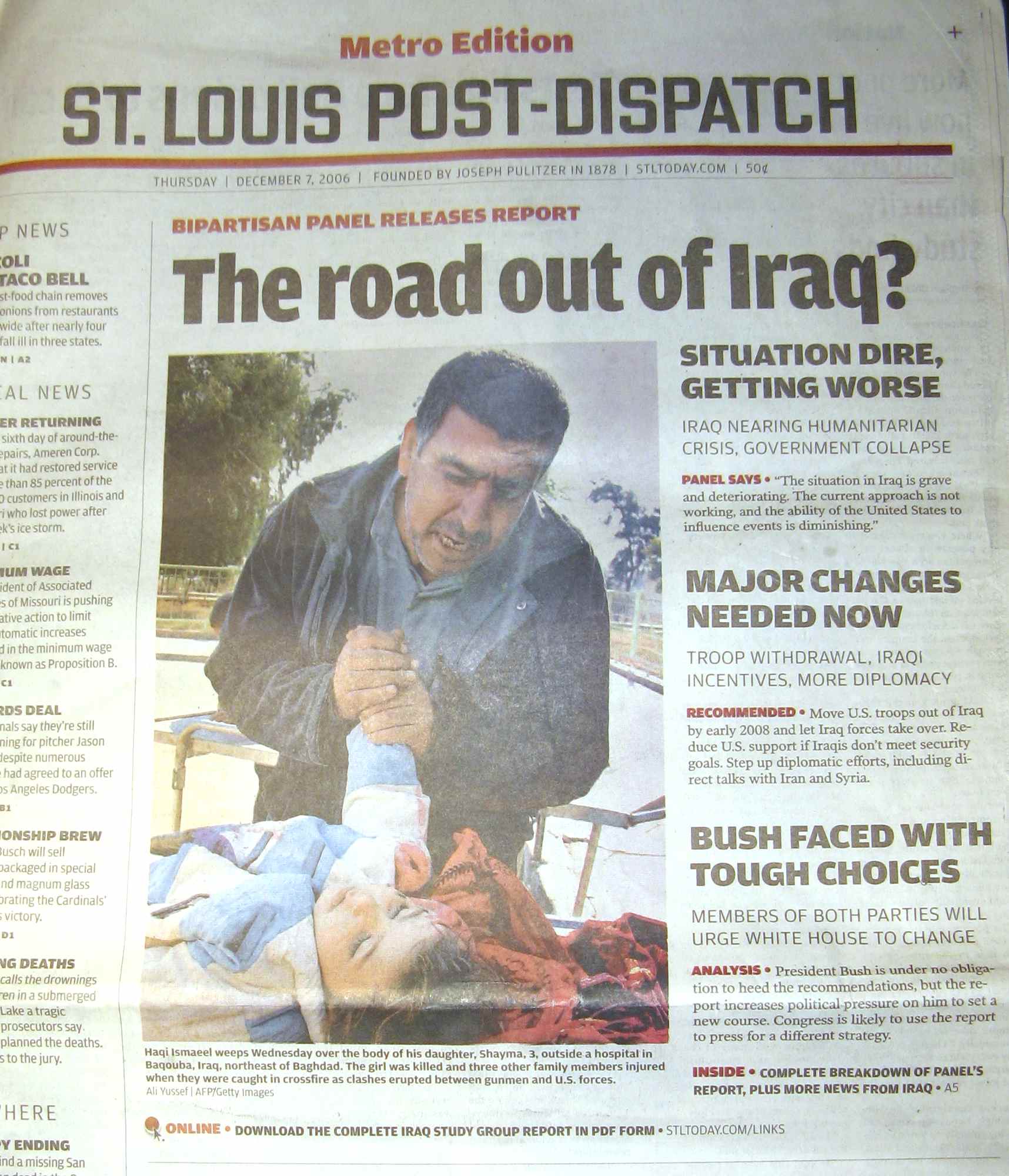
Take a look at the front page of today’s St. Louis Post-Dispatch. 

PD headline - smaller.JPG

You can see the photo of an Iraqi man grieving over the body of his three-year-old daughter outside of the Baghdad hospital.  According to the paper, “the girl was killed and three other family members injured when they were caught in crossfire as clashes erupted between gunmen and US forces.”

The lead story starts with this assertion:

The situation in Iraq is grave and deteriorating.  The current approach is not working, and the ability of the United States to influence events is diminishing.

This story line and this photograph clearly impugn the integrity of the United States.  Publishing such information is unpatriotic.  Or, at least, those are the sorts of things we’ve been told, until recently. 

It was always OK to publish pictures of our proud soldiers and our high-tech missiles taking off, of course.   It was up to Al Jazeera and the Europeans to publish pictures of what happened when those missiles exploded on the ground, however.  And when those non-American media sources published those photos of Iraqi civilian carnage, it infuriated “America.”  It’s not that American soldiers weren’t also credible witnesses to the civilian killings on the ground.   The evidence was there to be published, if anyone cared to know. 

For most of the past 3 1/2 years, the Post-Dispatch (along with most mainstream newspapers across the United States) did not publish pictures like this, certainly not in prominent places.  It simply wasn’t deemed news …

Share

Continue ReadingHow to acquiesce in a national catastrophe: a case study featuring the St. Louis Post-Dispatch