
Greenwald: Trump’s Confrontational Russia Foreign Policy Was the Opposite of Obama’s Accommodationist Foreign Policy

From most legacy media reports, you would think that Donald Trump was a pawn of the Russian government. You'd never know that this narrative was wildly spun fiction concocted to get Trump out of the White House (Note: I am glad he's out of the White House).

The fable that Trump's foreign policy accommodated Russia lingers, however. As Matt Taibbi showed with numerous exhibits, we were showered with (literally) fake news suggesting that Trump was over-friendly to Russia. Now, Glenn Greenwald has written an article comparing Trump's often confrontational foreign policy toward Russia to the Obama's (and now Biden's) accommodationist policy toward Russia. By writing this, I'm not pretending to know how to approach foreign policy toward Russia. I suspect that I don't know many of the relevant facts (because I'm ignorant of them or because they are secret). Rather, I'm linking to Greenwald's article because the information he presents is shockingly counter to the prevailing narrative of the majority of legacy news outlets: "Biden, Reversing Trump, Permits a Key Putin Goal: a New Russian Natural Gas Pipeline to Germany: That Trump was controlled by Putin and served his agenda was the opposite of reality. First Obama, and now Biden, have accommodated Moscow far more." Here are a few excerpts:

When it came to actual vital Russian interests — as opposed to the symbolic gestures hyped by the liberal cable and op-ed page circus — Trump and his administration were confronting and undermining the Kremlin in ways Trump’s predecessor, Barack Obama, had, to his credit, steadfastly refused to do.

Indeed, the foreign policy trait relentlessly attributed to Trump in support of the media’s Cold War conspiracy theory — namely, an aversion to confronting Putin — was, in reality, an overarching and explicit belief of President Obama’s foreign policy, not President Trump. During the 2012 presidential election, Obama and the Democratic Party famously and repeatedly mocked GOP nominee Mitt Romney’s warnings about the threat posed by Russia as a “relic of the Cold War.”

.    .   .

Consistent with that view, Obama rejected bipartisan demands to send lethal weapons to Ukraine throughout 2015 and into 2016. Even when Russia reasserted control over Crimea in 2014 after citizens overwhelmingly approved it in a referendum, Obama did little more than impose some toothless sanctions (though he did preside over, if not engineer, regime change efforts in Ukraine that swept out the pro-Moscow leader and replaced him with a pro-U.S. lackey). Obama worked directly with Putin to forge an agreement with Russia’s allies in Tehran to lift sanctions against Iran and bring them back into the international community, and then publicly praised the Russian leader for the constructive role he played in orchestrating that agreement.

And, enraging the bipartisan U.S. foreign policy community, Obama even refused to follow through on his own declared “red line” to attack Russia’s key ally in Syria, President Bashar al-Assad. Indeed, even after Russia asserted governance over Crimea, and even after Russia is said by intelligence agencies to have hacked the DNC and John Podesta’s computers, Obama, in 2016, sought to form a partnership with Russia in Syria to jointly bomb targets regarded by the two governments as “terrorists.”

Meanwhile, Trump — even as media figures gorged themselves on the conspiracy theory that he was a Kremlin agent — reversed virtually all of those Obama-era accommodations to Putin. Again and again, Trump acted contrary to the Kremlin’s core interests. After publicly threatening Russia over Syria, Trump twice bombed Putin’s key Middle Eastern ally — something Obama refused to do . . . Trump also reversed Obama’s Ukraine policy, sending the exact lethal arms to anti-Russian elements that Obama warned would be directly threatening to the Kremlin and thus excessively provocative. Trump filled his administration with long-time anti-Russia hawks who would never have been welcomed in the Obama administration (including CIA Director and Secretary of State Mike Pompeo, National Security Advisor John Bolton, NATO Ambassador Richard Grenell, and U.N. Ambassador Nikki Haley).

These excerpts are part of Greenwald's much longer, factually supported article.
Continue ReadingGreenwald: Trump’s Confrontational Russia Foreign Policy Was the Opposite of Obama’s Accommodationist Foreign Policy

No Apparent Solution to Homelessness in San Francisco

Christopher Rufo reports on escalating homelessness in San Francisco. As he reports, the city has tried many approaches, yet nothing seems to be working. It is, indeed, an incredibly complex issue that is taxing experts from many specialties. In his article at Real Clear Investigations, Rufo offers many facts and figures, as well as a concern that the currently favored approach, destigmatizing hopelessness and addiction, leads only to more of the same. Here are two excerpts:

The nexus between homelessness, addiction, and crime is clear: According to city and federal data, virtually all of the unsheltered homeless are unemployed, while at the same time, those with serious addictions spend an average of $1,256 to $1,834 a month on methamphetamine and heroin. With no legitimate source of income, many addicts support their habit through a “hustle,” which can include fraud, prostitution, car break-ins, burglaries of residences and business, and other forms of theft.

Boudin’s plan to decriminalize such property offenses – the mirror opposite of the low-tolerance “broken windows” approach adopted in the late 1980s as crime rates began historic declines – has contributed to the sense that he is not holding criminals accountable. In 2019, the city had an incredible 25,667 “smash-and-grabs,” as thieves sought valuables and other property from cars to sell on the black market. The following year, rather than attempt to prevent or even disincentivize this crime, Boudin has proposed a $1.5 million fund to pay for auto glass repair, arguing that it “will help put money into San Francisco jobs and San Francisco businesses.” In literal terms, Boudin is subsidizing broken windows, under the notion that it can be transformed into a job-creation program.

. . .

The final plank of San Francisco’s policy platform is “destigmatization.” Public health experts in the city have gradually abandoned recovery and sobriety as the ideal outcome, preferring the limited goal of “harm reduction.” In a recent task force report on methamphetamine, the San Francisco Public Health Department noted that meth users “are likely to experience high levels of stigma and rejection in their personal and social lives,” which are “often reinforced by language and media portrayals depicting individuals who use alongside images of immorality, having chaotic lives, and perpetual use.”

On the surface, this is a strange contention. If San Francisco’s perilous trifecta is any guide, methamphetamine use is heavily correlated with chaotic lives, perpetual drug abuse, crimes against others, and various transgressions against traditional morality. The harm reductionists’ argument, however, rests on the belief that addiction is an involuntary brain disease, akin to Alzheimer’s or dementia. In this view, addiction is better seen as a disability, and any stigma associated with it is therefore an act of ignorance and cruelty. According to the Department of Public Health, the goal of harm reduction policy is to reduce this unjustified stigma and focus public policy on “non-abstinence-based residential treatment programs,” “supervised injection services,” “trauma-informed sobering site[s],” and “training for staff on how to engage marginalized or vulnerable communities in ways that do not perpetuate trauma or stigma.”

Continue ReadingNo Apparent Solution to Homelessness in San Francisco

Matt Taibbi’s List of 21 False Claims About Russia by News Media

I'm still occasionally hearing people claim that the "stories" about "Russia" were "proven."

This article by Matt Taibbi was so well researched that I want to repost it, so you can have it ready to share. Written on March 18, 2021, the article is titled, "Master List Of Official Russia Claims That Proved To Be Bogus: The Director of National Intelligence releases a report, and the press rushes to kick the football again."

There were 21 such false stories, to which Taibbi cites, chapter and verse.

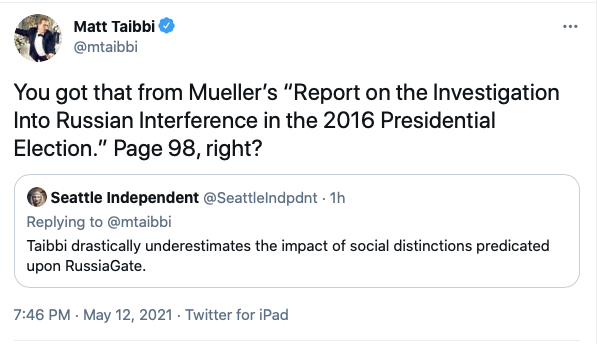
Taibbi himself tweeted the above article today, probably in response to this feeble tweet by the Seattle Independent:

Here is Volume I of Robert Mueller's March 2019 Report.

I've still occasionally hear from some people (informally, and on the street) that "Trump conspired with the Russians to interfere with the 2016 election."  When you next hear that claim, refer them to page 1 of Mueller's report and ask them whether, if Mueller had concluded the opposite, whether they would have believed that:

As set forth in detail in this report, the Special Counsel’s investigation established that Russia interfered in the 2016 presidential election principally through two operations. First, a Russian entity carried out a social media campaign that favored presidential candidate Donald J. Trump and disparaged presidential candidate Hillary Clinton. Second, a Russian intelligence service conducted computer-intrusion operations against entities, employees, and volunteers working on the Clinton Campaign and then released stolen documents. The investigation also identified numerous links between the Russian government and the Trump Campaign. Although the investigation established that the Russian government perceived it would benefit from a Trump presidency and worked to secure that outcome, and that the Campaign expected it would benefit electorally from information stolen and released through Russian efforts, the investigation did not establish that members of the Trump Campaign conspired or coordinated with the Russian government in its election interference activities.

Continue ReadingMatt Taibbi’s List of 21 False Claims About Russia by News Media

AOC’s Statements on the Israel-Palestinian Conflict Illustrate Modern Political Messaging Strategy and Tactics

When she condemns Israel's killing of Palestinian civilians (including children), why is AOC attacking mayoral candidate Andrew Yang instead of attacking the high ranking Democrat leaders who determine and implement the unquestioningly pro-Israel U.S. policy: Biden, Harris Pelosi, Schumer & Blinken? Glenn Greenwald offers a lesson in modern political messaging and fund-raising.

AOC said nothing about the State Department's ongoing defense of Israel. She condemned none of her powerful colleagues in Congress who did the same. She refused to call on the Biden administration explicitly to change its policies or denounce Biden's fanaticism on this issue. Her only previous utterance was a mealy-mouthed, barely cogent tweet in which she randomly threw the Israel/Gaza conflict into a laundry list along with “paramilitary violence in Colombia” and “the detention of children on our own border and the militarization of US police departments” to say: “the United States must seriously assess its role in state violence and condition aid.”

So when she finally worked up the courage on Monday to single out a political official for public scolding and shaming on the issue of Israel, she decided that it should be Andrew Yang.

Continue ReadingAOC’s Statements on the Israel-Palestinian Conflict Illustrate Modern Political Messaging Strategy and Tactics

Bill Maher: It’s Time for Republicans and Democrats to Reverse Rolls (Again) Regarding Prudery.

Bill Maher: The Democrats have sucked “the fun out of everything. . . . Once upon a time, the [Republicans] were the ones offended by everything. They were the party of speech codes and blacklists and moral panics and demanding some TV show had to go."

Continue ReadingBill Maher: It’s Time for Republicans and Democrats to Reverse Rolls (Again) Regarding Prudery.