
Minority Can Rule: 3.5% of People is Sometimes Enough to Evoke Widespread Change
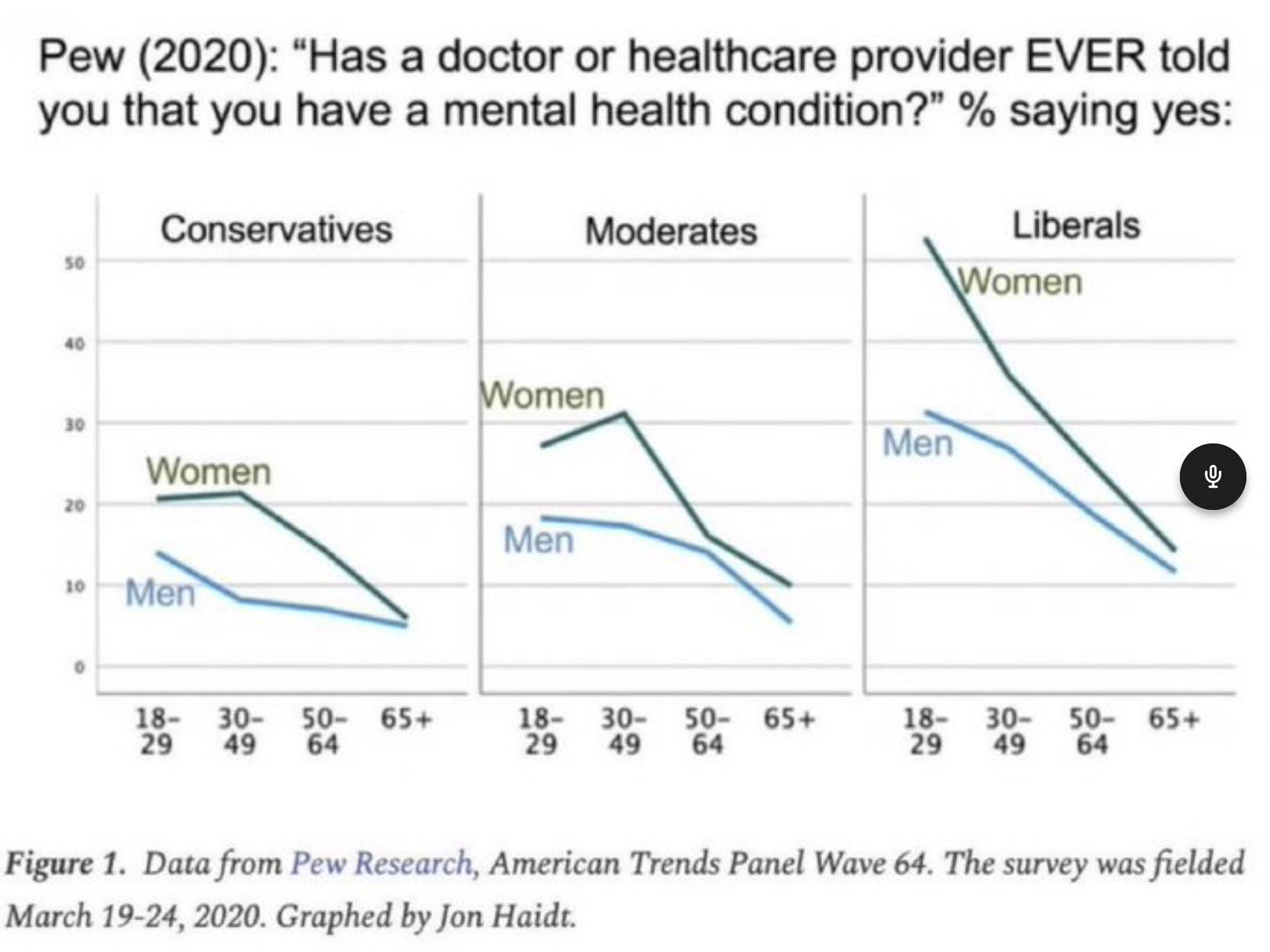
Can a tiny sliver of people change society. Yes. 3.5% is often enough. That's one person out of 30. It's happened often, even if the 3.5% are non-violent, as long as they are a cohesive and disciplined vocal minority:
Why cling to the myth that real change needs majorities—when data spanning a century proves a committed, nonviolent 3.5% has never failed? Erica Chenoweth’s research: Hundreds of movements analyzed. Once sustained participation hits 3.5%—strategic, disciplined, peaceful—success is guaranteed. No exceptions. The Civil Rights Movement nailed it: The 1963 March drew ~250,000 (<0.2% of Americans), but the real power was the unseen network—carpools, sit-ins, daily courage—that turned moral force into unstoppable momentum. Margaret Mead was right: Only small, thoughtful groups ever change the world. Now it’s proven. Key insight: This works beyond activism—in business, innovation, personal growth. Stop chasing consensus. Build your aligned 3.5%. Which movement (or moment in your life) shows this rule in action? What could you shift by focusing on that core minority?
Luxury Beliefs in Chicago
Rob Henderson coined the term "Luxury Beliefs" as follows:
Luxury beliefs are ideas and opinions that confer status on the upper class while inflicting costs on the lower classes.
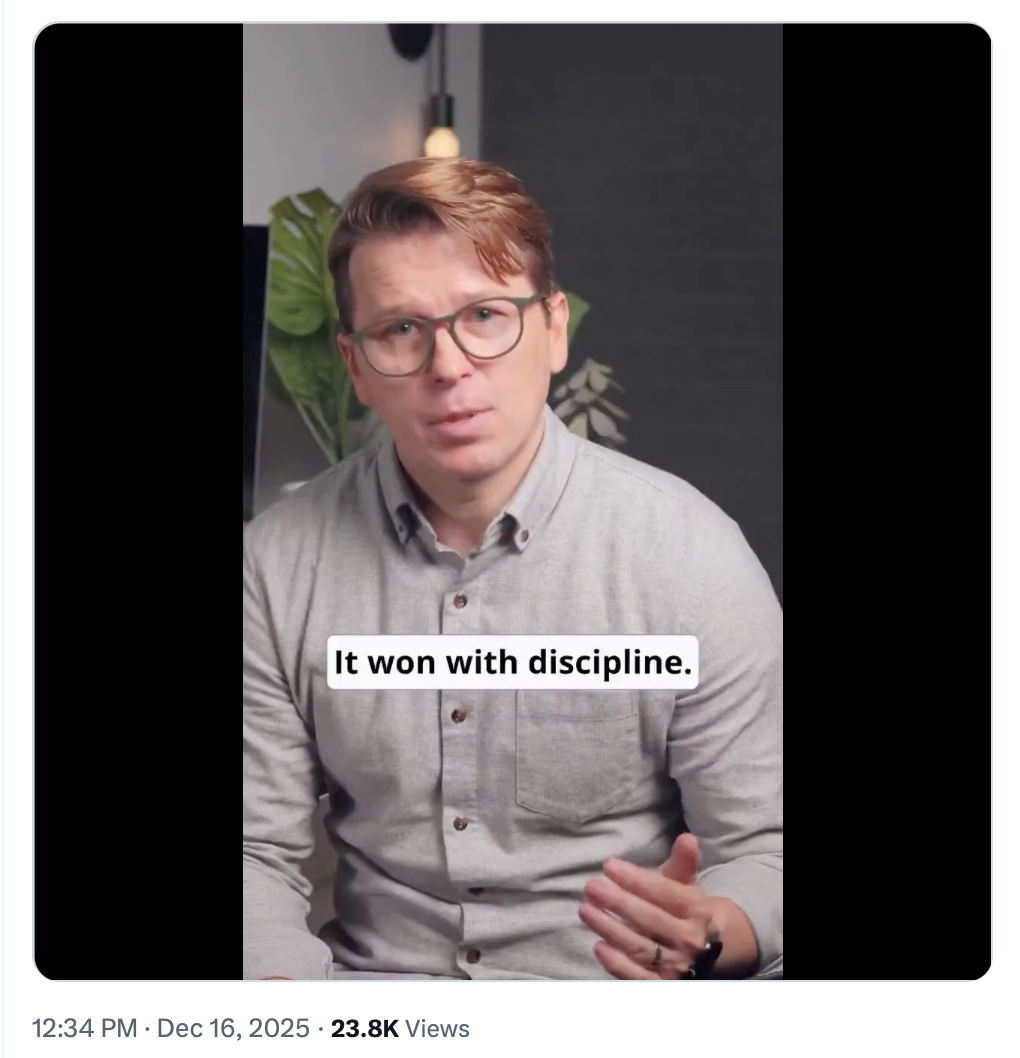
Here, Rob offers a more expansive discussion:In addition to my own experiences with social mobility, my luxury beliefs idea stems from Thorstein Veblen’s work, particularly his 1899 book, The Theory of the Leisure Class. Veblen, a sociologist and economist, described how the elites of his era displayed their status through conspicuous consumption, such as wearing delicate, expensive clothing, carrying pocket watches, or attending lavish ballroom events. While material possessions still play a role in signaling status today, I argue that they have become a noisier indicator of wealth. A century ago, one could easily distinguish the rich from the poor based on appearance alone. However, in our wealthier modern society, where access to goods is more widespread, it’s harder to gauge someone’s wealth at a glance.Today, I noticed this post by A Gene Robinson, who doesn't use the term "luxury beliefs," but is angry about non-stop high crime in Chicago contrasted with what he considered the detached cheap signaling of those who participated in the Chicago No Kings Rally:
Instead, status is increasingly expressed through what I call luxury beliefs, which have largely replaced luxury goods. These beliefs reflect what sociologist Pierre Bourdieu termed cultural capital. Elites invest in attending prestigious schools and universities, where they adopt the mannerisms, vocabulary, habits, and fashionable opinions of the upper class. This process enculturates them into the elite and sets them apart from the broader population. For example, while the conventional view might support law enforcement, someone seeking to signal their elite status might advocate for abolishing the police or reimagining law enforcement with ideas like hiring “violence interrupters.” Such unconventional or avant-garde views serve as a way to distinguish oneself from the masses and signal a superior social position.
I asked Grok to compare the economic circumstances of those in Chicago's crime ridden neighborhoods to the circumstances of people who work for corporate media:
Corporate media workers earn 2–5 times more than residents in these Chicago neighborhoods ($60,000+ vs. $25,000–$50,000), enabling comfortable lifestyles with savings, travel, and leisure. They benefit from employer perks like health insurance and flexible time off, contrasting with reliance on public aid in high-crime areas, where poverty rates are 2–3 times higher (40%+ vs. national 12%). Media lifestyles involve professional growth and urban amenities, while these neighborhoods face survival challenges, unemployment-driven desperation, and violence that perpetuates economic stagnation. This disparity highlights broader urban inequalities, where media professionals might even report on these communities from a position of relative privilege.
Then I asked Grok to compare the economic circumstances of those in Chicago's crime-ridden neighborhoods to those who marched in the Chicago no-kings rally:
The economic divide between residents of Chicago's crime-ridden neighborhoods and No Kings rally marchers is stark, highlighting urban inequalities in race, class, and opportunity. Neighborhood residents endure entrenched poverty, with incomes 2–4 times lower than the implied stability of rally participants, who benefit from assets like homes and retirement funds accumulated over decades.While the former face unemployment, reliance on aid, and violence-linked economic stagnation, marchers—often older, white, and from more affluent backgrounds—enjoy financial security enabling activism without personal economic risk.
This contrast underscores how protests like No Kings may draw from privileged demographics, potentially overlooking the direct economic hardships in the city's most vulnerable areas.
Batya Ungar-Sargon: The Political Left Intentionally Cultivate Real Life Violence
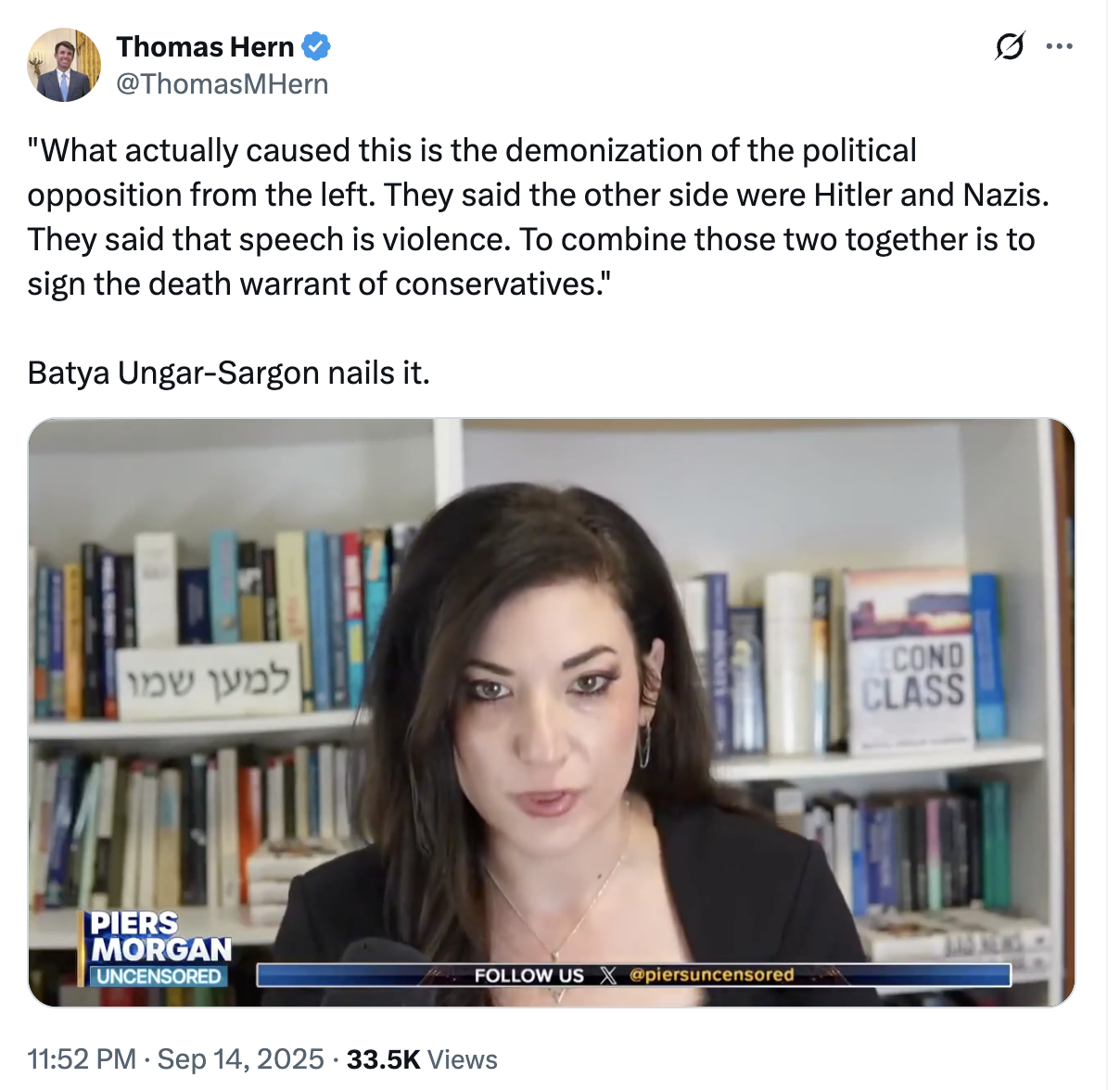
Batya Ungar-Sargon makes a strong case that the violent killing of Charlie Kirk is not a "both sides" issue:
I'm finding myself very caught between, on the one hand, wanting to honor his legacy of unity through debate and coming together to take down the temperature, and then wanting to honor his legacy of telling the truth. And the truth is this is not a both sides issue. The killer killed him, according to police reports, because he found Charlie Kirk to be spreading hate. This is a view shared by every single prominent Democrat.
Yes, there are people on blue sky advocating for violence, but what actually caused this was the utterly quotidian, utterly ubiquitous demonization of the political opposition from the left, and it has just led to violence because they said the other side were Hitler and Nazis. They said that speech is violence. To combine those two things together is to sign the death warrant of prominent conservatives, and that is what we are seeing again and again and again.
And it is utterly facetious to suggest that there is any comparison between political violence on both sides. Every example they bring is not actually showing that, whether it's Governor Shapiro whose attempted assassination was from a free, Palestine leftist, or whether it was the Minnesota assassinations, which were from somebody who said he was operating at the behest of Democrat Governor Tim Walz. There is a culture among Democrats at the highest level to suggest that their political opposition are a danger, and that suggests that their lives are forfeit.
And I want to come together. I do. I love what Shanks said. It brought tears to my eyes. I reached for a tissue while you were playing Charlie's words. But at the same time, we cannot unite with people who are lying to our faces about who we are, who will not take responsibility for the fact that they suggested that we are Nazis because of totally legitimate views that reflect the majority of Americans.
So what I say is, let the left say we were wrong. It is legitimate to vote for Donald Trump. It is legitimate to be pro life. It is legitimate to believe that there are only two genders, and we were wrong to suggest that that was not the case. We were wrong to say that that is hateful. When they say that, I am waiting with open arms to take down the temperature.
Nellie Bowles Exposes that Left Wing Media is Always About Agenda, not Curiosity
Here’s MSNBC contributor Matthew Dowd shortly after Charlie was shot: “I always go back to, hateful thoughts lead to hateful words, which then lead to hateful actions.†And: “You can’t stop with these sort of awful thoughts you have and then saying these awful words and not expect awful actions to take place.†And also: “We don’t know if this was a supporter shooting their gun off in celebration, we have no idea.†That makes more sense, right? A right-wing gun nut pointing a gun directly at the guy talking and pulling the trigger to celebrate him—that is definitely the most likely scenario. Later, facing outrage for its coverage, MSNBC apologized for these comments and ended Dowd’s contract.
Well, that’s MSNBC. But CNN? Within a few hours of Charlie’s slaughter, CNN anchor Abby Phillip was calling for the video to be censored, and did her best to do so from her pulpit. “The degree to which the algorithm on this platform is pushing video of the shooting is incredibly disturbing. There has to be some human that can turn the dial down in a situation like this.†Odd how reporters want much, much less reporting. Funny how she didn’t say that about a situation like, I don’t know, George Floyd’s killing. It’s almost like it’s political. ...
And then came the New York Times obituary. A classic. The headline: “Charlie Kirk, Right-Wing Provocateur and Close Ally of Trump, Dies at 31.†Right-wing provocateur. A person trying to provoke, if you think about it. As though there’s no belief system behind it. Just a provocateur. For the sake of it. In the mainstream media worldview, there are two kinds of people: those fighting for left-wing causes, who are described as people of conviction, activists for justice, deep believers in equality. And then there are those fighting for right-wing causes, who are described as provocateurs, cynics, racists, and shills. Archconservatives. They eventually changed the headline. But here’s the New York Times’ obituary: “He was so vocal in his willingness to spread unsupported claims and outright lies—he said that the drug hydroxychloroquine was ‘100 percent effective’ in treating the virus, which it is not—that Twitter temporarily barred him in early March 2020. But that move only added to his notoriety and seemed to support his claim that he was being muzzled by a liberal elite.†Fascinating. A man is murdered in public, in the middle of the day, while practicing his First Amendment rights, and the paper of record decides this must be the perfect moment to do fact-checking about hydroxychloroquine.
What you need to know from this: If your politics are that of a standard normie conservative man, your New York Times obituary will find the various things you said that weren’t exactly right (he got into hydroxychloroquine in 2020! Can you believe that?) and they’ll paint them in the sky. My politics are lib centrist, and these people would certainly celebrate my death, highlight my many errors, and refer to my defense of the SAT as my “repeated advocacy for a return to slavery†or something. What I’m saying is: Just try to stay alive because when you die, a New York Times reporter gets to juice your corpse for likes on Bluesky. MSNBC will invite talking heads on the air to suggest that the shooter could have been your mom who forgot to turn the safety on, we simply don’t know."
Nellie's TGIF column at The Free Press is one of my favorite parts of every week. I highly recommend it.