I get a lot of my information from long-form Podcasts. I am increasingly getting my exercise by briskly walking and I walk five miles per day. I don't want to get into a habit of sitting while I listen to podcasts. I want exercise, and I love getting two-fer's--exercise and high quality information at the same time. I don't want to plug my ears with earbuds or to wear over-the-ear headphones while I'm walking, because I want be aware of the sounds around me: people, animals and traffic. I also don't want to disturb others by blasting a podcast from my phone while I walk around.
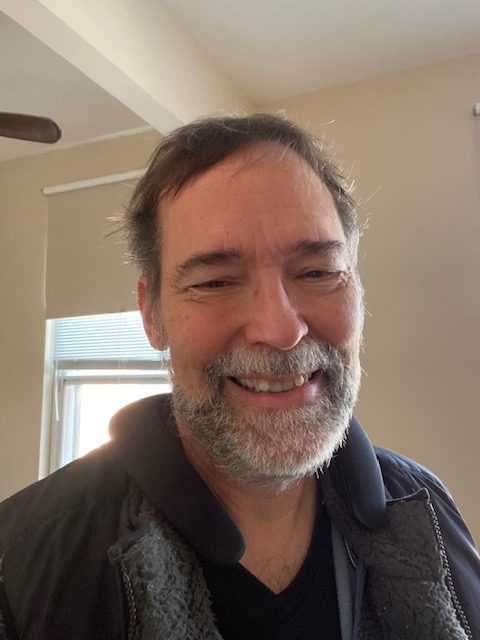
This is an unpaid endorsement. I want to share some information about a product I recently purchased that I'm enjoying. It satisfies all of my objectives stated above and it costs about $50. It is a hands-free bluetooth neckband speaker that you wear like a collar. It's comfortable and it will not fall off even when I'm doing chores around the house while I listen. Here's the one I'm using:
There are other models of these "wearable" or "neckband" speakers, but I've only tried this one, by a company named "Long Run." It produces excellent quality sound for podcasts, but it's almost like the sound is coming from inside my head. I don't use this collar for music, but I've tried this out and the music sound quality is decent--it won't give you deep bass, but I'm happy to make that trade-off for all of the advantages this device offers. You can also have two-way phone conversations using this device and that works well too.
I've worn this speaker for more than 10 hours already and it passes all of my tests with flying colors. When you are wearing it, the volume can be set at a robust-seeming level. I was concerned that this was too loud and it might be disturbing people nearby. But then I took off the collar while it was playing and I was impressed at how much lower the volume seemed. The trick is that the collar broadcasts the sound directly toward your ears, minimizing the sound moving out away from you.
I'm sharing this information because I suspect other people who walk a lot also seek a good hands-free speaker for podcasts. This is one that works for me.
The excerpt below is from The New York Post. I agree.  People who lean to the political left ought to check out a few episodes of Joe Rogan's podcast for themselves, rather than allowing others to scare them away.  They might find that they enjoy looking straight at issues without being pushed or pulled by any political narratives. They might enjoy wide-open conversation.
[A] progressive antipathy towards Rogan is reaching new heights of hysteria — not because the 53-year-old podcaster is some kind of dogmatic, Trump-supporting conservative. Far from it. Rather, he is a progressive-minded thinker supportive of LGBT rights, a woman’s right to choose, and drug legalization who also consistently challenges the orthodoxies of the left, such as the more concerning dogmas of trans advocacy, the excesses of the #MeToo movement, and the popular conflation of Trump’s most egregious characteristics with the millions of Americans who voted for him.
. . .
Rogan is a fundamentally critical thinker who formulates his views on a case-by-case basis rather than adhering to ideological narratives . . . For those heavily invested in political narratives, Rogan’s platform presents a mortal threat — a grave transgression to their narrow-minded thought bubbles and ideological safe spaces. Unlike many ideologues, Rogan daringly humanizes perspectives that deviate from his own. “I like being proven wrong,†he said in a recent episode.
The self-annointed thought police are still working overtime at Haverford, where free-speech is merely a phrase and where tribal truths are the reality. I could not imagine sending any student to Haverford if they wanted to learn how to think self-critically and be prepared to hold a job in the outside world.
Jonathan Kay's long article leaves a pit in my stomach and casts a pall over my evening as I write this comment. He needed to fill his article with an extraordinary amount of details in order to substantiate his extraordinary conclusions, including the following: A) Nothing insensitive or racist occurred at Haverford College leading up to the current shrill unrest. B) Nothing that happened at Haverford justified the long ridiculous list of student demands (to which the administration mostly acceded). C) Most chillingly, the administrators of Haverford (and many other colleges) lack the the necessary resources to have meaningful conversations with students or to take respectable negotiating positions during these Woke-fueled paroxysms.
A few excerpts from Jonathan Kay's excellent article:
[T]he mania that swept Haverford College in late October and early November 2020 lays bare, with unusual clarity, the fervid atmosphere of grievance and self-entitlement that has made the administration of elite colleges and universities so difficult.
Of all the Haverford community members I spoke with, the only one who asked to be quoted by name was recently graduated philosophy major Alex Gutierrez, who once summarized the mindset of campus activists in an essay about Jacques Lacan. “Modern activists have psyches that are built for the joy of transgression,” he observed. “They engage in activism so they can repeatedly experience that joy, a joy that is denied them in everyday life because everyday life is dominated by the ethics of pleasure… And so they need to invent fictional dominant orders so that they can defy them. This is why protesters would actually be extremely unhappy if oppression went away. They want white patriarchy to be as powerful as possible, so they can defy it.”
Gutierrez wrote these words before his alma mater fell into upheaval in late October. But his analysis seems apt. When students complained that Raymond had caused them “harm” with her October 28th email, they weren’t really speaking up as activists denouncing racism on campus (since there doesn’t seem to be much of it), but as consumers whose parents paid good money for them to experience the sensation of transgressive social-justice heroism. “Normally, the administrators are the perfect target for student transgression,” Gutierrez told me. “They take the abuse and they’re not supposed to push back. That’s part of their role. That’s what students expect.”
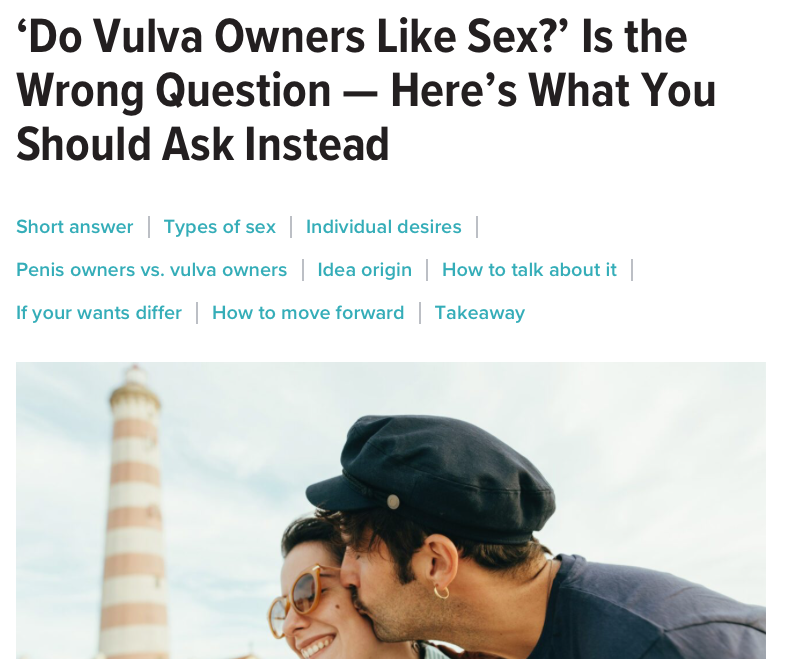
‘Do Vulva Owners Like Sex?’ Is the Wrong Question — Here’s What You Should Ask Instead. . . . Some do like sex and some don’t. Just like some penis owners like sex and some don’t.
This question, in and of itself, isn’t great, though. It makes some broad generalizations and assumptions about people and sex in general.
So instead of asking whether vulva owners like sex, you should really be focusing on the person you want to have sex with, and ask them how they feel, what they want, and what they need.
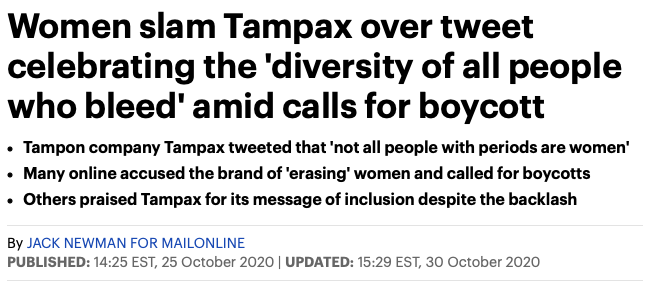
Here's an article about a recent ad by Tampa. Same issue:
One of the things I find most disturbing about "anti-racists" is their demand that you must either agree to everything they say or else you are a "racist." Popular authors Ibram X. Kendi and Robin DiAngelo claim that if you are not an "anti-racist" you are a racist. There are only two options. Thus speak the anti-racists. This false dilemma, this unjustified dichotomy, is just "because."
"Anti-racism" is not the opposite of racism, despite the misleading nomenclature. It is virulent new form of racism. To pull off this minor miracle of creativity, the "anti-racists" have invoked a new expansive definition of "racism" that has nothing to do with specific unfair attitudes or behavior of specific people. The "anti-racists" invoke a Manichean claim that it is OK to judge people as good and bad (respectively Blacks and whites) based on immutable physical appearance, just because. In doing this, they are dusting off that old disreputable idea that melanin should serve as a guilt barometer. This is something they have in common with racists of the Civil War and Jim Crow eras, although the new barometer is upside-down.
This "anti-racist" formula has worked all too well for the past several years. Well-meaning people who fervently disagree with this "anti-racist" claim, however, including the specific claim that "all white people are racist," are being held emotional hostage. They are afraid to speak up, to disagree in public places. It is truly bizarre to see so many people who disagree with these "anti-racist" claims who are afraid to speak up. I know this from numerous private conversations. It's starting to look like many religions, where the preachers preach at the flock and members of the flock merely nod their heads, even thought they know in every bone of their bodies that the Earth is not 6,000 years old, that virgins don't have babies and that (an example from my Catholic upbringing) eating the host is not literally eating bloody muscles and capillaries. Members of the flock sat in total silence when the NYT promoted claims that the American Revolution was primarily for the purpose of promoting slavery, a central claim of "The 1619 Project."
So this is where we are: the preachers are preaching and members of the flock keep sitting silently because they are afraid of going to "anti-racist" hell. For them, hell is what would happen is they were publicly called "racist." Thus, members of the flock will sit in paralyzed silence, even when the anti-racists call all "white" people and their Black intellectual allies "racist" no matter how exemplary their lives have been. Isn't that weird? "White" people are already being called racists as a group merely by their skin color, yet they fear being called "racist" as individuals. And what drives this fear is, ironically, that they hate racism. This is stranger than any fiction any creative writer could concoct. These "anti-racist" threats of name-calling are successfully turning many people into Zombies (this reminds me of how many types of wasps sting and zombify other bugs to use as hatcheries). After getting stung by the threat of being called "racists," the fearful zombified flock is willing to sit in silence even when the "anti-racists" make patently false claims that no racial progress has occurred since 1619, since the Civil War or since the Civil Rights era. They sit in silence while the "anti-racists" ridicule Martin Luther King's idea that we should not be judged by the color of our skin, but only by the content of character.
Once this creepy dynamic settled into place, anti-racists, such as Ibram X. Kendi and Robin DiAngelo, began getting free rides from individuals who knew better but who were afraid to speak out. More troublesome, the anti-racists' fact-free and oftentimes false diatribes also began getting luxury free rides from corporate HR departments, government agencies (and here) and many members of our sense-making institutions, including left-leaning legacy media. In addition to securing the silence of people who disagree under threat of being called names, the "anti-racists" employ another big weapon: the rage of Woke mobs who are willing to destroy the careers of anyone who dares to dissent (recent example).
Hello, I invite you to subscribe to Dangerous Intersection by entering your email below. You will have the option to receive emails notifying you of new posts once per week or more often.
Thank you for your interest in DI!
Erich Vieth
[jetpack_subscription_form subscribe_button=”Sign Me Up”]