Critical Race Theory Compared to the Civil Rights Ideals of the 1960s

Critical Race Theory claims to be the new improved way to deal with racial issues. How does the Woke doctrine, spreading through American schools and workplaces, compare to the principles of the Civil Rights Movement of the 1960's?
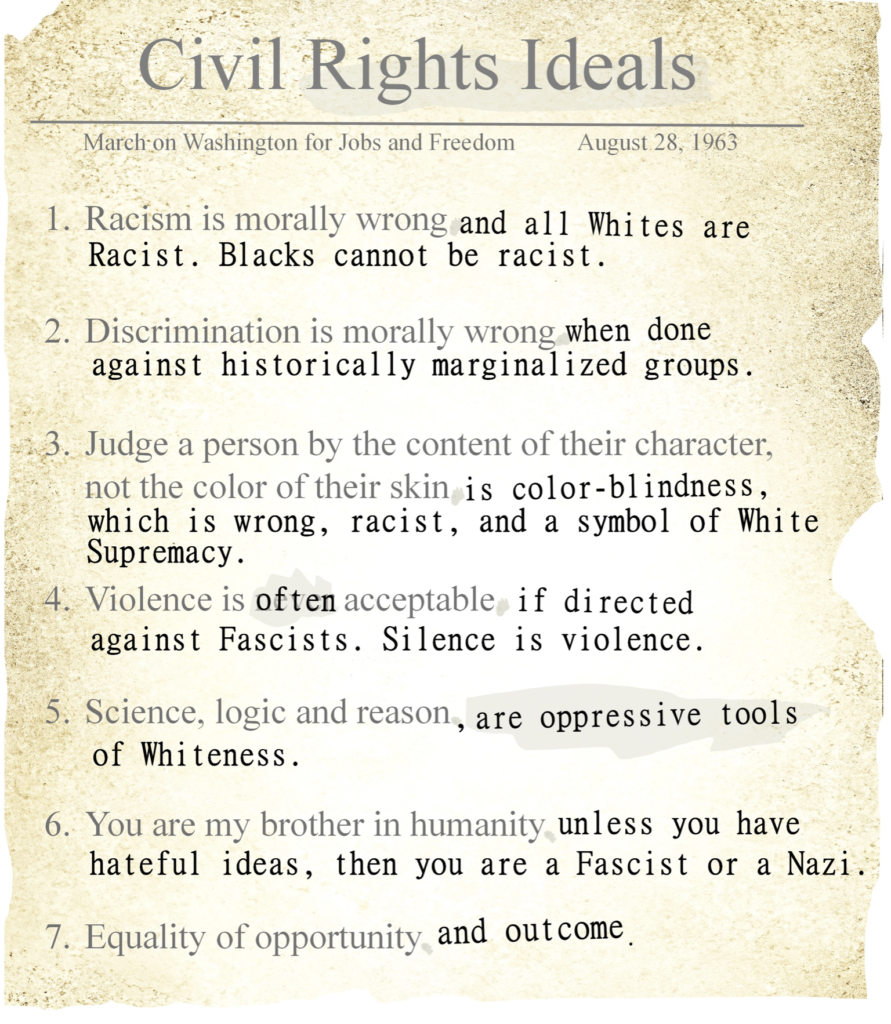
The creator of the above image is Woke Temple at Twitter. The "original document" above doesn't exist (I confirmed this through personal communication with "Woke Temple"), but it accurately serves as a summary of some of Martin Luther King's core teachings.  The "corrections" in the graphic accurately reflect commonly espoused principles of Critical Race Theory (For more on CRT, consider the lectures and writings of prominent CRT advocates Robin DiAngelo and Ibram Kendi).  See also this glossary entry for CRT at New Discourses.

It should be apparent that one cannot honor the memory and teachings of Martin Luther King and, at the same time, support Critical Race Theory. They are mutually exclusive, so each of us needs to decide where we stand on this clash of ideas.

In the early 1960s, I was a young boy.  I barely watched the news back then and I didn't appreciate the importance of the civil rights movement. That said, I always knew it was a bad idea to judge each other based on the way we looked. It made deep visceral sense, as did the platitude: "Don't judge a book by its cover."  Now that I'm much older, I sometimes imagine going back in time to march with Martin Luther King to make a strong show of support for the real Civil Rights Movement.

For those of us who were too young to march with MLK, 2021 is our second chance to stand up for true Civil Rights Movement.  Are you willing to be called names like "racist" by a loud group of zealots in order to take this strong moral stand? That would be such a small price to pay compared to what MLK had to endure.  Are you willing to allow people to call you names to help keep this country from decaying back to days where we judge each other by immutable physical characteristics like color of skin?  Where millions of people obsess about what "race" someone is?  To a system of categorizing each other that makes no more sense than astrology or phrenology? Again, this is your chance - - your voice is needed, and all you need to do is to say out loud those thoughts you are already thinking.  Judging each other by the way we look is an outrageously dysfunctional approach to interact with each other.

The longer we don't take a strong stand against Critical Race Theory, the more entrenched CRT will become in numerous schools (grade schools and colleges and see here), media outlets and governmental offices. Here's how bad it recently got at a major national museum.  See also John McWhorter's  analysis: CRT is a new fundamentalist religion.

You know what is at stake.  We've already set aside a national holiday in his honor.  Are you ready to speak up in support of Martin Luther King?

--

Quotes of Martin Luther King that bear on the principles set forth in the "document" above:

[Don't Judge Others by the Color of their Skin]

I have a dream that my four little children will one day live in a nation where they will not be judged by the color of their skin but by the content of their character. I have a dream today.

[Violence, Hatred, Love]

Hate begets hate; violence begets violence; toughness begets a greater toughness. We must meet the forces of hate with the power of love... Our aim must never be to defeat or humiliate the white man, but to win his friendship and understanding.

The ultimate weakness of violence is that it is a descending spiral begetting the very thing it seeks to destroy, instead of diminishing evil, it multiplies it. Through violence you may murder the liar, but you cannot murder the lie, nor establish the truth. Through violence you may murder the hater, but you do not murder hate. In fact, violence merely increases hate. Returning violence for violence multiplies violence, adding deeper darkness to a night already devoid of stars. Darkness cannot drive out darkness; only light can do that. Hate cannot drive out hate; only love can do that.

[Segregation]

Now is the time to rise from the dark and desolate valley of segregation to the sunlit path of racial justice. Now is the time to lift our nation from the quicksands of racial injustice to the solid rock of brotherhood. Now is the time to make justice a reality for all of God's children

[More . . . ]
Continue ReadingCritical Race Theory Compared to the Civil Rights Ideals of the 1960s

Intentional Misunderstandings, for Better or Worse

In my work as an attorney I often encounter opposing attorneys who object to my written questions (interrogatories), insisting that they are "vague."  Opponents often make these objections in an attempt to avoid answering my questions or to slow down the progress of the lawsuit. I remind my law students that they will often encounter this unfortunate behavior when they graduate.  When it is convenient for them, the people we communicate with often give us the least charitable readings of our words. This common occurrence is one of my least favorite parts of being an attorney. It eats up a lot of time and money trying to force motivated opponents to acknowledge common and ordinary meanings of words.

This isn't just a problem for attorneys.  Whenever any of us communicate, the attitude of the other person often determines whether we will get a responsive answer or no meaningful answer. Word meanings can easily be bent and twisted and it often happens when there is no ill-intent. Consider too the existence of contronyms, words that have some opposite or contradictory meanings, such as "bolt," "dust" or "out."

There is also a fun side to unreasonable misunderstandings. It can make for good comedy.  Here's an example from Monty Python's "Holy Grail":

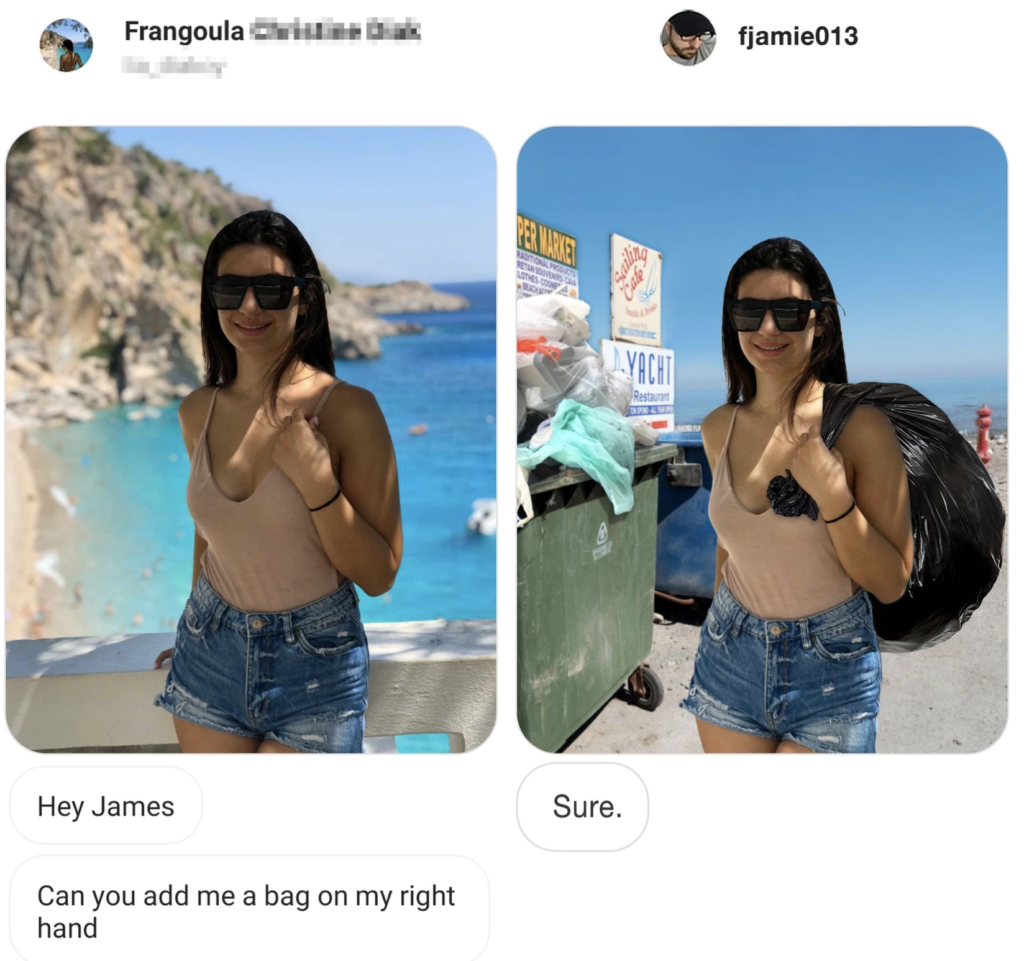
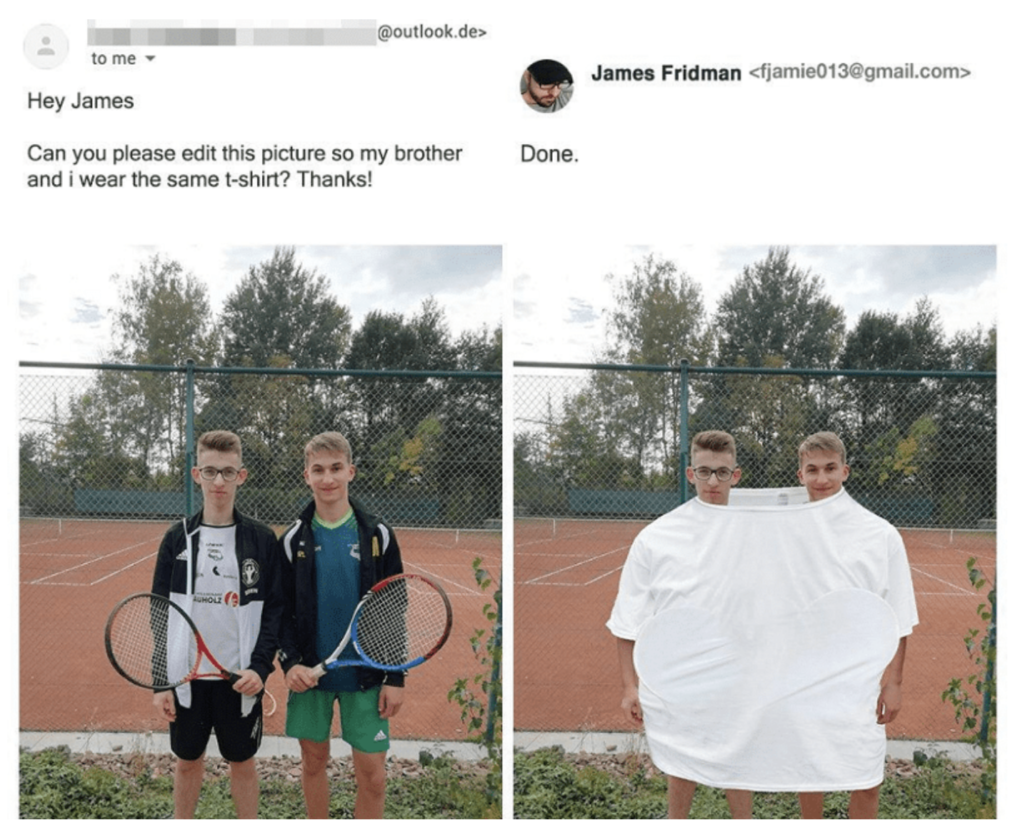
One of the most entertaining uses of intentional misunderstanding is found in the work of photoshop artist James Fridman. Many people send James requests to improve their photos and James intentionally misunderstands their requests. Over and over. Here are a few examples of Fridman's work:

and here . . .

Check out many more examples of Fridman's work here.

Continue ReadingIntentional Misunderstandings, for Better or Worse

Matt Taibbi Discusses the Sovietization of the American Press

I follow Matt Taibbi writings at his site, TK. His recent article is titled: "The Sovietization of the American Press: The transformation from phony "objectivity" to open one-party orthodoxy hasn't been an improvement."

It is a thoughtful analysis with many examples. What I'd like to do in this post is simply post one excerpt showing how the exact same issue is treated extraordinarily differently by the same Newspaper (NYT) under Trump versus under Biden:

[C]overage of Biden increasingly resembles official press releases, often featuring embarrassing, Soviet-style contortions. When Biden decided not to punish Saudi Prince Mohammed bin Salman for the murder of Washington Post writer Jamal Khashoggi on the grounds that the “cost” of “breaching the relationship with one of America’s key Arab allies” was too high, the New York Times headline read: “Biden Won’t Penalize Saudi Crown Prince Over Khashoggi’s Killing, Fearing Relations Breach.” When Donald Trump made the same calculation, saying he couldn’t cut ties because “the world is a very dangerous place” and “our relationship is with the Kingdom of Saudi Arabia,” the paper joined most of the rest of the press corps in howling in outrage.

“In Extraordinary Statement, Trump Stands With Saudis Despite Khashoggi Killing.” was the Times headline, in a piece that said Trump’s decision was “a stark distillation of the Trump worldview: remorselessly transactional, heedless of the facts, determined to put America’s interests first, and founded on a theory of moral equivalence.” The paper noted, “Even Mr. Trump’s staunchest allies on Capitol Hill expressed revulsion.”

This week, in its “Crusader for the Poor” piece, the Times described Biden’s identical bin Salman decision as mere evidence that he remains “in the cautious middle” in his foreign policy. The paper previously had David Sanger dig up a quote from former Middle East negotiator Dennis Ross, who “applauded Mr. Biden for ‘trying to thread the needle here… This is the classic example of where you have to balance your values and your interests.’” It’s two opposite takes on exactly the same thing.

Continue ReadingMatt Taibbi Discusses the Sovietization of the American Press

To What Extent Can the Government Prosecute Liars?

To what extent can the government prosecute lies? First Amendment Law Professor Eugene Volokh has written an excellent article considering many angles. Here's an excerpt:

Surprisingly, the Supreme Court has never resolved the question. It hasn’t resolved the big-picture question: When can the government punish lies? It hasn’t resolved the medium-size question: Can the government punish lies in election campaigns? And it hasn’t resolved the particular question: Can the government punish lies about the mechanisms of voting, and in particular about how to vote?

[T]he court considered the case of Xavier Alvarez, a local government official in an LA suburb; he had lied about getting the Congressional Medal of Honor, and was prosecuted under the Stolen Valor Act, a statute that bans such lies about military decorations. Unconstitutional, six justices said. There was broad agreement that “Laws restricting false statements about philosophy, religion, history, the social sciences, the arts, and other matters of public concern … would present a grave and unacceptable danger of suppressing truthful speech.” “The point is not that there is no such thing as truth or falsity in these areas or that the truth is always impossible to ascertain, but rather that it is perilous to permit the state to be the arbiter of truth.” (That’s from the dissent, but the concurrence endorsed it, and the plurality’s opinion was even more speech-protective than the others.)

Yet when it came to more specific lies, whether about one’s own medals or something else, there was no majority opinion.

Continue ReadingTo What Extent Can the Government Prosecute Liars?

The Self-Loathing by Media Elites

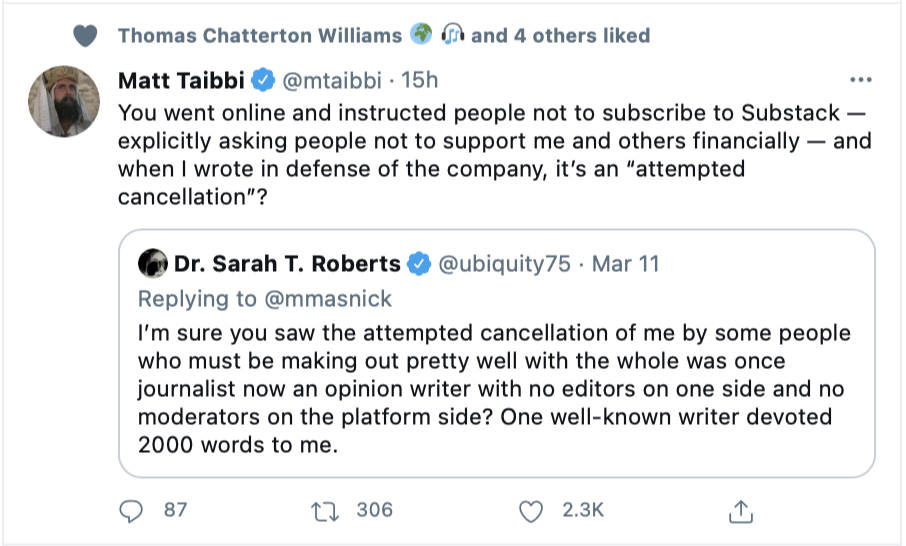
Matt Taibbi offers a peek into the workings of the brain of a prominent member of the media elite. These people are threatened by the fact that there are some real-life independent journalists who vigorously investigate stories (including stories about the corruption of the media elite) and who zealously follow the facts where they lead. I suspect they are also jealous that these real journalists are doing what these elites only pretend to do and they cannot hide this fraud from their own friends and family. They are jealous to the point of a self-loathing that has bloomed into Nietzschean ressentiment. That's my analysis. Even though I am not a professional psychiatrist, I don't think I'm far off.

See also, Glenn Greenwald's take on who is trying to cancel who, using the most twisted of logic.

Continue ReadingThe Self-Loathing by Media Elites