For many people it is an interesting fact that the co-founder of organization Black Lives Matters has gone on a expensive home buying spree. Hasn't this story been told hundreds of times over the years when famous people do some expensive signaling? It sometimes raises interesting questions about where these people got all of that money. In this case, it was determined by the New York Post that Patrisse Khan-Cullors bought four houses worth $3.2M. In a country that values free speech, information should flow and people can make of these stories what they want. For some people it won't be a big deal. For others, these purchases are controversial, because it suggests that money that should be going to a non-profit cause is being siphoned off into luxury.
Facebook has barred users from sharing a New York Post report from last week about the controversial property acquisitions by Black Lives Matter co-founder Patrisse Khan-Cullors.
Users of the social media giant noticed on Thursday they could not share the link to a story that shed light on Cullors' multi-million-dollar splurge on homes. Fox News can confirm that an error message appears whenever users try sharing the article on their personal Facebook page or through the Messenger app.
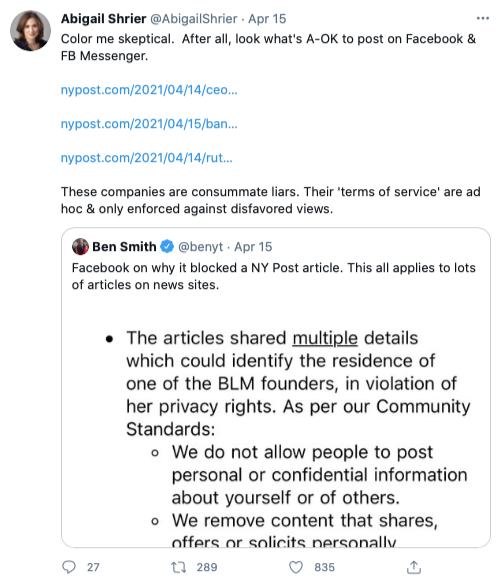
When users attempt to send the link, an error message alleges that the article "goes against our Community Standards."
The New York Post published this follow-up story today, where Khan-Cullors claimed in a strangely narrowly-tailored defense: "“I have never taken a salary from the Black Lives Matters Global Networks Foundation,” she also said Thursday."
Again, this real estate buying spree could be an interesting story for many people, especially for those who wonder whether their donations to BLM (and its many affiliates) are really helping struggling black people. The NYP adds: "But in insisting she did not take a salary from the organization’s non-profit foundation, Khan-Cullors left unsaid whether she was paid through BLM’s network of similarly named for-profit entities." Shouldn't people be able to freely share this information and make up their own minds about whether it is interesting?
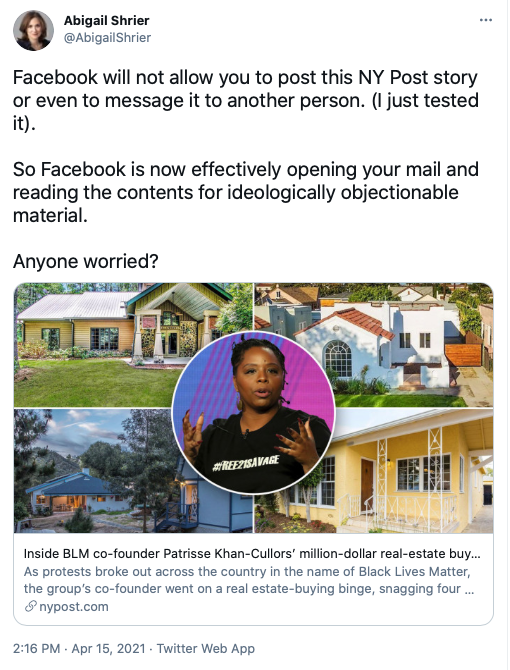
Numerous Facebook users, however, were blocked from sending the NYP story. One of those people, Abigail Shrier, was blocked from sending it as a private message on FB Messenger. Outraged, she wrote: "Facebook will not allow you to post this NY Post story or even to message it to another person. (I just tested it). So Facebook is now effectively opening your mail and reading the contents for ideologically objectionable material."
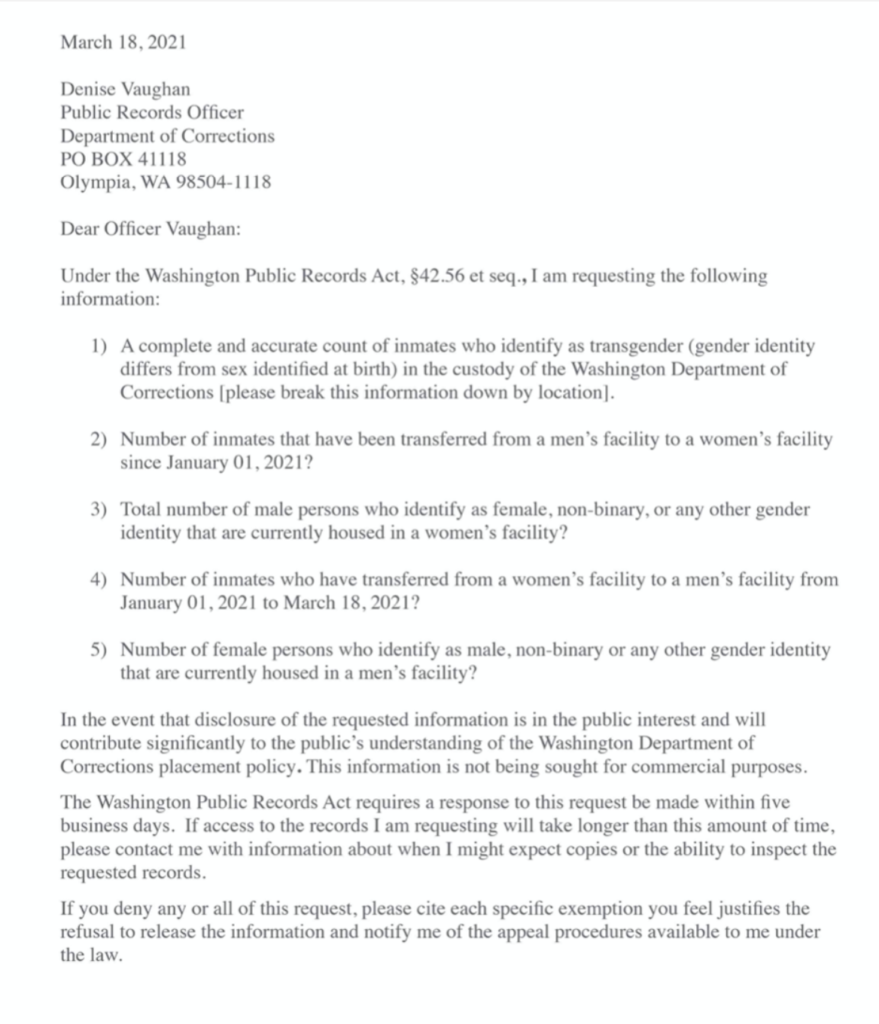
A woman was interested to know how many inmates in Washington state identify as transgender, and how many of those transgender identified inmates have been given transfers to go from men's prison to women's prison, and the reverse. To get this information, she filed a Freedom on Information Act request. Instead of getting the information she requested, she got sued by the ACLU.
Here's a copy of the public records request filed by the citizen:
Why did this woman seek this information?
"I started requesting information about what is happening in US prisons after learning about cases abroad where violent male offenders were housed in women's prisons," the woman who made the request told The Post Millennial, "including a case where a woman became pregnant as a result. Due to the shameful lack of impartial media reporting on this issue, the public can't trust the institutions we've come to rely on to get accurate information.
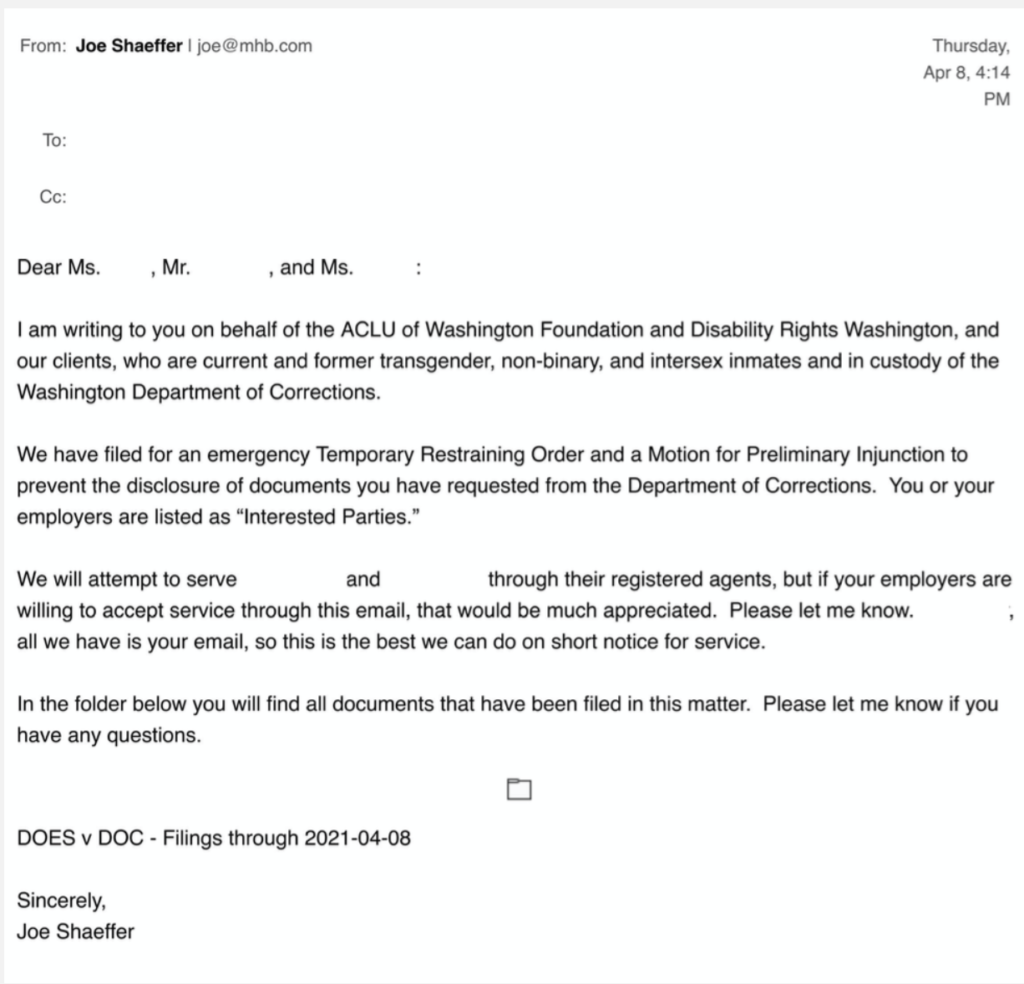
The ACLU responded by sending the woman this letter:
We must seize every opportunity to protect and advance our civil rights and liberties — in legislatures, the courts, and our communities. Join us in holding our leaders and institutions accountable to fulfill the promise of democracy. With your support, we can lead freedom forward.
I know that by attaching my name to this I’m risking not only my current job but my career as an educator, since most schools, both public and private, are now captive to this backward ideology. But witnessing the harmful impact it has on children, I can’t stay silent.
My school, like so many others, induces students via shame and sophistry to identify primarily with their race before their individual identities are fully formed. Students are pressured to conform their opinions to those broadly associated with their race and gender and to minimize or dismiss individual experiences that don’t match those assumptions. The morally compromised status of “oppressor†is assigned to one group of students based on their immutable characteristics. In the meantime, dependency, resentment and moral superiority are cultivated in students considered “oppressed.â€
All of this is done in the name of “equity,†but it is the opposite of fair. In reality, all of this reinforces the worst impulses we have as human beings: our tendency toward tribalism and sectarianism that a truly liberal education is meant to transcend.
Rossi offers details and it is shocking to see what goes on in the name of education, especially the fact that his school excels at telling those with contrarian viewpoints to shut up and feel ashamed for thinking.
I notice from the school's "Message from the Head of School" page, that the school is not inclined to do real work, to look in the mirror or to consider the long-term consequences of its incredibly divisive approach to running Grace Church High School. That message ends:
So if the boorish “cancel culture†press wants to condemn us a newly dubbed “Woke Noho†school of politeness, dignity and respect, then I embrace it, and I hope you will too.
George P. Davison
Head of School
To what extent are confused teenagers being used by profit-seekers? Catherine Karena of the "LGB Alliance," who has studied many other industries that create demand out of thin air, shines a light on what she terms the "Business Model of Youth Transitioning." She describes the products and services associated with transgender treatment as a 5.2 trillion dollar industry. Watching this video reminded me of the heyday of the tobacco industry.
Here is an excerpt from the opening minutes of this video:
I've studied and worked with tech startups for 21 plus years. Startups are different from established businesses they focus on growth and being game changers they look for a new and unique solution to a problem either a new solution to an old problem for example cds or the cassettes. Or they give you a solution to something you didn't even know was a need. For example when apple gave us the iPod. Or they redefiner problems, where they provide a different solution altogether.
The aim of any software startup is to become a unicorn achieving 1 billion revenue in the first year by aggressively opening up markets for a highly scalable product. Although we've heard that the huge increase in the transgender movement is a grassroots movement or social contagion human rights movement or a typical generational youth rebellion, I'll argue here that the heart of this movement is just business.
The gender identity phenomenon has achieved huge growth by creating a killer brand that can be accessed by consuming medical treatments. The target consumers of this product are teenagers who are forming their identities in an identity-obsessed world market demand is developed through viral marketing and underpinned by legal challenges and social advocacy in the background.
In Karena's model, the skyrocketing alleged rates of gender dysphoria are linked to crass money-making. First, consider the statistics regarding the rates of alleged gender dysphoria. I used the modifier "alleged" because gender dysphoria is often self-diagnosed in modern times. Consider that the DSM-5 In 2013, the DSM-5 estimated that about 0.005% to 0.014% of people assigned male at birth and 0.002% to 0.003% of people assigned female at birth were diagnosable with gender dysphoria. It is now 1000 times greater Consider this:
When [author Abigail] Shrier uses the term “craze,” she means it in the scientific sense. Rapid Onset Gender Dysphoria (ROGD) is what Dr. Lisa Littman calls a “social contagion,” and it primarily impacts young girls. Just a short time ago, only .002 percent to .003 percent of girls in the U.S. identified as transgender. Now, it is up to 2 percent, and Shrier told me that she believes the rate has spiked by thousands of percentage points (in the UK, the number of girls identifying as trans has risen by over 4000 percent). Most trans-identified youth used to be males – that has reversed. In 2016, for example, girls accounted for 46 percent of sex reassignment surgeries in the U.S. One year later, that number had spiked to 70 percent.
In Littman’s much-maligned 2018 study “Parent reports of adolescents and young adults perceived to show signs of a rapid onset of gender dysphoria,” she discovered that a full 70 percent of trans teens belonged to a peer group in which one had already had already come out as trans, and according to parents, a third of these had shown no sign of being dysphoric previously. Despite the insistence of trans activists that this is simply “transphobia” on the part of the parents, 85 percent of the parents surveyed were LGBT-supportive. But for asking questions, for begging their daughters to delay puberty blockers and top surgeries, they are condemned by trans activists as vicious bigots
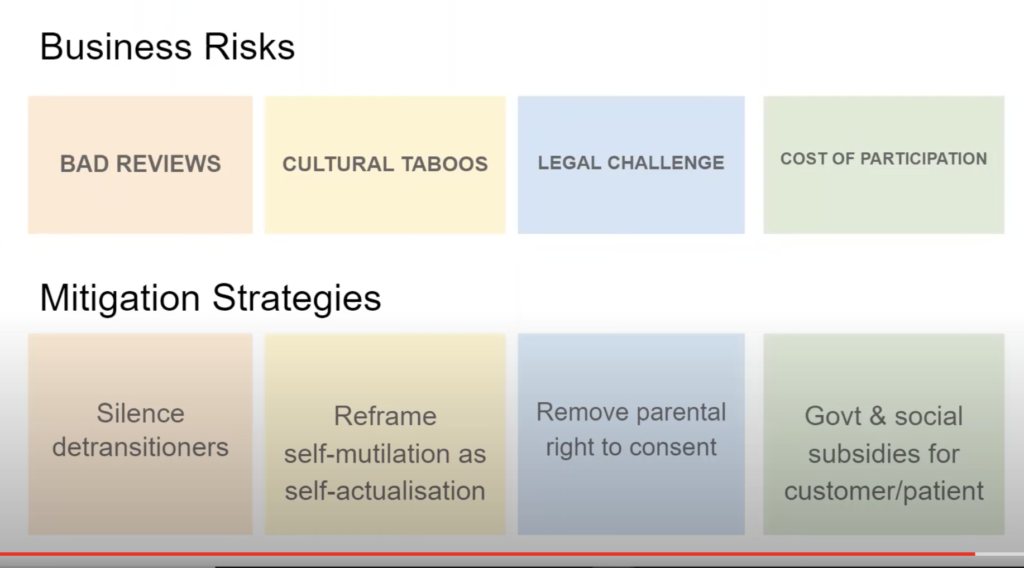
As with any startup, there are business risks that lead to mitigation strategies. Karena outlines these in one of her graphics:
This is a 9-minute video that succinctly and sharply questions the motives of those making enormous profits off of the bodies of teenagers, even while the "wait and see" approach resolves teenage concerns between 73-98% of the time.
Hello, I invite you to subscribe to Dangerous Intersection by entering your email below. You will have the option to receive emails notifying you of new posts once per week or more often.
Thank you for your interest in DI!
Erich Vieth
[jetpack_subscription_form subscribe_button=”Sign Me Up”]